Perforated Stainless Steel Strip
Perforated stainless steel strip is a precision-engineered material produced by punching or laser-cutting regular patterns of holes into thin-gauge stainless steel coil or strip. The perforation
Perforated Stainless Steel Strip
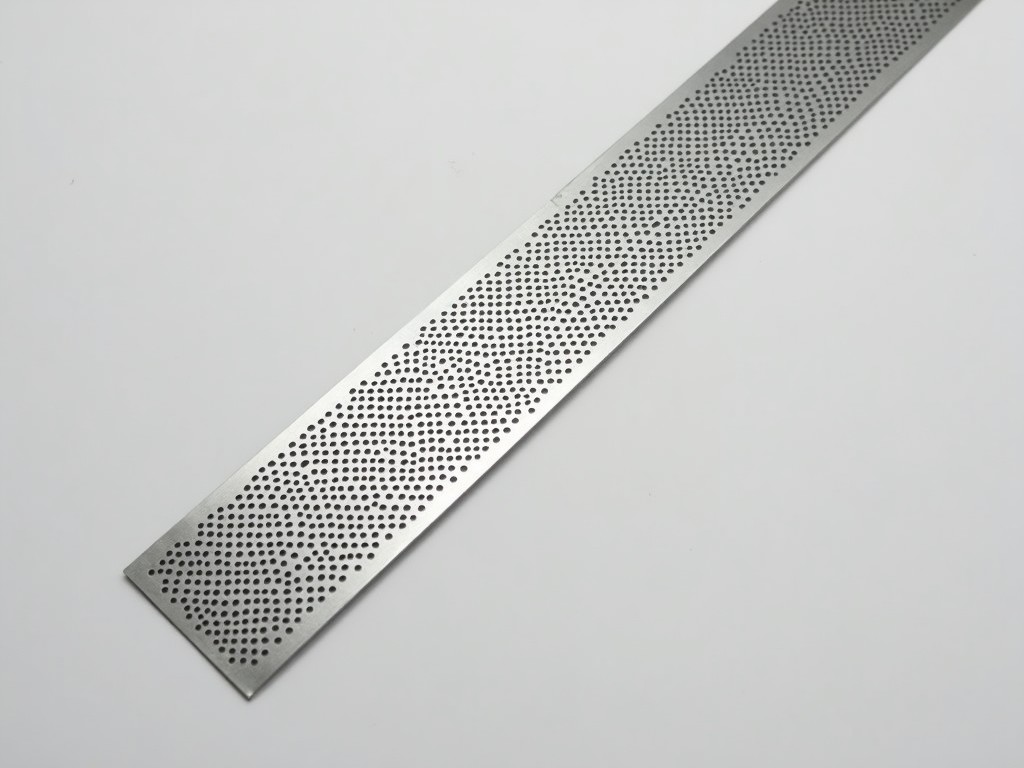
Perforated stainless steel strip is a precision-engineered material produced by punching or laser-cutting regular patterns of holes into thin-gauge stainless steel coil or strip. The perforation pattern, hole size, open area percentage, and material thickness are controlled to meet specific functional requirements in filtration, separation, ventilation, and acoustic applications.
Unlike solid strip, perforated versions offer controlled passage of fluids, gases, light, or sound while maintaining structural integrity. The base material is selected from austenitic, ferritic, or martensitic stainless steel grades depending on corrosion resistance, strength, and formability needs. Common grades include 304, 316L,16L, 430, and 410, each offering distinct performance characteristics in various environments.
The manufacturing process begins with slit stainless steel coil, which is fed into high-speed rotary punch presses or CNC laser systems. Tooling is designed to produce consistent hole geometry across the entire length of the strip, minimizing burr and distortion. Post-perforation operations may include leveling, edge trimming, washing, and recoiling to ensure dimensional stability and surface cleanliness.
Key Technical Characteristics
The functional performance of perforated stainless steel strip depends on several interrelated parameters. Hole diameter typically ranges from 0.5 mm to 20 mm, with center-to-center spacing (pitch) adjusted to achieve desired open area. Open area percentage—the ratio of hole area to total surface area—can vary from less than 10% for screening applications to over 50% for high-flow ventilation or sound absorption.
Material thickness affects both structural rigidity and perforation feasibility. Thinner gauges (0.1–0.5 mm) are suitable for fine filtration or decorative uses but require careful tooling to avoid tearing. Thicker sections (0.5–3.0 mm) support higher mechanical loads and are used in industrial screens, machine guards, and load-bearing panels. The relationship between hole size, pitch, and material thickness determines the ligament strength—the remaining material between holes—which must be sufficient to prevent tearing under operational stress.
Surface finish is specified according to application needs. Common finishes include 2B (cold-rolled, annealed, pickled), BA (bright annealed), and No. 4 brushed. These finishes influence not only appearance but also cleanliness, friction, and light reflectivity. In hygienic environments such as food processing or pharmaceuticals, smoother finishes reduce microbial retention and simplify cleaning protocols.
Material Selection and Corrosion Resistance
Grade 304 stainless steel is the most widely used for perforated strip due to its balanced corrosion resistance, formability, and cost. It performs well in indoor environments, mild atmospheric exposure, and applications involving water, steam, or weakly acidic substances. Its chromium-nickel composition provides a stable passive oxide layer that resists oxidation under normal conditions.
For environments with chloride exposure—such as marine settings, chemical processing, or road-salt atmospheres—grade 316L is preferred. The addition of molybdenum enhances resistance to pitting and crevice corrosion, particularly in warm chloride-containing solutions. Perforated 316L strip is commonly used in coastal HVAC systems, seawater filtration, and pharmaceutical equipment where sanitation and durability are critical.
Ferritic grades like 430 offer lower cost and good resistance to nitric acid and organic compounds but are less suitable for welding or severe forming. Martensitic grades such as 410 provide higher hardness and strength after heat treatment but have reduced corrosion resistance and are typically used in wear-resistant or high-stress mechanical applications where corrosion exposure is limited.
Material selection must consider not only the operating environment but also fabrication requirements. Austenitic grades (304, 316L) are non-magnetic in the annealed condition and easier to form, while ferritic and martensitic types may exhibit magnetic properties and require different handling during perforation to avoid cracking or tool wear.
Perforation Patterns and Design Considerations
The arrangement of holes significantly influences both function and manufacturability. Common patterns include round holes in staggered or straight rows, square slots, hexagonal arrays, and custom geometries such as louvers or decorative motifs. Staggered patterns (typically 60° or 45° angles) provide higher open area and more uniform flow distribution compared to straight rows, which are simpler to tool and may be preferred for linear flow applications.
Hole shape affects flow dynamics and particle retention. Round holes offer predictable flow characteristics and are standard for most industrial uses. Slotted or elongated holes increase flow capacity in one direction and are used in screens where directional flow or anti-clogging is desired. Hexagonal patterns provide high structural efficiency and are often selected for lightweight panels requiring maximum strength-to-weight ratio.
Ligament width—the unperforated material between holes—is a critical design parameter. As hole size increases or pitch decreases, ligament width diminishes, reducing the strip’s resistance to tearing or deformation. Engineers calculate ligament strength based on material yield thickness and hole geometry to ensure the strip can withstand handling, installation loads, and operational pressures without failure.
Edge conditions are also specified based on application. Strips may be supplied with mill edges, slit edges, or deburred and rounded edges to prevent injury during handling or to ensure proper fit in mating components. Edge quality is particularly important in precision applications such as encoder strips, conveyor belts, or medical device components where burrs could cause interference or contamination.
Typical Applications by Industry
In filtration systems, perforated stainless steel strip serves as a support media for filter cartridges, pleated elements, or cylindrical screens. The perforations allow fluid to pass while preventing collapse of the filter medium under differential pressure. Applications include hydraulic filters, lubrication systems, and industrial dust collectors where mechanical strength and chemical compatibility are essential.
In ventilation and HVAC, perforated strip is used in ceiling panels, air diffusers, and sound attenuators. The open area facilitates air movement, while the hole pattern contributes to sound absorption by dissipating acoustic energy through viscous losses in the perforations. Architects and engineers select specific open area and hole size combinations to meet both airflow and noise reduction criteria in offices, hospitals, and industrial facilities.
Perforated strip also functions as a protective barrier in machine guarding, conveyor systems, and industrial enclosures. It provides visibility and ventilation while preventing access to moving parts. The stiffness of the perforated section, combined with edge flanges or frames, creates a rigid panel that resists impact and maintains integrity under vibration.
In architectural and decorative applications, perforated stainless steel strip is used for façades, sunscreens, and interior cladding. The pattern modulates light transmission, creates visual texture, and reduces solar heat gain. Designers leverage the material’s durability, recyclability, and ability to retain finish over time to achieve long-lasting aesthetic effects in exterior and interior environments.
Manufacturing Tolerances and Quality Control
Dimensional accuracy is critical for perforated strip to function correctly in assembled systems. Width tolerance is typically held to ±0.1 mm for slit edges, ensuring consistent fit in guiding mechanisms or welding fixtures. Length tolerance depends on coiling method but is usually ±0.5% for cut lengths or ±10 mm for coil ends. Thickness variation across the width and length is monitored to maintain uniformity in hole formation and structural performance.
Hole placement accuracy is controlled through precision tooling and feed systems. Positional tolerance for hole centers is generally ±0.1 mm relative to a reference edge, ensuring pattern consistency across production batches. Hole diameter variation is kept within ±0.05 mm for precision applications, though looser tolerances (±0.1–0.2 mm) may be acceptable for general filtration or ventilation where exact sizing is less critical.
Burr height is a key quality indicator, especially in applications involving fluid flow or contact with sensitive materials. Post-perforation deburring or electrochemical polishing may be specified to reduce burr to less than 0.02 mm. Surface cleanliness is verified through visual inspection and wipe testing to ensure no oil, particulates, or residues remain that could contaminate processes in food, pharmaceutical, or semiconductor industries.
Mechanical properties such as tensile strength, yield strength, and elongation are verified through sampling and testing per ASTM or EN standards. For critical applications, additional tests like corrosion resistance (salt spray, humidity chamber) or open area verification (via image analysis or flow testing) may be performed. All inspection data is traceable to the production coil and available upon request.
| Parameter | Typical Range | Notes |
|---|---|---|
| Material Thickness | 0.1 – 3.0 mm | Dependent on grade and perforation feasibility |
| Hole Diameter | 0.5 – 20.0 mm | Smaller holes require precision tooling |
| Open Area | 5% – 60% | Calculated from hole size and pitch |
| Width (Slit) | 5 – 600 mm | Tolerance ±0.1 mm for slit edges |
| Surface Finish | 2B, BA, No. 4 Brushed | Custom finishes available upon request |
Customization and Ordering Information
Perforated stainless steel strip is produced to order based on specific application requirements. Customers must provide specifications for material grade, thickness, width, hole diameter, pitch, pattern type, open area target, and edge condition. Length can be supplied as cut-to-length pieces or in coiled form, with coil weight and inner/outer diameter specified for handling equipment compatibility.
Tooling costs may apply for non-standard hole patterns or diameters. For repeated orders, existing tooling can be reused to minimize setup time and expense. Prototyping services are available to validate perforation patterns, flow characteristics, or structural behavior before full-scale production. Samples are typically provided as short lengths or flat sections for customer evaluation.
Quotations are based on material consumption, perforation complexity, tolerances, finish requirements, and volume. Lead times vary depending on material availability, tooling readiness, and production scheduling. Customers are advised to consult technical representatives early in the design process to ensure manufacturability and optimize cost-performance balance.
For technical consultation, specification support, or to request a quotation, contact our engineering team.
Request Technical Support
More Products

Send Inquiry
If you are interested in our products, leave your information here and we will be in touch shortly.