Temporary Safety Fencing For Swimming Pools
Temporary safety fencing for swimming pools provides a rapid-deployment barrier solution designed to restrict access to pool areas during construction, maintenance, events, or seasonal use. Unlike
Temporary Safety Fencing for Swimming Pools
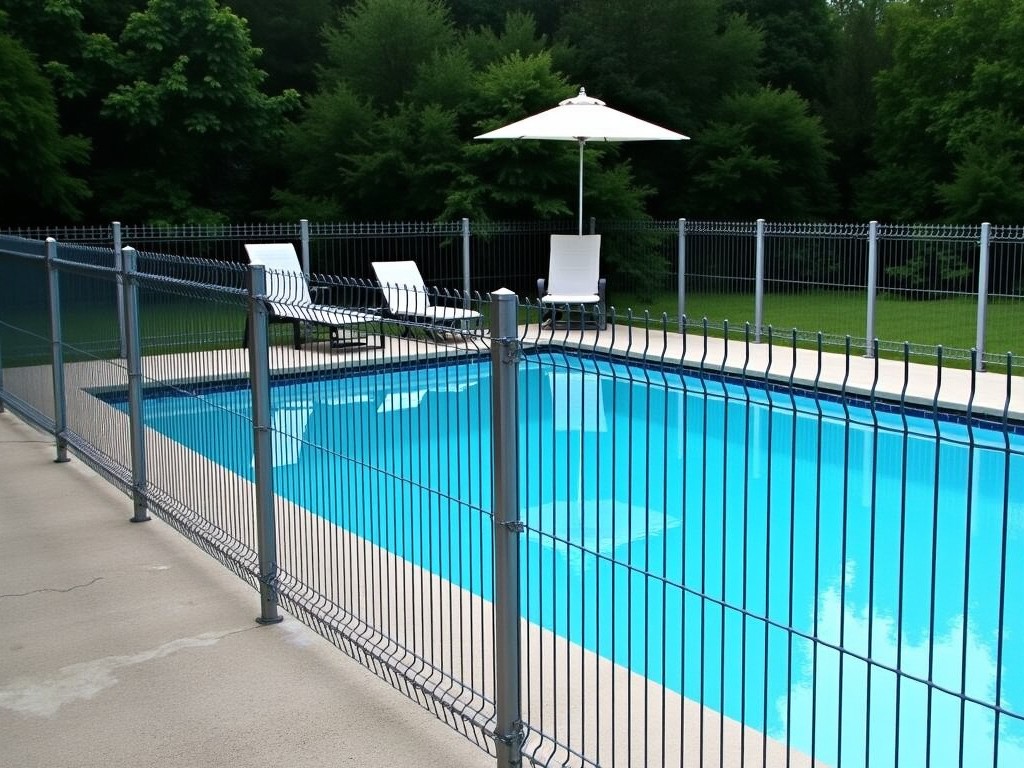
Temporary safety fencing for swimming pools provides a rapid-deployment barrier solution designed to restrict access to pool areas during construction, maintenance, events, or seasonal use. Unlike permanent fencing, these systems are engineered for quick assembly, disassembly, and relocation without compromising structural integrity or safety compliance. The primary function is to prevent unauthorized entry—particularly by children or untrained personnel—into zones where drowning hazards exist due to open water, incomplete barriers, or ongoing work.
Industrial buyers prioritize systems that meet or exceed local safety codes (such as ASTM F2286 or regional equivalents) while minimizing labor and setup time. Key technical considerations include panel height, gate mechanisms, anchoring stability, wind load resistance, and material durability under UV exposure and frequent handling. A well-designed temporary fence must maintain a minimum 48-inch height with no climbable features and self-latching gates that remain secure under repeated use.
Core Design and Material Specifications
Panel frames are typically constructed from 1.25-inch diameter galvanized steel tubing with a minimum wall thickness of 0.065 inches, providing a yield strength of approximately 50,000 psi. This ensures resistance to bending under lateral loads from wind or accidental impact. Infill options include 1.5-inch mesh polyethylene netting (UV-stabilized, 9 oz/yd²) or vertical pickets spaced no more than 4 inches apart to prevent sphere passage, complying with child safety standards.
Base systems vary by application: weighted rubber feet (typically 25 lbs each) are used on hard surfaces like concrete or decking, while ground spikes (12-inch steel stakes) are preferred for soil or grass installations. Each panel interconnects via spring-loaded pins or cam-lock couplings, allowing for straight runs, 90-degree corners, and custom angles without tools. Gate assemblies incorporate self-closing hinges and magnetic latches that meet ASTM F2286 requirements for pool barriers, with a release mechanism operable by one hand but resistant to unintentional opening by children under five.
| Component | Specification | Purpose |
|---|---|---|
| Frame Tubing | 1.25" OD, 0.065" wall, galvanized steel | Structural rigidity, impact resistance |
| Infill Mesh | 1.5" square, 9 oz/yd², UV-stabilized PE | Prevent climbing, maintain visibility |
| Base Weight | 25 lbs rubber foot (per base) | Stability on hard surfaces, no penetration |
| Ground Spike | 12" steel, galvanized | Anchoring in soil/grass, wind uplift resistance |
| Gate Latch | Magnetic, self-latching, ASTM F2286 compliant | Child-resistant, one-hand operation for adults |
Installation and Deployment Logic
Deployment begins with site assessment to determine required linear footage, gate placement, and terrain type. Panels are typically 6 or 8 feet wide, allowing for efficient coverage with minimal joints. Installation requires two personnel and averages 10–15 linear feet per minute on prepared surfaces. No drilling, welding, or permanent alterations are needed, preserving site integrity for restoration after use.
Tension is maintained through interlocking panel joints and weighted bases; additional bracing is only required in high-wind zones (exceeding 30 mph gusts) or for runs exceeding 50 feet without a gate or corner. The system’s modularity allows for reconfiguration mid-project—for example, shifting the barrier as construction phases progress—without dismantling entire sections. All components are designed for nested stacking, reducing storage volume by up to 70% compared to assembled length.
Applications in Industrial and Commercial Settings
Temporary pool safety fencing is critical during new pool construction, where the site remains hazardous until permanent barriers, alarms, or covers are installed. Contractors use these systems to satisfy OSHA and local jurisdiction requirements for unattended open water, reducing liability and inspection delays. Similarly, during resort renovations or public pool upgrades, temporary fencing maintains safety while allowing phased work to keep partial facilities operational.
Event venues utilize these barriers for seasonal pool access control—for instance, restricting swimming during off-hours or private functions while maintaining aesthetic neutrality. Disaster relief operations also deploy them in temporary housing areas with portable pools to prevent child drownings in emergency shelters. In all cases, the value lies not in the fence itself, but in its ability to provide immediate, code-compliant separation where permanent solutions are impractical or premature.
Customization and Project-Specific Adaptation
While standard configurations suit most applications, certain projects require adaptation. Panel height can be increased to 60 inches for facilities with elevated risk profiles (e.g., therapy pools with assisted access). Gate width is commonly customized from 36 to 48 inches to accommodate equipment transport or stretcher passage during medical emergencies. Infill density may be adjusted—for example, using tighter mesh in windy coastal areas to reduce sail effect, or opting for picket styles in high-visibility zones where aesthetics are a secondary consideration.
Color options are limited to safety-oriented hues (white, yellow, or black) not for branding, but to enhance visibility against water and surrounding surfaces—yellow being most effective under low-light conditions per ANSI Z535.1 guidelines. Surface treatments include powder coating for corrosion resistance in chlorinated or saline environments, extending service life beyond 5 years with proper maintenance. All customizations are evaluated for continued compliance with applicable barrier standards.
Quality Control and Lifecycle Considerations
Manufacturing tolerances are held to ±1/16 inch for tube cutting and ±1/8 inch for joint alignment to ensure consistent interlocking. Each panel undergoes a 50-cycle open/close test on gate assemblies and a 100-lb lateral load test on frames to verify structural integrity. UV resistance is validated through 1,000-hour accelerated weathering per ASTM G154, with post-test tensile strength retention exceeding 80%.
End-of-life considerations include material recyclability: steel frames are 100% recyclable, and polyethylene components can be reprocessed where facilities exist. Users are advised to inspect bases for cracking, mesh for UV degradation (indicated by chalking or fading), and latch mechanisms for spring fatigue before each redeployment. With proper care, a typical system achieves 20+ deployment cycles over its service life, delivering long-term value through reuse rather than single-use disposal.
For technical specifications, customization requests, or to discuss your project’s safety fencing requirements, contact our engineering team.
Product Categories


Send Inquiry
If you are interested in our products, leave your information here and we will be in touch shortly.