Perforated Aluminium Sheet Price
Understanding the cost of perforated aluminium sheet requires evaluating material specifications, perforation patterns, thickness, surface treatment, and order volume. This page explains the
Perforated Aluminium Sheet Price
Understanding the cost of perforated aluminium sheet requires evaluating material specifications, perforation patterns, thickness, surface treatment, and order volume. This page explains the technical and commercial factors that influence pricing to support informed procurement decisions.
Key Factors Affecting Perforated Aluminium Sheet Price
Price is not determined by a single variable but by the interplay of material grade, perforation geometry, sheet dimensions, finishing requirements, and manufacturing complexity. Each factor contributes to material waste, tooling wear, and production time, which directly impact unit cost.
For example, switching from 1050-H14 to 5052-H32 aluminium increases raw material cost by approximately 15–20% due to higher alloy content and improved mechanical properties. Similarly, reducing open area from 40% to 20% increases material usage per square meter, raising the effective material cost despite lower machining time.
Material Grade and Thickness Impact
Aluminium grades vary in cost based on purity, alloying elements, and temper. Common grades include 1050 (high purity, formable), 3003 (moderate strength, corrosion resistant), and 5052 (higher strength, marine suitability). Thickness directly affects material usage: doubling thickness from 1.0 mm to 2.0 mm increases material cost by ~100%, excluding processing adjustments.
Thinner gauges (0.5–1.0 mm) are more prone to deformation during perforation, requiring slower feed rates or backup support, which increases machine time. Thicker sheets (>2.0 mm) demand higher punch forces, accelerating tool wear and necessitating more frequent maintenance, adding to operational overhead.
Perforation Pattern and Open Area Influence
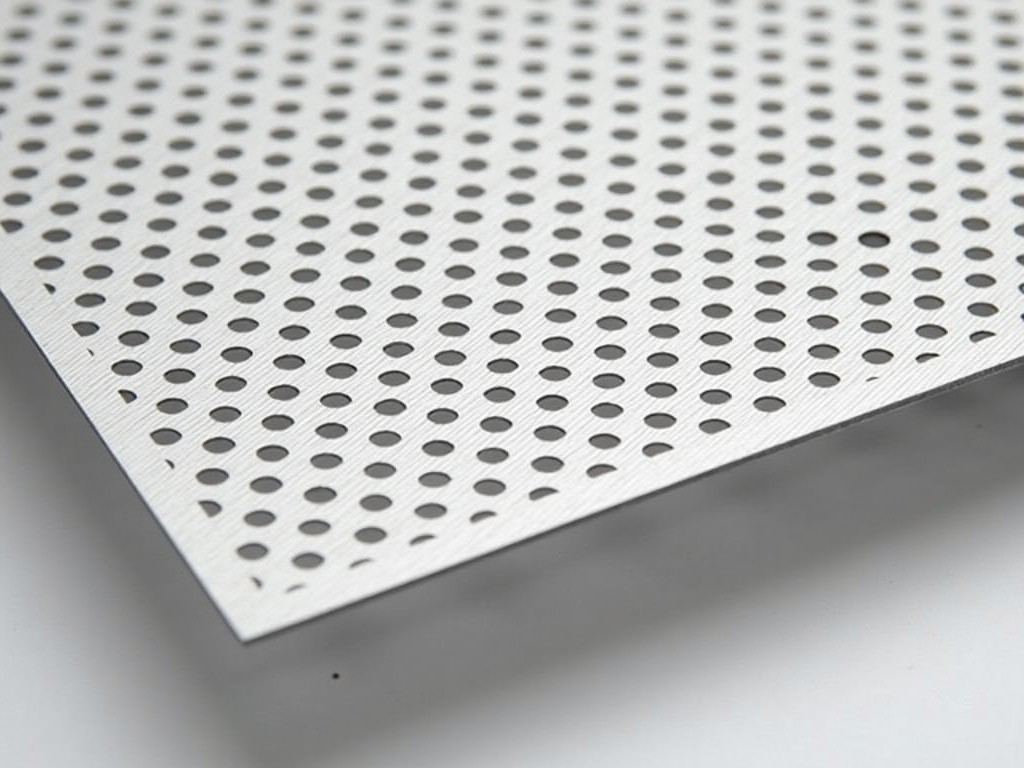
The perforation pattern—defined by hole shape, size, pitch, and arrangement—determines open area and affects both material utilization and machining efficiency. Standard round hole patterns on 60° staggered pitch are most economical due to optimized tool paths and minimal scrap.
Square or slotted holes require more complex tooling and often result in higher scrap rates, especially at narrow pitches. Decorative or custom patterns (e.g., logos, gradients) involve CNC programming, trial runs, and lower yield, increasing setup cost per sheet. Open area below 15% significantly raises effective material cost per functional unit due to high metal removal.
Surface Treatment and Finishing Options
Surface treatments add cost but may be essential for durability, aesthetics, or compliance. Mill finish is the base state—no additional cost. Anodizing (clear or dyed) adds $2–5/m² depending on thickness (5–25 µm) and colour. Powder coating adds $3–8/m² for standard colours, with custom colours or textures increasing cost further.
Chemical conversion coatings (e.g., Alodine) offer corrosion protection at lower cost (~$1–2/m²) but are less durable than anodizing or powder coating. For architectural applications requiring colour consistency, pre-anodized or pre-coated coils may be used, though they limit post-perforation touch-up options and can increase scrap if edge sealing is required.
Order Volume and Economies of Scale
Setup costs—including tooling, programming, and first-piece approval—are fixed per production run. As order volume increases, these costs are distributed over more units, reducing the per-piece price. Typical volume breaks occur at 50 m², 200 m², and 500 m², with diminishing returns beyond 1,000 m².
For example, a custom 1.5 mm 5052-H32 sheet with 8 mm round holes on 12 mm pitch (33% open area) may cost $45/m² at 50 m² but drop to $28/m² at 500 m² due to amortized setup and optimized nesting. Standard patterns (e.g., 5 mm holes on 8 mm pitch, 40% open area) in 1050-H14 show less variation: $22/m² at 50 m² to $16/m² at 500 m².
Typical Price Ranges (Indicative Only)
The following table provides indicative price ranges per square metre for common configurations. Actual pricing depends on project-specific requirements, material market fluctuations, and supplier capacity. These values exclude shipping, taxes, and special packaging.
| Material Grade | Thickness (mm) | Typical Perforation | Price Range (USD/m²) |
|---|---|---|---|
| 1050-H14 | 0.8 | 5 mm round, 8 mm pitch (40% OA) | $14 – $22 |
| 3003-H14 | 1.0 | 6 mm round, 10 mm pitch (36% OA) | $16 – $26 |
| 5052-H32 | 1.5 | 8 mm round, 12 mm pitch (33% OA) | $22 – $35 |
| 5052-H32 | 2.0 | 10 mm round, 15 mm pitch (36% OA) | $28 – $45 |
| 1050-H14 | 1.0 | Custom logo pattern (15% OA) | $35 – $55 |
Note: OA = Open Area. Price ranges reflect mid-volume production (100–300 m²) with mill finish. Surface treatments, tight tolerances (<±0.1 mm on hole position), or edge finishing (deburring, rounding) will increase costs. For architectural or acoustic applications requiring precise open area control or decorative patterns, request a formal quotation with full specifications.
How to Request an Accurate Quotation
To receive a precise price, provide the following: aluminium grade and temper, thickness (mm), sheet dimensions (width × length), perforation details (hole shape, size, pitch, pattern, open area %), required surface treatment, quantity, delivery location, and any special requirements (e.g., edge protection, film masking, inspection documentation).
Supplying a drawing or sketch helps avoid misinterpretation, especially for non-standard patterns. Suppliers may suggest alternative hole arrangements to reduce cost or improve structural integrity without compromising function. Early engagement allows for design optimization that balances performance and cost.
More Products

Send Inquiry
If you are interested in our products, leave your information here and we will be in touch shortly.