Perforated Aluminum Sheet Metal
Perforated aluminum sheet metal combines the lightweight corrosion resistance of aluminum with engineered hole patterns to achieve specific functional performance in filtration, ventilation, acoustic
Perforated Aluminum Sheet Metal
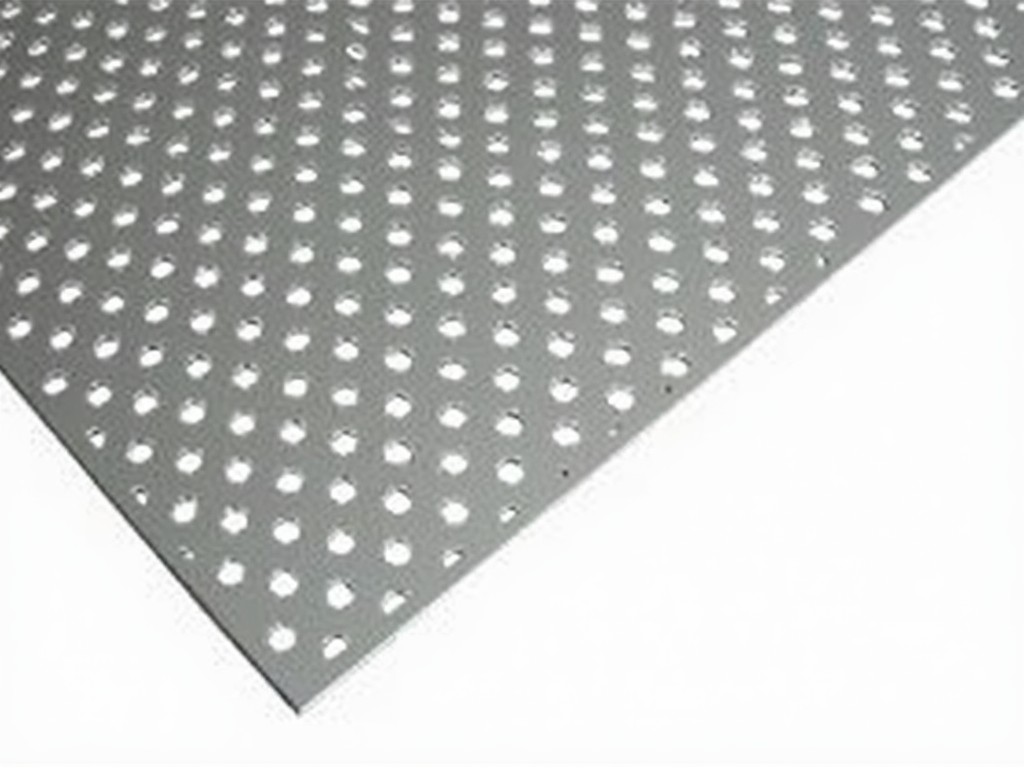
Perforated aluminum sheet metal combines the lightweight corrosion resistance of aluminum with engineered hole patterns to achieve specific functional performance in filtration, ventilation, acoustic control, and decorative applications. Unlike solid sheet, perforated variants transmit air, light, sound, or fluids while maintaining structural integrity, making them suitable where both mechanical strength and controlled permeability are required. The aluminum base provides natural oxidation resistance, eliminating the need for additional coatings in many environments, and its high strength-to-weight ratio simplifies handling and installation compared to steel alternatives.
Material Characteristics and Alloy Selection
The most commonly used alloys for perforated sheet are 3003-H14 and 5052-H32 due to their formability and corrosion resistance. 3003-H14 offers moderate strength (approximately 20 ksi tensile strength) and excellent workability, making it suitable for general purpose applications where forming or bending is required after perforation. 5052-H32 provides higher strength (approximately 33 ksi tensile strength) and superior resistance to marine environments, making it preferred for outdoor architectural panels, marine equipment, and chemical processing areas where exposure to salt or moisture is expected. Both alloys are non-heat-treatable and retain their properties after perforation, though the process does reduce cross-sectional area and must be accounted for in load calculations.
Thickness options typically range from 0.020 inch (0.5 mm) to 0.125 inch (3.2 mm), with thinner gauges used in decorative or low-load applications and thicker gauges selected for structural support, machine guarding, or high-pressure differential environments. The perforation process removes material, so the effective load-bearing capacity is calculated based on the remaining ligament strength between holes. For example, a 60% open area panel retains approximately 40% of the original sheet’s tensile capacity, though actual performance depends on hole shape, spacing, and pattern orientation relative to applied loads.
Perforation Patterns and Open Area Engineering
Perforation patterns are defined by hole shape, size, spacing (pitch), and arrangement, which collectively determine open area percentage, flow characteristics, and visual appearance. Common hole shapes include round, square, slotted, and hexagonal, each offering distinct advantages: round holes provide uniform flow distribution and are easiest to manufacture; square holes offer higher open area for the same pitch and are often used in screening applications; slotted holes increase directional flow capacity; hexagonal patterns maximize open area while maintaining structural ligaments in multiple directions. Open area typically ranges from 15% to 70%, with values outside this range requiring specialized tooling or compromising structural viability.
Staggered (60-degree) patterns are the most common due to their balance of open area, strength, and manufacturability, while straight (0-degree) alignments are used when directional flow or aesthetic alignment is required. The margin — the unperforated border around the sheet edge — is typically 0.5 inch (12.5 mm) minimum to maintain edge strength and facilitate handling, though custom margins are available for specific mounting or framing requirements. Engineers select patterns based on ASHRAE standards for ventilation, ISO 9090 for acoustic performance, or industry-specific flow coefficients for filtration efficiency.
Functional Applications Across Industries
In HVAC systems, perforated aluminum sheets serve as diffuser faces and return air grilles, where the pattern controls air dispersion velocity and noise generation; the open area is selected to match duct velocity requirements (typically 300–500 fpm) to prevent whistling or pressure drop. For acoustic applications, the perforated panel acts as a facing over absorptive backing (such as mineral wool or foam), with hole diameter and spacing tuned to target specific frequency ranges — smaller holes (1/16 inch) attenuate high frequencies, while larger holes (1/4 inch) affect mid-range frequencies, following Helmholtz resonator principles.
Industrial uses include machine guards where visibility and airflow are required alongside impact resistance; the perforation pattern must satisfy OSHA 1910.212 requirements for opening size (typically <0.25 inch to prevent finger entry) while maintaining sufficient open area for motor cooling. In architectural applications, perforated panels function as sunshades or facades, where the pattern modulates solar gain and glare while allowing visibility from inside — a 40% open area with 1/8 inch holes on 1/4 inch pitch, for example, can reduce direct solar transmission by approximately 60% while preserving outward sight lines. Food processing equipment uses perforated sheets for drying trays and washdown surfaces, where the smooth, non-porous aluminum resists bacterial retention and withstands frequent cleaning with alkaline detergents.
Manufacturing Considerations and Tolerances
Perforation is typically achieved via CNC turret punch presses or rotary die presses, with tooling wear and material thickness directly affecting hole edge quality and dimensional accuracy. Standard tolerances for hole diameter are ±0.005 inch for punched holes and ±0.002 inch for laser-drilled alternatives, though laser processing is cost-prohibitive for high-volume sheet production. Hole-to-hole positional tolerance is generally ±0.010 inch over 12 inches, ensuring pattern consistency across large sheets. Burr height on the exit side is typically controlled to less than 0.003 inch through proper punch-die clearance (usually 10–20% of material thickness), as excessive burrs can impede flow, trap particulates, or create stress concentrations.
Sheet flatness after perforation is influenced by the percentage of material removed and pattern symmetry; high open area or asymmetrical patterns can induce curling or warping, particularly in thinner gauges. To mitigate this, manufacturers often use balanced patterning (equal hole distribution in orthogonal directions) or apply leveling rolls post-perforation. For applications requiring tight flatness tolerances (e.g., <0.010 inch over 24 inches), stress-relieving annealing or stretcher leveling may be specified, though these add cost and are only necessary for precision optical or sealing applications. All standard commercial perforated aluminum meets ASTM B209 for sheet and B221 for extrusion, with perforation quality governed by internal process controls rather than a universal industry standard.
Customization Options and Ordering Information
Custom perforation patterns are developed from customer-supplied drawings or specifications, requiring details such as hole shape, size, pitch, pattern angle, open area target, sheet dimensions, alloy, thickness, and margin width. Engineers should specify whether the pattern is nominal (based on tooling centers) or actual (measured open area), as the latter accounts for hole size variation and is critical for flow calculations. Surface treatments include mill finish (standard), brushed, anodized (clear or colored), or powder coated, with anodizing increasing surface hardness and corrosion resistance while allowing color integration for architectural matching. Edge options include mill edge, deburred, or hemmed for safety and ease of handling.
| Parameter | Typical Range | Notes |
|---|---|---|
| Alloy | 3003-H14, 5052-H32 | Others available upon request |
| Thickness | 0.020–0.125 in (0.5–3.2 mm) | Thicker gauges reduce open area feasibility |
| Hole Diameter | 0.020–0.500 in (0.5–12.7 mm) | Limited by material thickness and tooling |
| Pitch (Center-to-Center) | 0.040–1.000 in (1.0–25.4 mm) | Determines open area with hole size |
| Open Area | 15%–70% | Outside range requires engineering review |
| Sheet Width | Up to 60 in (1524 mm) | Limited by press size and handling |
| Sheet Length | Up to 144 in (3658 mm) | Longer lengths available in coils |
Quotations require complete specifications to avoid costly revisions; missing details such as margin width, pattern direction, or edge treatment often lead to delays. Sample panels are available for functional testing — airflow, acoustic transmission, or light diffusion — allowing validation before full production. Lead times typically range from 2–4 weeks for standard patterns and 4–6 weeks for custom tooling, depending on material availability and shop load. Export shipments are packaged on wooden pallets with waterproof interleaving and edge protectors to prevent corrosion and mechanical damage during transit, with all documentation compliant with ISPM 15 for international shipping.
More Products

Send Inquiry
If you are interested in our products, leave your information here and we will be in touch shortly.