Perforated Corrugated Aluminum Panels
Perforated corrugated aluminum panels are manufactured from aluminum alloy sheets, typically grades 3003 or 5052, formed into a sinusoidal or trapezoidal corrugated profile to enhance structural
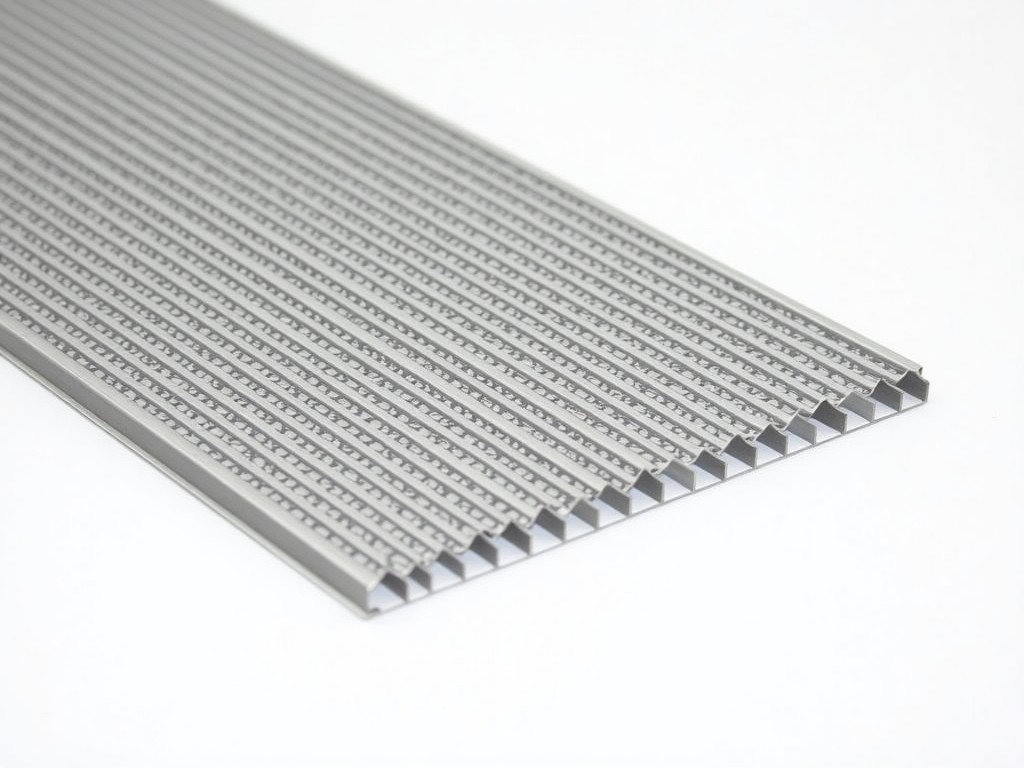
Perforated Corrugated Aluminum Panels
Material and Structural Characteristics
Perforated corrugated aluminum panels are manufactured from aluminum alloy sheets, typically grades 3003 or 5052, formed into a sinusoidal or trapezoidal corrugated profile to enhance structural rigidity. The perforation pattern—consisting of uniformly distributed holes—is applied via precision punching or laser drilling after forming, maintaining panel integrity while enabling controlled airflow, light transmission, or acoustic absorption. Panel thickness ranges from 0.5 mm to 1.5 mm, with corrugation heights between 8 mm and 25 mm, depending on load requirements and span conditions.
The combination of corrugation and perforation creates a high strength-to-weight ratio, allowing spans up to 3 meters without intermediate support in non-load-bearing applications such as cladding or screening. Aluminum’s natural oxide layer provides corrosion resistance suitable for exterior environments, while the perforated surface reduces wind uplift forces by up to 40% compared to solid panels of equivalent thickness, based on wind tunnel testing principles for perforated screens.
Perforation Patterns and Open Area Ratios
Perforation geometry directly influences functional performance: round, square, slotted, or custom shapes determine airflow resistance, sound absorption coefficients, and visual transparency. Open area ratio (OAR)—the percentage of perforated surface relative to total panel area—typically ranges from 15% to 60%, with higher OAR values increasing ventilation capacity but reducing structural stiffness and acoustic damping.
For acoustic applications, perforations paired with a backing material (e.g., mineral wool or foam) create Helmholtz resonators tuned to specific frequency bands; OAR between 20% and 35% with hole diameters of 3–6 mm is common for mid-frequency absorption (500–2000 Hz). In solar shading or facade applications, lower OAR (10–25%) with smaller holes (1–3 mm) provides glare reduction while maintaining outward visibility, adhering to ASHRAE 90.1 shading coefficient guidelines.
Typical Applications in Industrial and Architectural Settings
In industrial facilities, perforated corrugated aluminum panels are used as ventilated cladding for machinery enclosures, where controlled airflow prevents heat buildup around motors and drives while protecting equipment from dust and debris ingress. The corrugated profile allows vertical installation with overlapping seams that shed water, eliminating the need for additional flashing in low-slope applications.
Architecturally, these panels serve as sun screens on building facades, reducing solar heat gain coefficient (SHGC) by 30–50% depending on OAR and angle of incidence, thereby lowering HVAC load. They are also specified for interior acoustic ceilings in workshops and auditoriums, where the perforation-baffle system achieves noise reduction coefficients (NRC) of 0.6–0.85 when backed with 25–50 mm absorbent material.
Transportation infrastructure applications include noise barriers along highways and rail corridors, where the panel’s durability, low maintenance, and tunable acoustic performance meet ISO 10846-2 requirements for exterior sound insulation.
Comparison of Panel Configurations
| Configuration | Typical Thickness (mm) | Corrugation Height (mm) | Open Area Ratio (%) | Primary Use Case |
|---|---|---|---|---|
| Ventilated Cladding | 0.8–1.2 | 15–20 | 25–40 | Equipment enclosures, mechanical rooms |
| Acoustic Panel | 0.6–1.0 | 10–18 | 20–35 | Interior ceilings, wall linings |
| Solar Shading Screen | 0.5–0.8 | 8–15 | 10–25 | Facade systems, balcony guards |
| High-Strength Barrier | 1.0–1.5 | 20–25 | 15–30 | Highway noise barriers, security fencing |
*Values are typical ranges; actual specifications are customizable according to project requirements for load, span, and environmental conditions.
Manufacturing Considerations and Tolerances
Production begins with coil-fed aluminum sheet, which is roll-formed into the corrugated profile using hardened steel dies to ensure dimensional consistency. Perforation is performed in-line or via secondary CNC punching, with hole placement tolerance typically ±0.2 mm and burr height controlled to less than 0.1 mm to prevent edge corrosion initiation. Panel length is limited by transportation and handling constraints, commonly up to 6 meters, with longer lengths achievable via splice joints designed to maintain aerodynamic and acoustic continuity.
Edge treatments include folded hems, flanges for overlap joining, or extruded aluminum rails for mechanical fastening. Surface finishes range from mill finish to anodized (AA10–AA25) or PVDF-coated options, selected based on UV exposure and aesthetic requirements. All panels undergo visual inspection for perforation uniformity and corrugation symmetry, with dimensional checks conducted per ASTM E290 for profile accuracy.
Customization Options for Project-Specific Needs
Beyond standard configurations, panels can be engineered for unique performance criteria: variable perforation density across the panel face to create graded acoustic or visual effects, asymmetric corrugation profiles for directional stiffness, or integrated mounting features such as screw channels or clip systems. Hole patterns can be customized to match corporate logos, architectural motifs, or functional grading—for example, higher OAR at the base of a facade for increased ventilation where heat accumulates.
Material alternatives include marine-grade 5083 aluminum for salt spray environments or coated steel substrates when cost or magnetic properties are considerations, though aluminum remains preferred for its weight advantage and corrosion resistance. Surface treatments such as clear anodizing enhance durability while preserving metallic appearance, whereas powder coating allows color matching to RAL or NCS standards with warranty-backed UV stability.
Quality Assurance and Testing Protocols
Quality control begins with incoming material verification, including alloy composition (via optical emission spectroscopy) and thickness measurement (micrometer or XRF). During production, inline monitoring ensures corrugation pitch consistency (±0.5 mm) and perforation registration. Finished panels undergo bend testing to verify coating adhesion and flexibility, with no cracking permitted at 180-degree fold over a 10 mm mandrel per ASTM D522.
For acoustic applications, random samples are tested in impedance tubes to measure absorption coefficients per ASTM C423. Outdoor specimens undergo accelerated weathering (UV exposure, salt spray) per ASTM G154 and B117 to validate coating performance. Mill test reports and conformance documentation are available upon request, supporting project specification compliance for ISO 9001-certified manufacturing processes.
Environmental and Lifecycle Attributes
Aluminum is infinitely recyclable without degradation of properties, and perforated corrugated panels typically contain 30–80% post-consumer recycled content depending on alloy and supplier. The lightweight nature reduces transportation energy and structural support requirements compared to steel alternatives, contributing to lower embodied carbon in building assemblies. At end of life, panels can be separated from insulation or backing materials and returned to aluminum remelt streams.
In service, the panels require minimal maintenance—occasional cleaning with water and mild detergent suffices to remove particulates from perforations. Unlike coated steel, aluminum does not require repainting for corrosion protection in most environments, reducing long-term lifecycle costs. These attributes align with green building standards such as LEED and BREEAM for material reuse, regional sourcing, and low-emitting components.
Inquiry and Technical Support
To discuss project-specific requirements for perforated corrugated aluminum panels—including dimensions, perforation patterns, material grade, finish, and performance criteria—provide details such as intended application, span length, load conditions, environmental exposure, and desired functional outcomes (e.g., airflow rate, acoustic target, solar shading coefficient). Our technical team will review inputs and return a detailed quotation with lead time, packaging options, and installation guidance.
Samples are available upon request to validate perforation aesthetics, acoustic performance, or finish appearance under project lighting conditions. For export shipments, panels are packaged in horizontal crates with edge protection, moisture barriers, and corrosion-inhibiting interleaving to ensure arrival in factory condition.
Contact our engineering team to begin the specification process or request technical documentation such as load tables, acoustic data sheets, or wind load calculations.
More Products

Send Inquiry
If you are interested in our products, leave your information here and we will be in touch shortly.