Perforated Corrugated Metal Panels
Perforated corrugated metal panels combine structural corrugation with precision-engineered perforation patterns to deliver functional solutions for ventilation, light diffusion, acoustic control,
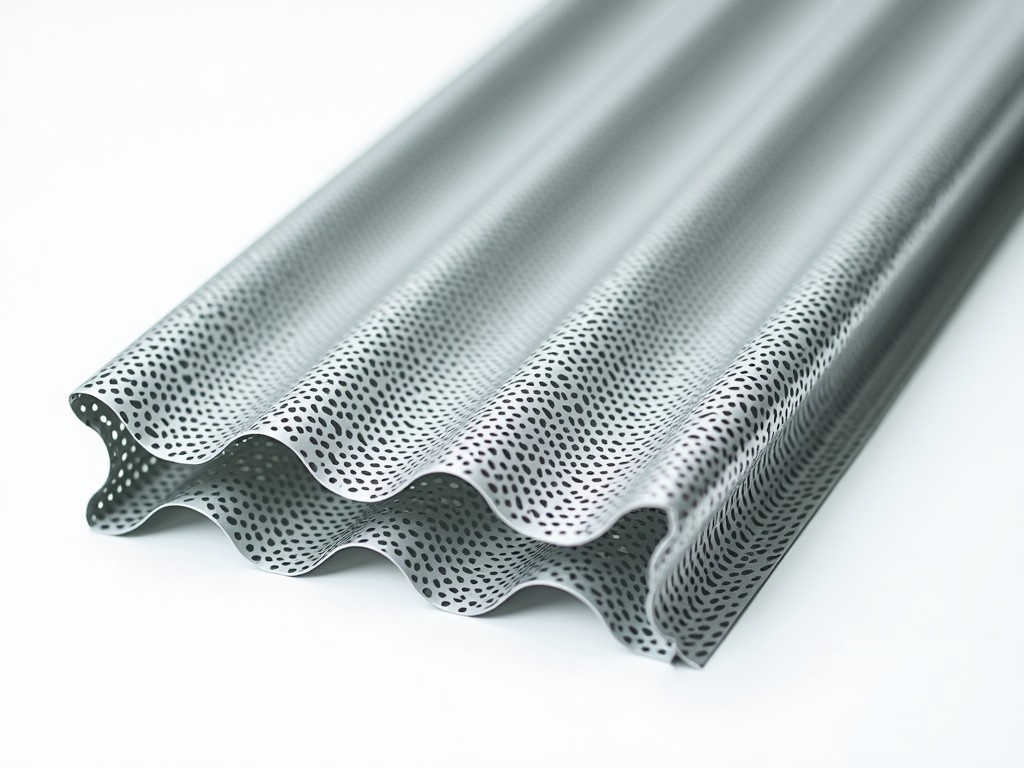
Perforated Corrugated Metal Panels
Perforated corrugated metal panels combine structural corrugation with precision-engineered perforation patterns to deliver functional solutions for ventilation, light diffusion, acoustic control, and aesthetic screening in industrial and architectural applications. These panels are manufactured from roll-formed sheet metal with alternating ridges and valleys that enhance stiffness, while strategically placed holes or slots provide controlled airflow, sound transmission, or visual permeability. The integration of corrugation and perforation allows engineers to meet multiple performance requirements—such as load resistance, weight reduction, and environmental modulation—within a single component.
Material Selection and Mechanical Properties
Common base materials include galvanized steel (Z275 coating), aluminum alloys (3003-H14 or 5052-H32), and stainless steel (grades 304 and 316L), each selected based on environmental exposure, required strength-to-weight ratio, and corrosion resistance. Galvanized steel offers a yield strength of approximately 250–350 MPa with cost-effective durability in mildly corrosive environments, while aluminum provides one-third the density of steel with natural oxide layer protection, making it suitable for coastal or high-humidity settings. Stainless steel grades 304 and 316L deliver superior resistance to chlorides and acidic atmospheres, with tensile strengths exceeding 500 MPa, though at higher material cost.
Material thickness typically ranges from 0.5 mm to 1.5 mm, depending on span requirements and load conditions. Thicker gauges increase resistance to buckling under uniform pressure or wind load, while thinner options reduce weight and material cost for non-structural screening applications. The corrugation profile—commonly sinusoidal, trapezoidal, or square-wave—further influences moment of inertia and sectional modulus, directly affecting the panel’s ability to resist deflection. Engineers select profile depth and pitch based on calculated bending stress and support spacing, often referencing standards such as AS/NZS 4600 or ASTM A792 for structural performance validation.
Perforation Patterns and Functional Design
Perforation design is defined by hole shape, size, pitch, and open area percentage—critical parameters that determine airflow rate, sound absorption coefficient, light transmission, and visual openness. Common hole shapes include round, square, slotted, and hexagonal, each influencing turbulence characteristics and pressure drop in HVAC or equipment enclosures. Round holes are most prevalent due to ease of tooling and predictable flow behavior, while slotted perforations enhance directional sound attenuation or light diffusion in specific orientations.
Open area typically ranges from 10% to 60%, with higher percentages increasing airflow and light penetration but reducing structural stiffness and impact resistance. For acoustic applications, perforation patterns are often paired with backing materials (such as mineral wool or foam) to create Helmholtz resonators tuned to specific frequency bands. In solar shading or facade systems, designers calculate perforation density to achieve target shading coefficients (SC) or daylight autonomy, using computational tools to model sun angle interactions throughout the year.
Manufacturing Process and Tolerances
Production begins with coil-fed roll forming, where flat sheet passes through a series of rollers to establish the corrugation profile before or after perforation, depending on tooling configuration. Perforation is typically achieved via CNC turret punch presses or laser cutting, allowing precise control over hole location, edge quality, and pattern repeatability. Punched holes may exhibit minor burrs or cold-work hardening around the perimeter, which can be mitigated through secondary deburring or vibratory finishing if required for fluid flow or aesthetic consistency.
Dimensional tolerances follow industry norms: length and width tolerances are typically ±3 mm or ±0.5% of dimension, whichever is greater, while hole position accuracy is maintained within ±0.25 mm for high-precision applications. Profile height and pitch are controlled during roll forming, with variations usually held within ±10% of nominal depth to ensure consistent nesting and fastening behavior. Manufacturers provide inspection reports detailing material certification, perforation accuracy, and flatness deviation upon request, particularly for projects requiring tight tolerances in modular cladding or ductwork systems.
Applications in Industrial and Built Environments
In industrial facilities, perforated corrugated panels are commonly used as intake or exhaust screens for HVAC units, compressor housings, and generator enclosures, where they protect internal components from debris ingress while maintaining adequate airflow to prevent overheating. The corrugated structure resists deformation from wind pressure or accidental impact, making it suitable for outdoor mounting on rooftops or ground-level pads. Engineers specify corrosion-resistant materials and adequate open area (often 20–40%) to balance protection with sufficient mass flow rate for cooling or ventilation demands.
Architectural applications include parking garage facades, pedestrian walkway canopies, and interior acoustic baffles, where the panels provide visual interest, glare reduction, and sound absorption without sacrificing structural integrity. The directional nature of corrugation allows architects to create shadow lines and texture that vary with viewing angle, while perforation patterns can be customized to project logos, gradients, or screening densities. In transit stations or schools, perforated corrugated metal is favored for its durability, low maintenance, and compliance with fire safety ratings when using non-combustible substrates.
Agricultural and food processing environments utilize these panels for grain drying floors, livestock barn ventilation, and washdown wall cladding, where resistance to moisture, chemicals, and frequent cleaning is essential. Perforations allow humid air to escape or fresh air to enter, while the corrugated profile facilitates drainage and prevents pooling. Stainless steel or powder-coated aluminum variants are often selected to withstand washdown cycles, ammonia exposure, or acidic cleaning agents without degradation.
Customization and Engineering Support
Customization options include material type, thickness, corrugation profile (sinusoidal, trapezoidal, or custom), perforation pattern (shape, size, pitch, open area), edge treatment (hemmed, flanged, or punched for fasteners), and surface finish (mill, galvanized, painted, anodized, or powder-coated). Panels can be manufactured to specific lengths, widths, and radii for curved applications, with nesting or interlocking edges available for seamless installation over large areas. Engineers often collaborate during the design phase to validate structural performance, airflow characteristics, or acoustic properties using computational modeling or prototype testing.
Value-added services may include CNC cutting to size, drilling or punching for mounting holes, application of sealants or gaskets, and packaging for protected transit. For projects requiring certification, manufacturers can provide material test reports (MTRs), coating adhesion test results, or fire performance classifications (e.g., ASTM E84 Class A) upon request. Lead times typically range from 2 to 4 weeks for standard configurations, with expedited options available for critical-path items, depending on material availability and production scheduling.
| Parameter | Typical Range or Option | Notes |
|---|---|---|
| Base Material | Galvanized steel, Aluminum (3003/5052), Stainless steel (304/316L) | Selected based on environment and load requirements |
| Thickness | 0.5 mm – 1.5 mm | Thicker gauges increase stiffness and span capability |
| Corrugation Profile | Sinusoidal, Trapezoidal, Square-wave | Affects moment of inertia and load resistance |
| Hole Shape | Round, Square, Slotted, Hexagonal | Influences flow dynamics and acoustic behavior |
| Open Area | 10% – 60% | Balances function (ventilation, light, sound) with structural integrity |
| Standard Width | 600 mm – 1200 mm | Custom widths available upon request |
| Length | Up to 6000 mm (limited by transport) | Longer lengths require special logistics |
| Surface Finish | Mill, Galvanized, Painted, Anodized, Powder-coated | Finish selected for corrosion resistance or aesthetics |
All specifications are subject to confirmation based on project-specific engineering requirements. Customers are advised to provide load conditions, environmental exposure, desired airflow or acoustic performance, and installation constraints to enable accurate quotation and design validation. Technical support is available to assist with pattern selection, material compatibility, and detailing for transitions, corners, and penetrations.
More Products

Send Inquiry
If you are interested in our products, leave your information here and we will be in touch shortly.