Perforated Galvanised Steel Sheet
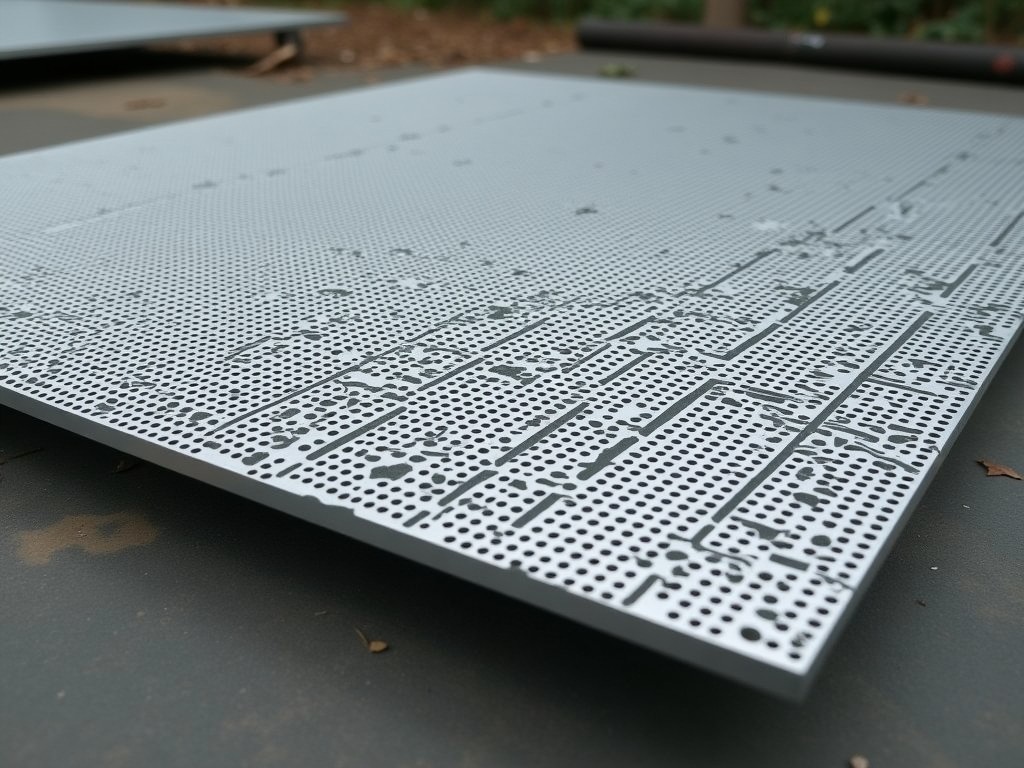
Perforated galvanised steel sheet combines the corrosion resistance of zinc-coated steel with the functional benefits of a patterned hole array. The galvanisation process applies a protective zinc
Perforated Galvanised Steel Sheet
Perforated galvanised steel sheet combines the corrosion resistance of zinc-coated steel with the functional benefits of a patterned hole array. The galvanisation process applies a protective zinc layer to carbon steel, typically through hot-dip coating, which inhibits rust formation in humid or exposed environments. Perforation is achieved via precision punching or laser drilling, creating openings that serve specific engineering purposes such as fluid flow, sound attenuation, light diffusion, or particulate separation. The resulting product maintains structural integrity while enabling tailored performance characteristics based on hole size, shape, spacing, and open area percentage.
Material and Coating Specifications
The base material is typically low-carbon steel (e.g., DC01 or equivalent), selected for its formability and weldability. Hot-dip galvanisation follows EN 10346 standards, applying a zinc coating weight ranging from Z80 to Z275 (80–275 g/m² total on both sides), depending on environmental exposure requirements. This coating provides sacrificial protection, meaning zinc corrodes preferentially to shield the underlying steel. The coating adheres metallurgically to the steel surface, forming zinc-iron alloy layers that enhance durability. After galvanisation, the sheet undergoes perforation, which may locally disrupt the coating at hole edges; however, the zinc layer remains continuous and protective across the majority of the surface.
Perforation Patterns and Open Area
Perforation patterns are defined by hole shape, pitch (center-to-center distance), and layout. Common hole shapes include round, square, slot, and hexagonal, each influencing flow dynamics, structural strength, and aesthetic appearance. The pitch determines hole density and directly affects the open area percentage—the ratio of hole area to total sheet area. Open area typically ranges from 15% to 60% for industrial applications, balancing permeability with load-bearing capacity. For example, a 10 mm round hole on a 15 mm pitch yields approximately 35% open area. Custom patterns are available to meet specific acoustic, filtration, or ventilation requirements, with tolerances maintained to ±0.1 mm for hole diameter and ±0.2 mm for pitch in precision applications.
Mechanical Properties and Structural Performance
The yield strength of perforated galvanised steel sheet depends on the base steel grade and the reduction in cross-sectional area due to holes. For DC01 steel, the base yield strength is typically 140–280 MPa, but the effective strength of the perforated sheet is lower, calculated using the net section method. Designers must account for stress concentration around hole edges, particularly under cyclic loading. The elongation at break remains suitable for forming processes, typically 20–30%, allowing for bending or rolling without cracking. Stiffness is reduced proportionally to open area, so deflection calculations should use the effective moment of inertia of the perforated section. These factors are critical in applications such as walkways, machine guards, or ventilated enclosures where load-bearing capacity is essential.
Surface Finish and Edge Treatment
The galvanised coating produces a spangled surface finish, which varies in appearance based on zinc bath chemistry and cooling rate—minimised spangle or zero-spangle options are available for applications requiring uniform paint adhesion or visual consistency. Hole edges may exhibit slight burrs or roll-over from punching, which can be mitigated through deburring, vibratory finishing, or laser perforation (which produces cleaner edges with minimal thermal distortion). For applications involving frequent handling or contact with sensitive materials, edge conditioning is recommended. The zinc coating itself is non-toxic and inert once passivated, making it suitable for use in food processing areas, agricultural buildings, and public infrastructure when compliant with local regulations.
Typical Industrial Applications
In HVAC systems, perforated galvanised steel sheets are used as diffuser plates and return air grilles, where the open area ensures adequate airflow while the pattern contributes to noise reduction by breaking up sound waves. In agricultural buildings, they serve as ventilation panels in livestock housing, providing durability against ammonia and moisture while allowing gas exchange and temperature regulation. Industrial machinery manufacturers use them as safety guards and chip guards around rotating equipment—offering visibility, containment of debris, and resistance to coolant and lubricant exposure. They are also employed in architectural cladding for parking structures and façades, where the perforation enables wind pressure equalization, reduces material weight, and creates dynamic light-shadow effects. Filtration applications include pre-filters in air handling units and screens in liquid processing systems, where hole size controls particle retention.
Customization Options
Customization begins with base material selection—alternatives include hot-dip galvanised high-strength steel (e.g., S350GD) for structural components requiring higher yield strength, or galvannealed steel for improved paint adhesion. Hole geometry can be tailored to specific functions: elongated slots enhance directional flow, while staggered square patterns improve uniform load distribution. Sheet dimensions are commonly supplied in widths up to 1500 mm and lengths up to 3000 mm, though custom slitting and cut-to-length services are available. Thickness typically ranges from 0.5 mm to 3.0 mm, with thinner gauges used for decorative or low-load applications and thicker gauges for walkways or machine bases. Additional options include post-perforation chromating or sealing to enhance white rust resistance during storage or transit.
Quality Control and Testing
Quality assurance involves multiple checkpoints. Coating weight is verified via magnetic induction or gravimetric testing per EN ISO 2178, ensuring compliance with the specified Z-class. Hole dimensions and positional accuracy are inspected using optical comparators or CNC vision systems, particularly for high-precision applications. Flatness is measured against EN 10162 limits, as perforation can induce residual stress leading to curl or wave. Adhesion of the zinc coating is assessed through bend testing where the specimen is folded over a defined radius without cracking or flaking. For batches intended for corrosive environments, salt spray testing (ASTM B117) may be conducted on representative samples, though results are indicative rather than predictive of real-world service life. All inspection data is traceable to the production batch.
Packaging and Handling
Sheets are typically stacked on wooden pallets with interleaving paper or plastic film to prevent surface abrasion and moisture transfer. Edge protection using angle boards or corner guards minimizes damage during forklift handling. For export or long-term storage, sheets may be wrapped in vapor-corrosion inhibitor (VCI) film and placed inside crush-resistant crates. Humidity indicators are sometimes included inside packaging to monitor exposure. Handling guidelines recommend lifting with vacuum suction devices or balanced clamps to avoid point loading that could deform thin sheets. Storage should occur in a dry, ventilated area with temperature fluctuations minimized to prevent condensation. Sheets are labeled with grade, coating weight, dimensions, perforation pattern, and batch number for traceability.
Comparison with Alternatives
Compared to stainless steel perforated sheets, galvanised steel offers lower material cost and adequate corrosion resistance for many outdoor or semi-exposed environments, though it lacks the chemical resistance of grades like 304 or 316 stainless in acidic or chloride-rich conditions. Aluminium perforated sheets are lighter and naturally corrosion-resistant but have lower strength and stiffness, limiting their use in structural roles. Powder-coated cold-rolled steel provides aesthetic flexibility but requires intact coating for corrosion protection—any perforation damage exposes the substrate. Galvanised steel’s advantage lies in the self-healing nature of zinc coating at cut edges and scratches, providing ongoing protection where other coatings would fail. For applications requiring long-term exposure with minimal maintenance, galvanised steel often delivers the best balance of cost, durability, and availability.
More Products

Send Inquiry
If you are interested in our products, leave your information here and we will be in touch shortly.