Perforated Galvanized Steel Sheet
Perforated galvanized steel sheet combines corrosion resistance from hot-dip zinc coating with engineered hole patterns for functional performance in filtration, ventilation, screening, and
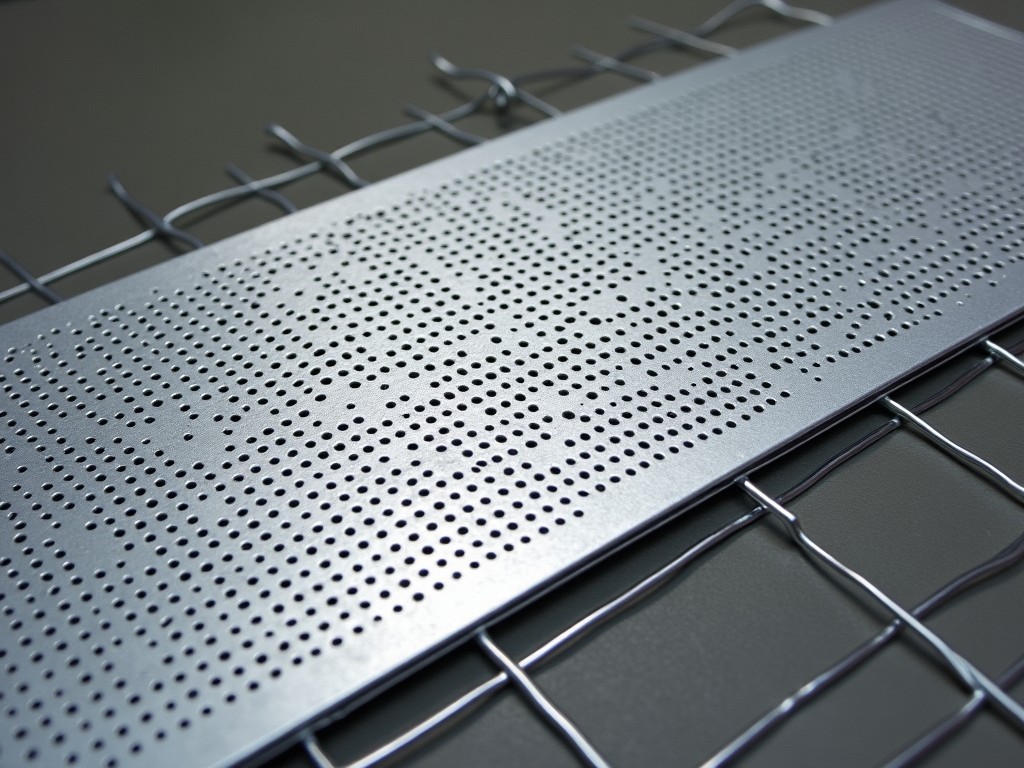
Perforated Galvanized Steel Sheet
Perforated galvanized steel sheet combines corrosion resistance from hot-dip zinc coating with engineered hole patterns for functional performance in filtration, ventilation, screening, and architectural applications. The zinc layer provides sacrificial protection to the underlying steel, extending service life in outdoor and humid environments while maintaining structural integrity. Hole geometry—including size, shape, spacing, and open area—is precisely controlled during manufacturing to meet specific flow, load-bearing, or aesthetic requirements. This material is selected when both durability and perforated functionality are required in a single component.
Material Composition and Coating Standards
The base steel is typically low-carbon cold-rolled or hot-rolled sheet, selected for formability and weldability without compromising coating adhesion. Hot-dip galvanizing follows ASTM A653/A653M standards, with zinc coating weights designated as G30, G60, or G90, indicating the total weight of zinc on both sides in ounces per square foot. G60 (0.60 oz/ft² total) is common for general industrial use, while G90 provides enhanced protection for severe environments. The coating forms a metallurgical bond with the steel, creating a barrier that resists moisture, UV exposure, and mild chemical contact.
Coating thickness directly influences longevity; G90 coatings typically exceed 20 years in rural atmospheres and 10+ years in industrial zones before significant zinc depletion. The perforating process occurs after galvanizing to preserve coating integrity over the entire surface, including hole edges, which are critical for corrosion resistance. Alternative coatings like galvannealed (ASTM A653) or electrogalvanized are available upon request for applications requiring paint adhesion or tighter thickness tolerances.
Perforation Patterns and Open Area Calculations
Perforation patterns are defined by hole shape (round, square, slotted, hexagonal), center-to-center pitch, and hole diameter, which together determine the open area percentage—a key metric for airflow, liquid flow, or light transmission. For example, a 6mm round hole on a 10mm pitch yields approximately 28% open area, while the same hole size on a 8mm pitch increases open area to 44%. Open area directly impacts pressure drop in filtration systems or visibility in security screens.
Pattern selection balances functional needs with structural strength; higher open area reduces material cross-section, affecting load-bearing capacity and rigidity. Engineers use empirical formulas or manufacturer-provided charts to calculate expected pressure drop based on hole geometry, fluid velocity, and sheet thickness. Custom patterns—including variable pitch, gradient density, or decorative motifs—are achievable through CNC turret punch presses or laser perforation systems, allowing optimization for specific fluid dynamics or acoustic performance.
Thickness Options and Structural Implications
Sheet thickness ranges from 0.5mm to 3.0mm, with thinner gauges (0.5–1.0mm) used in lightweight applications like HVAC diffusers or speaker grilles, and thicker gauges (2.0–3.0mm) selected for walkway treads, machine guards, or industrial screening where impact resistance and deflection limits are critical. Thickness is chosen based on span length, expected load, and hole size—larger holes in thinner sheets increase susceptibility to tearing or deformation under stress.
Deflection under uniform load can be estimated using standard plate bending formulas, adjusted for reduced moment of inertia due to perforation. For instance, a 1.5mm thick sheet with 30% open area behaves structurally similar to a solid sheet of approximately 1.05mm thickness. Stiffening techniques such as edge flanging, corrugation, or adding support frames are commonly employed to compensate for strength loss in large-span perforated panels.
Surface Finish and Post-Processing Options
After perforation, sheets may undergo additional treatments depending on end-use requirements. Passivation or chromate conversion coatings can be applied to enhance white rust resistance during storage or transit. For painted finishes, the galvanized surface is cleaned and primed with a zinc-compatible primer before topcoating to ensure adhesion and prevent peeling. Uncoated galvanized surfaces are often left exposed in architectural applications where the spangle pattern is desired for aesthetic effect.
Deburring is standard after perforation to remove sharp edges, particularly important in safety guards or handheld equipment. Options include vibratory tumbling, brushing, or electrochemical deburring for complex geometries. Secondary operations like bending, rolling, or welding are performed with consideration for zinc vaporization at high temperatures; proper ventilation and compatible welding techniques (e.g., MIG with silicon bronze filler) are required to maintain coating integrity in heat-affected zones.
Typical Industrial Applications
In HVAC systems, perforated galvanized steel serves as diffuser faces and return air grilles, where open area ensures adequate airflow while the coating resists condensation-induced corrosion. In industrial filtration, it functions as support media for filter cartridges or as pre-filters in dust collection systems, combining rigidity with particle retention. For security and machine guarding, small-hole patterns (<3mm) prevent finger ingress while maintaining visibility and ventilation, meeting OSHA 1910.217 requirements for point-of-operation guards.
Architectural uses include sunscreens, facade panels, and acoustic baffles, where perforation patterns are designed to modulate light transmission, reduce glare, or absorb sound energy when backed with absorbent material. In agriculture, it is used in grain drying floors and animal pen flooring, where corrosion resistance and load distribution over uneven surfaces are essential. The material also appears in electrical enclosures as EMI/RFI shielding panels, where hole size is tuned to block specific frequency ranges while allowing airflow for cooling.
Quality Control and Inspection Protocols
Dimensional inspection verifies hole size, pitch, and positional tolerance using optical comparators or coordinate measuring machines (CMM), with typical tolerances of ±0.1mm for hole diameter and ±0.2mm for pitch. Coating thickness is measured via magnetic or eddy-current probes per ASTM A90/A90M, ensuring compliance with G60 or G90 specifications. Visual inspection checks for coating defects such as bare spots, drips, or excessive spangle, which could indicate inadequate surface preparation or bath imbalance.
Open area is validated through flow testing or photometric analysis for critical filtration or lighting applications. Mechanical properties like tensile strength and yield strength are assessed on sample coupons to confirm base steel meets ASTM A1008 or A1011 standards. Adhesion testing (e.g., knife scratch or tape test) may be conducted post-forming to ensure coating remains intact after bending or stamping. All test data is traceable to production lots and available upon request.
Comparison Table: Common Perforation Specifications
| Hole Type | Nominal Size (mm) | Pitch (mm) | Typical Open Area (%) | Common Use Case |
|---|---|---|---|---|
| Round | 3.0 | 5.0 | 28 | HVAC grilles, light fixtures |
| Round | 6.0 | 10.0 | 28 | Filtration supports, machine guards |
| Square | 4.0 | 6.0 | 36 | Security screens, speaker panels |
| Slotted | 5.0 x 20.0 | 10.0 x 25.0 | 40 | Ventilation panels, conveyor guards |
| Hexagonal | 5.0 | 8.0 | 33 | Acoustic panels, decorative screens |
Values represent typical configurations; custom hole sizes, patterns, and open areas are available based on project requirements.
Customization and Ordering Considerations
Perforated galvanized steel sheets are produced to order based on customer-specified parameters: base steel grade (e.g., CS Type B, DS Type B), thickness, zinc coating weight (G30, G60, G90), hole shape and size, pitch, open area, sheet dimensions, and edge condition (mill edge, trimmed, or deburred). Tolerances for hole location and size are typically ±0.1mm for precision applications, though looser tolerances may be accepted for structural or architectural uses to reduce cost.
Secondary operations such as cutting to size, notching, bending, or forming are performed in-house or through certified partners. Packaging options include interleaving with paper or plastic to prevent surface abrasion, strapping on pallets, or crating for export shipments. Lead times vary based on complexity but generally range from 2–4 weeks for standard patterns and 4–6 weeks for highly customized orders. Samples or test coupons can be provided upon request to validate coating adhesion, open area, or formability before full production.
To initiate a quotation, provide the application context (e.g., indoor/outdoor exposure, load expectations, fluid type), required dimensions, perforation details, and any post-processing needs (painting, bending, etc.). Engineers review submissions for manufacturability and may suggest alternatives—such as adjusting hole pitch to improve structural rigidity or selecting galvannealed for better paint adhesion—based on performance goals and environmental factors.
For technical consultation or to request a quote, provide your specifications via our inquiry form.
Submit Inquiry
More Products

Send Inquiry
If you are interested in our products, leave your information here and we will be in touch shortly.