Perforated Mild Steel Sheet
Perforated mild steel sheet is a low-carbon steel plate precision-punched with a regular pattern of holes to achieve specific functional and aesthetic outcomes. The base material, typically ASTM A36
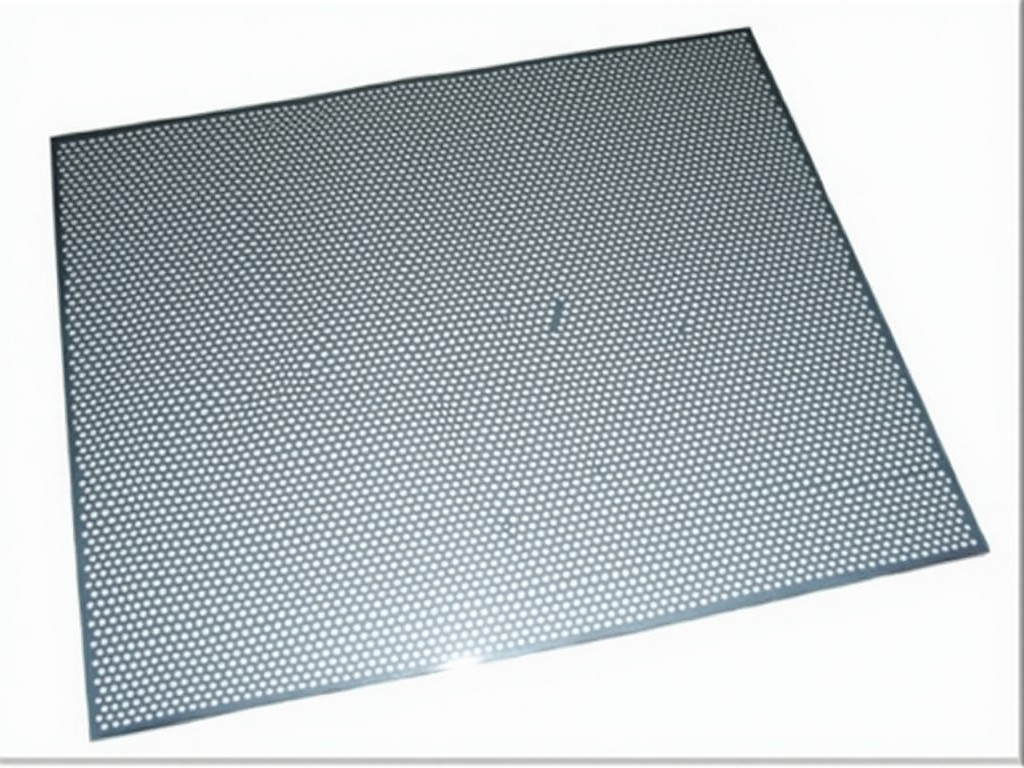
Perforated Mild Steel Sheet
Perforated mild steel sheet is a low-carbon steel plate precision-punched with a regular pattern of holes to achieve specific functional and aesthetic outcomes. The base material, typically ASTM A36 or equivalent, offers a balance of formability, weldability, and tensile strength averaging 400–550 MPa, making it suitable for structural and non-structural applications where controlled airflow, light diffusion, or particulate filtration is required. Hole geometry—round, square, slotted, or decorative—is defined by diameter, pitch, and arrangement (straight or staggered), directly influencing open area percentage, which typically ranges from 15% to 60% depending on design. Unlike expanded metal or wire mesh, perforated sheet maintains full sheet integrity between holes, preserving load-bearing capacity while enabling engineered functionality. This combination of mechanical reliability and pattern precision supports use in industries ranging from architectural facade systems to industrial machinery guards.
Material and Manufacturing Specifications
The base mild steel used in perforated sheet production is cold-rolled or hot-rolled, with thickness commonly ranging from 0.5 mm to 6.0 mm. Thinner gauges (0.5–1.5 mm) are often cold-rolled for tighter tolerance on flatness and hole edge quality, while thicker sections (>2.0 mm) may use hot-rolled stock to reduce material cost and improve punchability. Hole punching is performed via CNC turret presses or rotary dies, achieving positional accuracy within ±0.1 mm and burr heights typically under 0.05 mm for thicknesses up to 3 mm. Post-punching, sheets may undergo stress-relief annealing if significant cold work has occurred, particularly in thicknesses above 2.5 mm, to prevent distortion during subsequent forming or welding. Surface treatments such as galvanization (Z275), powder coating, or pre-painting are applied after perforation to ensure complete coverage of hole edges and prevent corrosion initiation at cut points.
Open area (OA) is a critical design parameter calculated as the ratio of hole area to total sheet area, expressed as a percentage. For round holes in a 60° staggered pattern, OA ≈ (π/2√3) × (d/p)² × 100, where d is hole diameter and p is pitch. A 5 mm diameter hole on 8 mm pitch yields approximately 30% OA, while the same diameter on 10 mm pitch reduces OA to ~19%. Square holes in a straight grid yield OA = (d/p)² × 100, offering higher OA at equivalent pitch but reduced directional strength. Slotted holes provide anisotropic flow characteristics, useful in screening applications where directional particle movement is desired. These calculations allow engineers to predict pressure drop, acoustic transmission, or light penetration with precision during the design phase.
Functional Advantages in Industrial Applications
In HVAC systems, perforated mild steel sheets serve as diffuser panels where the hole pattern controls air velocity and distribution uniformity. A 40% OA round hole pattern with 3 mm diameter and 5 mm pitch creates laminar flow diffusion, reducing draft discomfort in occupied spaces compared to solid deflectors. The steel’s rigidity prevents flutter under positive pressure, maintaining consistent performance over time. Unlike fabric or foam alternatives, it does not degrade under UV exposure or temperature cycling, making it suitable for rooftop air handling units. Acoustic perforated panels use specific hole diameters and backing cavities to achieve Helmholtz resonance, targeting noise reduction in the 500–2000 Hz range commonly generated by fans and motors.
As machine guarding, perforated sheet provides visibility and containment without compromising structural integrity. A 2 mm thick sheet with 6 mm round holes on 10 mm pitch (OA ~28%) stops flying debris from grinding or milling operations while allowing operators to monitor processes. The hole edges, when properly deburred, present no snag hazard, and the material withstands impact energies up to 5 J without permanent deformation—verified via drop-ball testing per ISO 12443. Compared to polycarbonate, it resists scratching from metal chips and maintains clarity of view over years of industrial use. For high-heat zones near welding stations, untreated or oxidized steel performs reliably where polymers would deform or emit fumes.
In industrial filtration, perforated mild steel acts as a support screen for filter media such as non-woven polyester or wire mesh. The hole pattern must balance open area with sufficient collapse resistance; a 1.5 mm thick sheet with 2 mm square holes on 4 mm pitch (OA ~25%) provides adequate stiffness to prevent media extrusion under differential pressures up to 0.5 bar. The steel’s compatibility with common cleaning methods—backwashing, chemical rinsing, or thermal regeneration—extends service life in environments like food processing or chemical recovery. Staggered hole patterns reduce vortex shedding compared to straight alignments, minimizing media fatigue in pulsating flow systems.
Customization and Design Considerations
Hole diameter, pitch, and pattern are fully customizable to meet specific engineering requirements. Standard round hole sizes range from 1 mm to 20 mm, with pitches typically 1.5× to 3× the diameter to maintain sheet strength. Staggered (60°) arrangements are most common for uniform strength distribution, while straight grids are used when directional flow or alignment with mating parts is critical. Slot dimensions—length and width—can be tailored for specialized screening, such as separating elongated particles in agricultural processing. Edge margins, usually 10–20 mm unperforated, are preserved for handling and framing unless full-sheet perforation is specified for seamless tiling in architectural panels.
Thickness selection depends on span, load, and forming requirements. For self-supporting panels over 600 mm spans, 1.5 mm is often the minimum to avoid sag under its own weight; thicker sections (2.5–3.0 mm) are used where wind load or impact resistance is critical. Bending perforated sheet requires careful consideration: the neutral axis shifts due to material removal, and hole deformation can occur if bend radii are too small. As a rule of thumb, internal bend radius should exceed 2× thickness for thicknesses under 2 mm, and 3× thickness above that to prevent hole elongation. Laser cutting is preferred for prototypes or low-volume custom patterns, while turret punching remains economical for volumes over 50 m².
Surface finish is specified based on environmental exposure. Indoor applications may use untreated or oiled steel to reduce cost, with light rust acceptable in non-critical zones. For outdoor or humid environments, hot-dip galvanizing (minimum Z275 coating) provides sacrificial protection, with cut edges protected by zinc migration. Powder coating over galvanized or phosphatized steel offers color stability and UV resistance, with typical film thickness of 60–80 μm. In food-grade or pharmaceutical zones, 304 stainless steel may be substituted despite higher cost, but mild steel with food-safe epoxy coating remains a viable alternative where magnetic properties are required for sensor activation.
Typical Specifications Table
| Parameter | Typical Range | Notes |
|---|---|---|
| Base Material | ASTM A36 / EN 1.0038 | Low-carbon steel, equivalent grades available |
| Thickness | 0.5 mm – 6.0 mm | Cold-rolled <2.0 mm, hot-rolled ≥2.0 mm typical |
| Hole Diameter | 1 mm – 20 mm | Custom sizes available upon request |
| Pitch | 1.5× – 3× hole diameter | Depends on pattern and strength requirements |
| Open Area | 15% – 60% | Calculated from hole size, pitch, and pattern |
| Standard Patterns | Round (staggered/straight), Square, Slot, Hex | Custom designs via CAD file |
| Surface Finish | Untreated, Oiled, Galvanized (Z275), Powder Coated | Post-perforation coating recommended |
| Flatness Tolerance | ≤5 mm/m (typically) | Dependent on thickness and hole density |
Quality Assurance and Inspection
Dimensional verification begins with coil or sheet intake, where thickness and width are checked against mill certifications using micrometers and calipers. After perforation, each sheet undergoes optical inspection via backlit vision systems to confirm hole position, diameter consistency, and absence of micro-burrs or partial punches. Open area is validated through image analysis software, comparing actual hole geometry to the CAD pattern with tolerance typically set at ±5% of target OA. Edge camber and bow are measured using laser profilometers, with acceptance criteria based on intended application—architectural panels may require <3 mm/m deviation, while industrial guards allow up to 8 mm/m. Hardness testing (HRB) is performed on samples to confirm base material has not been inadvertently work-hardened beyond acceptable limits (typically <90 HRB for mild steel).
Adhesion and coating integrity are assessed post-finishing. For galvanized sheets, coating weight is verified via weigh-strip-weigh method per ASTM A90, ensuring minimum Z275 compliance. Powder-coated films undergo cross-hatch adhesion testing (ASTM D3359) and thickness measurement via magnetic induction, with 60–80 μm being standard for exterior durability. Salt spray testing (ASTM B117) may be conducted on samples to validate corrosion resistance, with 500 hours to white rust and 1000 hours to red rust common for coated mild steel in industrial environments. All inspection data is retained for traceability, and material test reports (MTRs) are available upon request, linking each batch to specific coil numbers and process parameters.
Packaging and Logistics
Perforated mild steel sheets are packaged to prevent edge damage, hole deformation, and surface abrasion during transit. Sheets under 1.5 mm thickness are typically interleaved with polyethylene film or kraft paper and stacked on wooden pallets with corner protectors, then secured with polyester strapping. Thicker sheets (≥2.0 mm) may be packed without interleaving if surface finish is robust (e.g., galvanized or powder coated), but edge guards remain mandatory to prevent chipping. Standard pallet sizes accommodate widths up to 1250 mm and lengths up to 2500 mm, with height limited to 1000 mm for safe forklift handling. Moisture barrier lining is added inside stretch-wrap for export shipments to prevent condensation-induced staining, particularly for untreated or oiled steel.
Each pallet is labeled with product code, dimensions, quantity, heat number, and inspection status. For customized orders, a packing list includes hole pattern specifications and any secondary operations performed (e.g., notching, bending). Flatness-critical sheets are transported horizontally; vertical stacking is only permitted for thicknesses above 3.0 mm or when supported by internal dividers. Lead times vary from 5–10 days for stock patterns to 15–25 days for custom tooling, depending on hole complexity and thickness. Sample sheets (typically 300×300 mm) are available upon request to validate hole appearance, edge quality, and finish before full production.

More Products

Send Inquiry
If you are interested in our products, leave your information here and we will be in touch shortly.