Vegetable Grill Basket With Removable Handle
Grilling vegetables requires consistent heat exposure and secure containment to prevent loss through grill grates. A vegetable grill basket addresses these needs by enclosing produce in a perforated
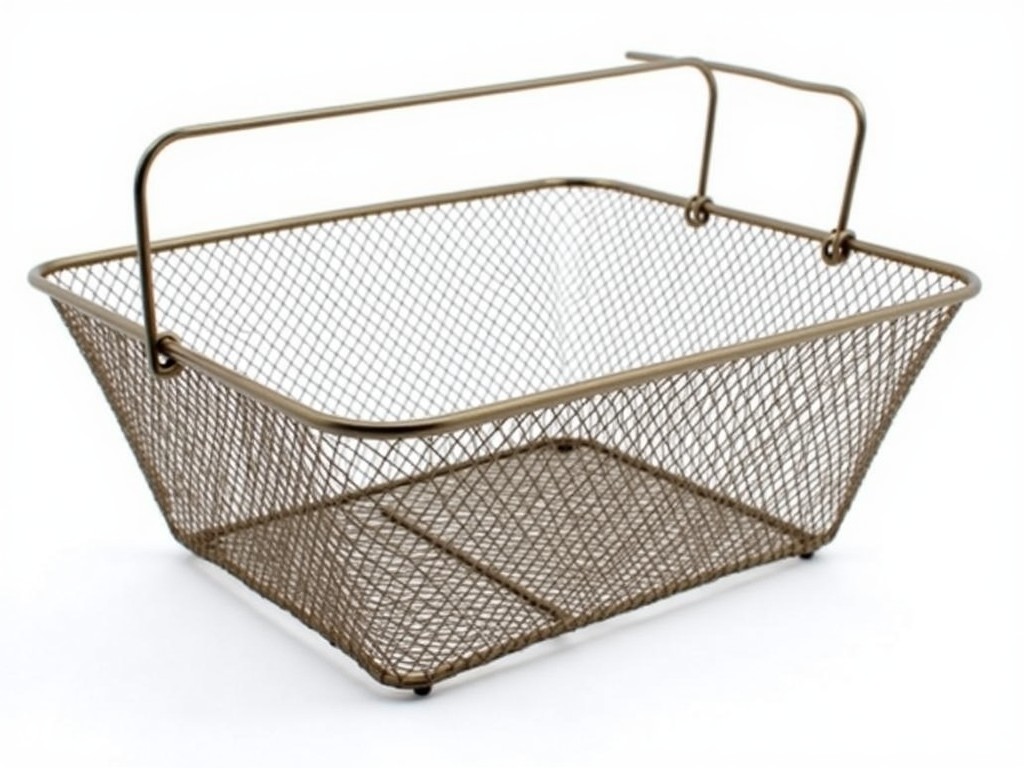
Vegetable Grill Basket with Removable Handle
Grilling vegetables requires consistent heat exposure and secure containment to prevent loss through grill grates. A vegetable grill basket addresses these needs by enclosing produce in a perforated metal container that allows smoke and flame contact while retaining small or delicate items. The removable handle adds operational flexibility, enabling safe transfer from grill to serving surface and compact storage when not in use. This design supports both direct and indirect grilling methods across charcoal, gas, and electric grill types.
Core Design Features
The basket body is constructed from 0.8mm thick food-grade 304 stainless steel sheet, formed into a rectangular prism with rounded corners to eliminate sharp edges. Perforation pattern consists of 6mm diameter holes arranged in a staggered grid at 12mm centers, providing 40% open area for optimal heat and smoke penetration while retaining vegetables as small as diced carrots or sliced mushrooms. Side walls are 75mm high, balancing capacity with ease of stirring and food inspection during cooking.
The handle assembly uses a 12mm diameter stainless steel rod, bent into a U-shape with 100mm grip width and 75mm vertical rise. Attachment points feature spring-loaded detent pins that engage with matching receptacles welded to the basket’s upper corners. When deployed, the handle locks securely in both vertical and horizontal orientations, supporting a static load of 15kg without deformation. Removal requires simultaneous depression of both pin actuators, preventing accidental disengagement during use.
Basket dimensions are 300mm (L) x 200mm (W) x 75mm (H), yielding a 4.5L internal volume. External dimensions with handle attached are 350mm (L) x 200mm (W) x 150mm (H). When handle is removed, the basket nests within a 50mm clearance for storage. All external surfaces undergo electropolishing to achieve a surface roughness of Ra 0.4μm, minimizing food adhesion and simplifying cleaning.
Material and Construction Details
304 stainless steel was selected for its combination of corrosion resistance, thermal stability, and food safety compliance. The alloy contains 18% chromium and 8% nickel, providing resistance to oxidation at temperatures up to 870°C—well beyond typical grilling surface temperatures of 260–310°C. Low carbon content (max 0.08%) minimizes sensitization risk during welding, preserving intergranular corrosion resistance in heat-affected zones.
Forming processes include CNC punching for perforation precision, followed by brake forming of side walls and base. Corner joints are resistance-welded using pulsed TIG technology to minimize heat distortion and maintain uniform wall thickness. Handle receptacles are machined from solid bar stock and TIG-welded to basket walls with 3mm fillets, ensuring full penetration and leak-proof integrity. Detent pins are made from 17-4 PH stainless steel, heat-treated to H900 condition for 1000MPa tensile strength and elastic recovery after 10,000 actuation cycles.
No coatings, paints, or non-metallic additives are applied to food-contact surfaces. All materials comply with FDA 21 CFR §177.2600 for stainless steel used in repeated food contact applications. The basket is suitable for use with acidic ingredients (e.g., tomatoes, citrus marinades) without risk of metal leaching or surface degradation under normal grilling conditions.
Functional Advantages
The perforated design enables 360-degree heat exposure, eliminating the need to flip vegetables mid-cook for even caramelization. Compared to solid trays or foil packets, open area reduces steam buildup, promoting surface dehydration and Maillard reaction development—key factors in achieving grilled texture and flavor. Users report 20–30% faster cooking times for dense vegetables like potatoes or root crops when using perforated baskets versus enclosed methods.
Removable handle transforms the basket from a cooking tool to a serving vessel. After grilling, the handle can be detached, allowing direct placement of the basket on dining tables or buffet lines. This eliminates transfer steps that risk spilling or cooling food. For storage, the nested configuration reduces vertical footprint by 65% compared to fixed-handle designs, benefiting commercial kitchens with limited space.
The basket’s geometry supports multi-zone grilling. When placed on a grill grate, the 75mm wall height shields contents from direct flame impingement while allowing radiant heat penetration—ideal for delicate items like asparagus or zucchini. In indirect heat configurations, the basket functions as a contained convection oven, suitable for slow-roasting garlic or peppers. Handle removal enables use in oven or smoker environments where handle protrusion would interfere with door closure.
Typical Applications
In food service operations, the basket streamlines high-volume vegetable grilling for restaurants, catering services, and institutional kitchens. Line cooks use it to prepare consistent batches of grilled peppers, onions, and eggplant for fajitas, sandwiches, or side dishes. The removable handle supports rapid pan-to-line transfer during peak service, reducing handling time and minimizing burn risk. Batch sizes of 1.5–2kg per basket align with standard portion control practices.
Retail and consumer applications include backyard grilling, camping, and tailgating events. Home users benefit from preventing loss of small items like cherry tomatoes, garlic cloves, or herb sprigs through grill grates. The basket’s compact storage profile suits apartment balconies or RV kitchens where space is constrained. For outdoor adventures, the detachable handle allows packing the basket flat in a cooler or gear bag, reassembling on-site with no tools.
Industrial food processors utilize the basket in pilot-line grilling or thermal testing scenarios. Its standardized dimensions and material traceability support repeatable experiments on caramelization kinetics, moisture loss, or acrylamide formation in vegetables. The electropolished surface facilitates cleaning between test runs, reducing cross-contamination risk in R&D environments.
Comparison Table: Key Specifications
| Parameter | Value | Notes |
|---|---|---|
| Body Material | 304 Stainless Steel | Food-grade, electropolished finish |
| Wall Thickness | 0.8mm | Balances rigidity and weight |
| Perforation Size | 6mm diameter | Staggered grid, 12mm pitch |
| Open Area Ratio | 40% | Optimizes heat/smoke transfer |
| Internal Dimensions | 300×200×75mm | 4.5L volume |
| Handle Type | Removable U-rod | Spring-detent locking |
| Handle Load Rating | 15kg static | Verified via deflection testing |
| Operating Temp. | -40°C to 400°C | Continuous use limit |
| Storage Configuration | Nested (handle removed) | 65% height reduction |
Quality and Manufacturing Considerations
Each basket undergoes dimensional verification using calibrated CMM probes to confirm wall height, perforation alignment, and handle receptacle positioning within ±0.2mm tolerance. Surface finish is assessed via profilometry to ensure Ra ≤0.4μm on all food-contact areas. Handle actuation is tested over 15 cycles to validate pin engagement force (25–35N) and audible click confirmation. Weld integrity is checked via 2x magnification visual inspection and dye penetrant testing on 10% of production lot.
Material traceability is maintained through mill certificates linked to batch numbers, enabling verification of 304 stainless steel composition and heat treatment records. Cleaning validation follows ASTM F3122 guidelines for residual debris removal after standard wash cycles. Baskets are packaged in polyethylene sleeves with corrugated cardboard overpacks, preventing surface abrasion during transit. Unit weight is 1.2kg, allowing efficient palletization at 48 units per standard layer.
Customization options are available upon request, including alternative perforation patterns (e.g., 4mm for fine herbs, 8mm for large chunks), adjusted dimensions to fit specific grill models, or handle configurations with heat-resistant silicone grips. Quotations require specification of intended use environment, estimated annual volume, and any regulatory compliance needs (e.g., NSF, ISO 22000). Lead times typically range from 3–6 weeks for standard configurations, depending on material availability and tooling requirements.
Ready to discuss your specific requirements?
Contact our technical team to review application details, request samples, or obtain a formal quotation.
Request Technical Consultation

More Products

Send Inquiry
If you are interested in our products, leave your information here and we will be in touch shortly.