6X12 Anti Climb Temporary Fence Panels
Temporary fencing systems are specified for sites requiring rapid deployment, reconfiguration, and removal without permanent ground disturbance. The 6x12 anti-climb panel addresses security and
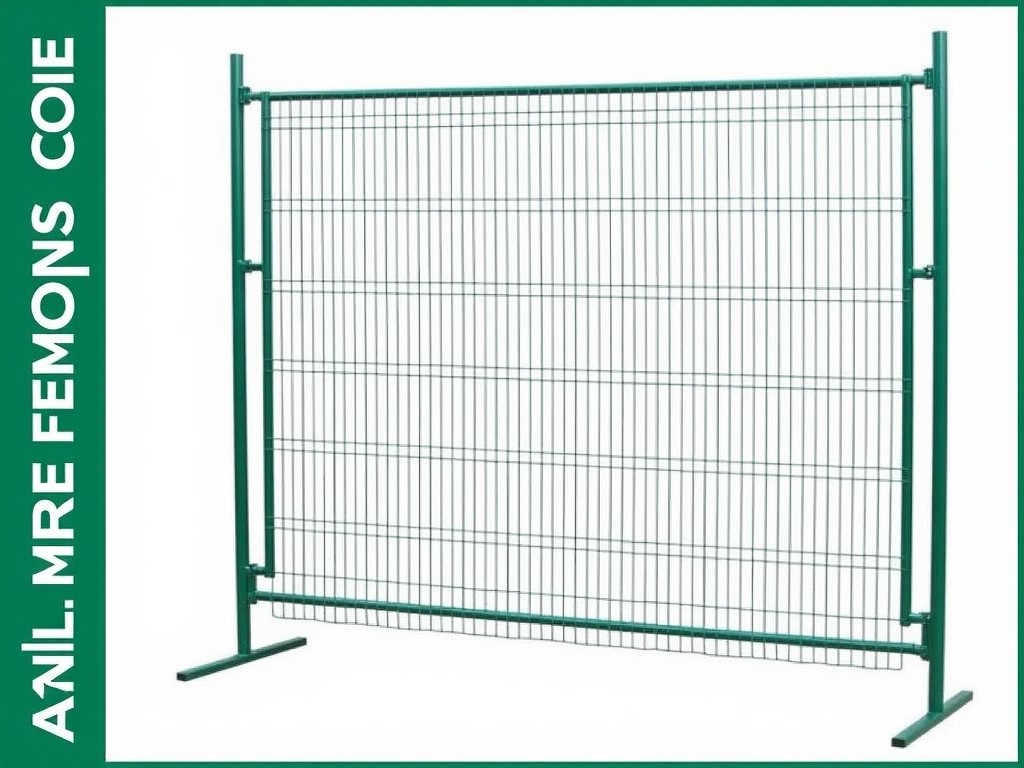
6x12 Anti-Climb Temporary Fence Panels
Temporary fencing systems are specified for sites requiring rapid deployment, reconfiguration, and removal without permanent ground disturbance. The 6x12 anti-climb panel addresses security and safety requirements where unauthorized access must be deterred while maintaining visibility and airflow.
Structural Design and Anti-Climb Geometry
The panel measures 6 feet in height and 12 feet in width, forming a single rigid unit. Vertical pickets are spaced at 2-inch intervals, preventing hand and foothold formation. Horizontal rails are positioned at 24-inch intervals from the base, with the top rail featuring a 45-degree outward overhang to further inhibit climbing attempts.
All members are constructed from 14-gauge galvanized steel tubing. Verticals use 1.5-inch square tubing; horizontals employ 1.25-inch round tubing. Connections are made via punched and dimpled joints, eliminating weld points that could corrode or fail under cyclic loading. The design allows for panel-to-panel coupling using forged steel clamps that engage the vertical members without drilling or welding in the field.
Material Specifications and Corrosion Protection
The base material is ASTM A500 Grade B steel, hot-dip galvanized per ASTM A123 with a minimum zinc coating of 1.8 oz/ft². This provides a typical service life of 5–7 years in moderate industrial environments before maintenance inspection is recommended. For coastal or high-humidity applications, a powder-coated overlay in gray or black is available, adding a polymer barrier that extends coating life to 10+ years under UV exposure.
Alternative materials include stainless steel (Type 304) for chemical exposure zones and aluminum alloy 6061-T6 for weight-sensitive installations. These options are quoted per project due to material cost variability and require confirmation of load requirements, as aluminum reduces panel weight by 40% but lowers impact resistance compared to steel.
Load Performance and Wind Resistance
Each panel is engineered to withstand a uniform lateral load of 20 psf (pounds per square foot) without permanent deformation. This equates to a total force of 1,440 pounds acting across the 72 sq ft panel surface. Testing follows ANSI/ASSE Z359.1 principles for temporary guardrail systems, adapted for fence loading.
Wind load calculations assume a basic wind speed of 90 mph (Exposure C) per ASCE 7-16. At this velocity, the panel experiences approximately 15 psf, leaving a 25% safety margin. For sites in hurricane-prone regions, optional wind bracing kits are available, consisting of diagonal steel struts that attach to the panel’s interior face and anchor to the base system, increasing lateral capacity to 35 psf.
Base System Compatibility and Installation
Panels are designed to couple with three primary base systems: concrete-weighted stands, driven steel spikes, and bolt-down plates for asphalt or concrete surfaces. The weighted stands use 50-lb recycled rubber bases, stacked two high per post, providing 100 lb of resisting weight per post. Spike bases are 24-inch long, 1-inch diameter steel pins with a welded foot plate, suitable for soil with CBR > 3%. Bolt-down plates are 6x6 inch, 3/8-inch thick steel with four 3/4-inch anchor holes.
Installation requires two workers and takes approximately 8 minutes per panel when using weighted bases. No power tools are needed; coupling is achieved via overhead cam levers that apply 500 lb of clamping force. Panel alignment is maintained through tapered lugs on the verticals, ensuring vertical and horizontal registration within 1/8 inch tolerance.
Applications in Temporary Security and Safety Zones
These panels are commonly deployed at construction site perimeters where OSHA 1926.502 requires protection against fall hazards and unauthorized entry. The anti-climb feature satisfies ANSI A10.34 guidelines for deterring trespass in high-risk zones such as excavation sites or material storage yards. Their modularity allows rapid reconfiguration as site phases change, reducing downtime compared to fixed barriers.
In event management, the panels delineate VIP areas, backstage zones, and equipment storage. The 2-inch picket spacing prevents concealment of prohibited items while allowing clear sightlines for security personnel. For utility work, they secure substation entrances during maintenance, complying with NESC Rule 124 for temporary barriers around energized equipment.
Disaster relief operations use these panels to establish safe perimeters around collapsed structures or hazardous material zones. The lightweight design enables transport via standard pallet jack or forklift, and the system can be erected on uneven terrain due to the adjustable base couplers that accommodate up to 5 degrees of slope.
Quality Control and Testing Protocols
Each panel undergoes dimensional inspection at four stages: raw material receipt, post-forming, pre-galvanizing, and final assembly. Critical dimensions include vertical spacing (±1/16 inch), rail height (±1/8 inch), and overall squareness (±1/4 inch diagonal difference). Galvanizing thickness is verified via magnetic pull-off gauge on five random points per panel, with readings recorded and traceable to batch number.
Load testing is performed on a sampling basis: one panel per 500 units is subjected to 150% of rated lateral load (30 psf) for 10 minutes, with deflection measured at the mid-span. Acceptance criteria limit permanent set to 1/2 inch. Weld-free joints are inspected via dye penetrant on 10% of connections monthly to detect micro-cracks from forming stress.
Coating adhesion is tested per ASTM D3359 Method B, with a minimum rating of 4B required. For powder-coated variants, UV stability is assessed using accelerated weathering (ASTM G154) for 1,000 hours, with color change limited to ΔE < 5 units. All test reports are available upon request and referenced to the panel’s unique serial number etched on the bottom rail.
Customization Options and Project-Specific Adaptations
Standard panels are offered in 6x12 ft dimensions, but height can be adjusted from 4 to 8 ft in 2-inch increments, and width from 8 to 16 ft in 4-inch increments, subject to engineering review for buckling resistance. Picket spacing can be reduced to 1.5 inches for high-security zones or increased to 3 inches for improved airflow and reduced material cost.
Top rail configurations include vertical extensions (for barbed tape attachment), inward curves (to prevent clothing snag), or integration with mesh screening for dust control. Base systems can be modified for specific substrates: thermoplastic rubber bases for temperature extremes (-20°F to 120°F), or stainless steel spikes for marine environments.
Color options extend beyond standard gray and black to include OSHA safety orange, yellow, and white for high-visibility requirements. Retroreflective tape strips (Engineer Grade or High Intensity) can be applied to verticals and rails for nighttime visibility under vehicle headlights. All customizations are priced per linear foot and require a signed approval drawing before production.
Packaging, Shipping, and Handling
Panels are stacked in bundles of 10, with protective corner guards and stretch film wrapping. Each bundle measures 6x12x10 inches (LxWxH) and weighs approximately 850 lbs. Forklift pockets are formed into the base rails, allowing safe handling from all four sides. For international shipments, bundles are placed on ISPM-15 compliant pallets and secured with poly strapping.
Volume discounts apply at quantities of 50+ panels, with flat-rate shipping available within the continental US for orders over 200 units. Lead time is typically 10–15 business days for standard configurations; custom orders add 5–7 days for drawing approval and material sourcing. Expedited production is available upon request, subject to factory capacity.
Upon receipt, inspect for bundle integrity, coating damage, and bundle count. Store panels vertically on level ground to prevent warping. Avoid direct ground contact in wet conditions; use dunnage or pallets. Assembly instructions and base system compatibility charts are included in each shipment and available for download via the product serial number portal.
More Products

Send Inquiry
If you are interested in our products, leave your information here and we will be in touch shortly.