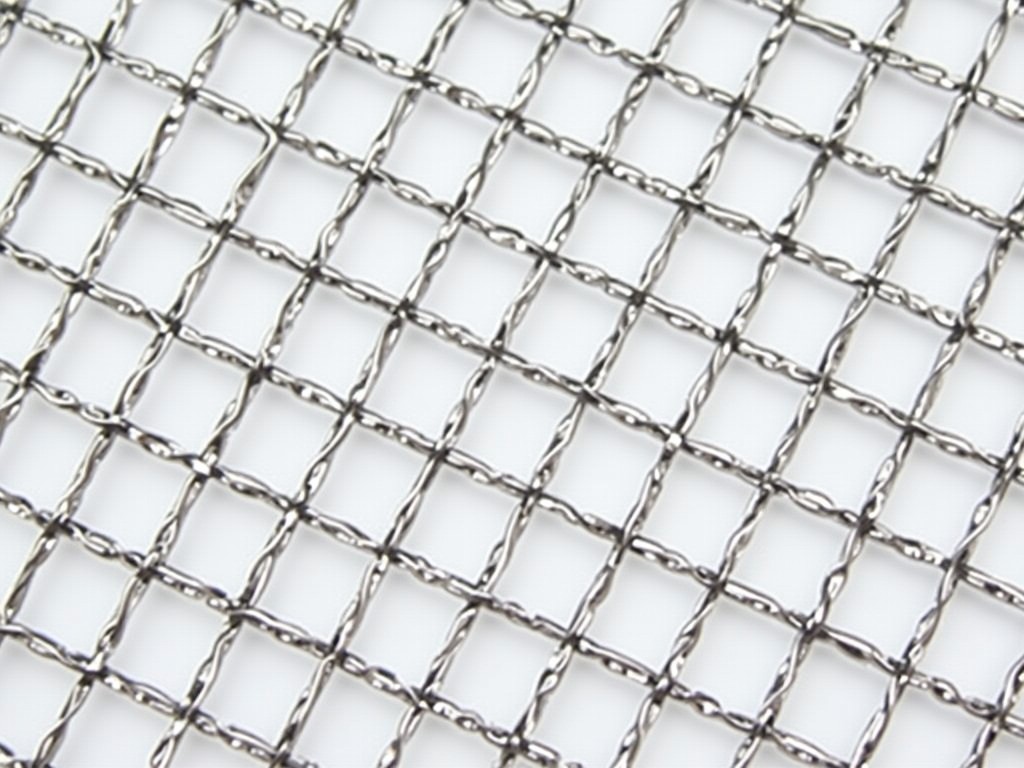
304 Stainless Steel Woven Wire Mesh 120 Mesh
304 stainless steel woven wire mesh with a 120 mesh count is a precision filtration and screening material engineered for applications requiring fine particle retention, consistent aperture geometry,
304 Stainless Steel Woven Wire Mesh 120 Mesh
304 stainless steel woven wire mesh with a 120 mesh count is a precision filtration and screening material engineered for applications requiring fine particle retention, consistent aperture geometry, and corrosion resistance in mildly aggressive environments. This specification denotes 120 openings per linear inch in both warp and weft directions, resulting in a nominal opening size of approximately 125 microns when constructed with standard wire diameters. The mesh is produced using a plain weave pattern where each warp wire alternates passing over and under each weft wire, creating a uniform, stable structure with minimal deformation under tension.
The base material, AISI 304 stainless steel, contains 18% chromium and 8% nickel, providing inherent resistance to oxidation, atmospheric corrosion, and many organic and inorganic chemicals encountered in food processing, pharmaceutical, and light industrial settings. Unlike coated or plated alternatives, the homogeneous alloy composition ensures consistent performance throughout the material thickness, eliminating risks of delamination or localized corrosion at stress points. The wire drawing and weaving processes are controlled to maintain tensile strength typically between 800–1000 MPa, depending on temper, ensuring dimensional stability under cyclic loading or pressure differentials.
This mesh specification is commonly selected when filtration efficiency must balance with flow rate and mechanical durability. The 120 mesh density provides sufficient open area—typically 30–35% depending on wire diameter—to allow adequate fluid or gas passage while capturing particulates in the 100–150 micron range. Engineers specify this grade for applications such as ink filtration in printing, catalyst screening in chemical reactors, particulate separation in laboratory analysis, and screen printing where precise ink deposition is critical. The smooth surface finish, achieved through controlled annealing and post-weaving cleaning, minimizes particle adhesion and facilitates cleaning-in-place (CIP) procedures.
Technical Specifications
| Parameter | Typical Value / Range | Notes |
|---|---|---|
| Mesh Count | 120 wires per inch (warp and weft) | ISO 9044 compliant |
| Nominal Opening Size | 125 µm (varies with wire diameter) | Calculated: 1/120" – wire diameter |
| Wire Diameter Range | 30–50 µm | Selected based on pressure drop and strength requirements |
| Open Area Percentage | 30–35% | Depends on exact wire diameter; impacts flow rate |
| Material Grade | AISI 304 Stainless Steel (UNS S30400) | 18% Cr, 8% Ni; ASTM A240 / A240M |
| Tensile Strength (Wire) | 800–1000 MPa | Dependent on temper (annealed to 1/4 hard) |
| Standard Widths | 500 mm, 1000 mm, 1220 mm | Custom widths available upon request |
| Typical Temper | Annealed or 1/4 hard | Annealed for forming; 1/4 hard for taut screening |
Material Properties and Performance
The corrosion resistance of 304 stainless steel in this mesh format stems from a passive chromium oxide layer that self-repairs in oxidizing environments. This makes it suitable for intermittent exposure to water, steam, dilute acids, and alkaline solutions commonly found in cleaning-in-place (CIP) systems. However, it is not recommended for prolonged contact with chlorides above 100 ppm at elevated temperatures, where pitting or stress corrosion cracking may initiate. For such conditions, 316L stainless steel mesh would be a more appropriate selection due to its molybdenum content.
Mechanical performance is governed by the wire diameter and temper selection. A 40 µm wire diameter in annealed condition offers high flexibility and conformability, useful for applications requiring the mesh to be formed over curved surfaces. Increasing the wire diameter to 50 µm or selecting a 1/4 hard temper significantly increases tensile strength and resistance to deformation under sustained differential pressure—critical in cartridge filters or vibratory screens where cyclic loading occurs. The plain weave structure provides isotropic strength in both machine and transverse directions, minimizing anisotropy-related warping.
Thermal stability is another key attribute; 304 stainless steel retains structural integrity up to 870°C in intermittent service and 925°C in continuous service, though oxidation scaling becomes noticeable above 500°C. For most ambient and process temperatures below 300°C, mechanical properties remain largely unchanged. The mesh exhibits non-magnetic properties in the annealed state, which may be beneficial in electronic packaging or magnetic separation preprocessing steps where ferrous contamination must be avoided.
Common Industrial Applications
In the pharmaceutical industry, 120 mesh 304 stainless steel is frequently used in bulk powder sieving to remove agglomerates and foreign particulates from active pharmaceutical ingredients (APIs) and excipients. The fine aperture ensures compliance with particle size distribution specifications while the smooth, crevice-free surface minimizes product adhesion and facilitates validation of cleaning procedures under cGMP guidelines. Unlike polymeric screens, it does not shed particles or degrade under gamma or ethylene oxide sterilization cycles.
Printing and packaging operations specify this mesh for screen printing stencils where fine detail reproduction is required. The consistent aperture geometry allows precise ink transfer for halftone dots and fine line work in graphics, electronics (e.g., circuit board printing), and ceramic decal applications. The dimensional stability under squeegee pressure prevents stencil distortion, ensuring repeatable print quality over long production runs. Post-use, the mesh can be reclaimed and reused multiple times after proper solvent cleaning.
Laboratory filtration assemblies often incorporate 120 mesh 304 stainless steel as a support layer for filter media or as a standalone screen for particle analysis. Its inert nature ensures no leachables contaminate samples during aqueous or solvent-based filtration. In catalyst testing rigs, it serves as a distributor or retainer bed, maintaining even flow distribution while withstanding exposure to reactive gases and temperatures up to 500°C. The mesh is also used in food processing for sieving powders like flour, sugar, and spices, where metal detection compatibility and cleanability are essential.
Customization Options
While 120 mesh count is fixed, the wire diameter can be tailored between 30 µm and 50 µm to adjust open area, pressure drop, and mechanical strength according to specific process demands. Thinner wires increase open area and reduce flow resistance but decrease burst strength; thicker wires enhance durability at the cost of reduced throughput. This trade-off is evaluated during application engineering to optimize for either filtration efficiency or mechanical longevity.
Width and length are customizable to suit equipment integration. Standard roll widths range from 500 mm to 1220 mm, but slit widths down to 50 mm or custom diameters for circular discs can be produced. Lengths are typically supplied in rolls of 10–50 linear meters, though cut-to-length pieces or pre-formed shapes (e.g., gaskets, conical filters) are available upon request. Edge treatments such as hemming, fringing, or welding to frames can be specified to prevent fraying and simplify installation.
Surface finishes can be modified beyond the standard mill finish. Electropolishing reduces surface roughness and enhances corrosion resistance in critical hygienic applications. Passivation treatments (e.g., nitric acid dip) are available to ensure optimal passive layer formation after manufacturing. For applications requiring non-stick properties, PTFE or silicone coatings can be applied, though these alter the effective aperture and require validation for compatibility with process temperatures and chemicals.
Quality Assurance and Testing
Quality control begins with raw material verification, where each coil of 304 stainless steel wire is accompanied by mill test reports confirming chemical composition and mechanical properties. Incoming wire is sampled for diameter tolerance (±2 µm) and tensile strength before weaving. During production, mesh count is verified using optical comparators or digital imaging systems at multiple points across the width to ensure consistency. Aperture size is indirectly validated through mesh count and wire diameter measurements, with statistical process control applied to maintain tight tolerances.
Visual inspection is conducted under standardized lighting to detect weaving defects such as missing wires, double picks, or irregular tension. For critical applications, bubble point testing or air permeability testing may be performed to confirm pore structure integrity and uniformity. These tests are particularly relevant when the mesh is used as a precision filter medium where predictable particle retention is required. All test methods follow ASTM E11 or ISO 3310-1 standards for test sieves, adapted for woven wire mesh specifications.
Final inspection includes dimensional verification of roll width and length, surface cleanliness assessment, and packaging integrity check. Rolls are wound onto corrosion-resistant cores with interleaving paper or film to prevent surface damage during transit. Each shipment includes a certificate of conformance detailing the specified parameters, test results, and material traceability. Customers may request additional documentation such as material safety data sheets (MSDS), REACH compliance statements, or FDA contact suitability letters for food-grade applications.
Comparison with Alternative Mesh Specifications
| Specification | 120 Mesh 304 SS | 100 Mesh 304 SS | 150 Mesh 304 SS |
|---|---|---|---|
| Mesh Count (wires/inch) | 120 | 100 | 150 |
| Nominal Opening Size | ~125 µm | ~150 µm | ~100 µm |
| Typical Open Area (%) | 30–35% | 36–40% | 25–30% |
| Flow Resistance | Moderate | Lower | Higher |
| Particle Retention | 100–150 µm | 120–180 µm | 80–120 µm |
| Best Suited For | Fine filtration, screen printing, lab analysis | General screening, coarse filtration | Ultrafine filtration, catalyst support |

Product Categories


Send Inquiry
If you are interested in our products, leave your information here and we will be in touch shortly.