Concertina Wire Making Machine Manufacturer
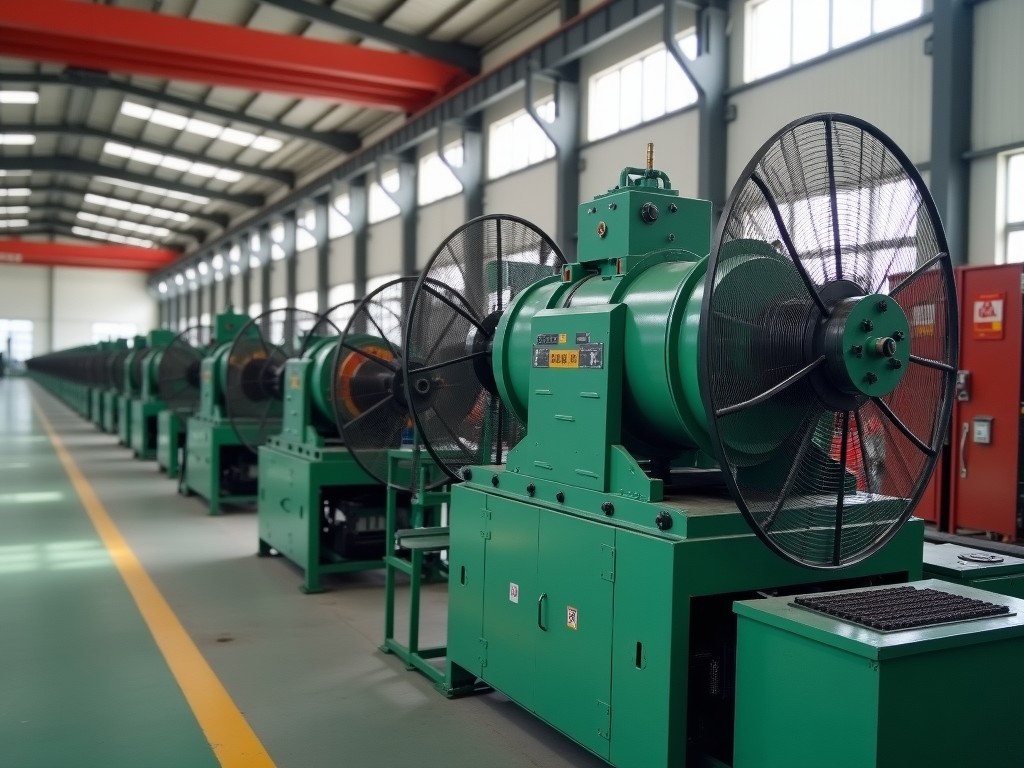
Concertina wire making machines are specialized industrial systems designed to produce helical-barbed security fencing by forming galvanized or stainless steel wire into concertina coils. These
Concertina Wire Making Machine Manufacturer
Concertina wire making machines are specialized industrial systems designed to produce helical-barbed security fencing by forming galvanized or stainless steel wire into concertina coils. These machines automate the precise twisting, barbing, and coiling processes required to meet international security barrier standards such as ISO 1461 and ASTM A123. Manufacturers of this equipment focus on dimensional accuracy, repeatability, and material compatibility to ensure the final product performs reliably in perimeter defense applications.
The production process involves feeding high-tensile steel wire through a series of forming rollers, barb attachment mechanisms, and coiling mandrels under controlled tension. Machine design must account for wire diameter variations (typically 2.0mm to 3.5mm), barb spacing consistency (75mm to 150mm), and coil diameter stability (450mm to 750mm) to maintain structural integrity and deployment effectiveness. Technical buyers evaluate these machines based on throughput capability, changeover flexibility, and long-term wear resistance of forming components.
Core Technical Specifications
Key performance parameters define the operational envelope of concertina wire making machines. Wire feed speed typically ranges from 15 to 40 meters per minute, directly influencing daily output capacity. Barb formation systems utilize either rotary dies or punch-and-die mechanisms, with tolerances held to ±0.5mm for barb length and ±2mm for spiral pitch to ensure uniform coil expansion characteristics.
Drive systems commonly employ AC servo motors paired with planetary gearboxes to maintain consistent torque during coiling, preventing wire slippage or over-tensioning. Mandrel assemblies are hardened to HRC 58-62 to resist abrasion from continuous wire contact, while forming rollers use chromium-plated surfaces to reduce friction and extend service life. Electrical controls integrate PLC-based logic with touchscreen interfaces for recipe storage, enabling quick transitions between different wire gauges and coil diameters.
Safety interlocks guard all moving points, and emergency stop circuits comply with ISO 13850 standards. Machines are designed for continuous operation in industrial environments, with dust-resistant enclosures rated IP54 for main control cabinets. Lubrication systems are centralized for critical bearings and gearboxes, reducing maintenance frequency to quarterly intervals under normal use.
Material Compatibility and Processing
The machine’s ability to process different wire types directly affects product versatility. Standard configurations handle hot-dip galvanized steel wire conforming to ASTM A641 Class 3, with zinc coating weights between 275g/m² and 600g/m². For corrosive environments, machines can be adapted to process 304 or 316L stainless steel wire, requiring adjustments in forming roller pressure and barb attachment force due to higher tensile strength and work-hardening characteristics.
Wire straightness tolerance entering the machine must not exceed 5mm over 1 meter to prevent coil deformation. Pre-straightening units are often integrated to correct coil set from wire payoffs. Barb wire is typically produced separately and fed laterally via guided chutes; attachment methods include mechanical crimping or welding, with crimp force monitored via load cells to ensure joint strength exceeds 90% of the parent wire’s tensile capacity.
Lubrication during processing uses water-soluble compounds applied via mist nozzles to reduce galling without contaminating the wire surface. Post-production, coils may undergo optional passivation or polymer coating, though these steps occur downstream. Machine design avoids crevices where debris can accumulate, facilitating cleaning between material changes to prevent cross-contamination.
Customization Options
Manufacturers offer configurable modules to align machine output with specific security barrier requirements. Coil diameter is adjusted by swapping mandrel assemblies, with common sizes including 450mm, 600mm, and 750mm outer diameters. Barb spacing is modified through programmable cam profiles or servo-driven positioning, allowing patterns such as 75mm, 100mm, or 150mm intervals to match regional threat assessments or client specifications.
Barb geometry can be customized—standard configurations use 4-point barbs, but 2-point or reversed-angle variants are available upon request. Wire tension control systems include dancer arms or load-feedback loops to maintain consistent coiling pressure across varying wire hardness levels. For high-volume operations, dual-wire feeding stations enable alternating between primary and secondary spools without line stoppage.
Optional integrations include inline weight meters for real-time coil mass verification, UV-resistant coating applicators for post-forming treatment, and automated stacking arms that orient finished coils for palletizing. Control software can be configured to log production data per ISO 9001 traceability requirements, including operator ID, batch number, and process parameters for each coil produced.
Quality Control and Testing
Quality assurance begins with incoming wire inspection, where diameter, tensile strength, and coating adhesion are verified using calibrated micrometers, universal testers, and kiss-off tests. During operation, inline sensors monitor wire feed speed, tension fluctuations, and barb placement accuracy, triggering alerts if deviations exceed preset thresholds. Finished coils undergo dimensional checks using go/no-go gauges for inner diameter, outer diameter, and helical pitch.
Barb retention is validated through pull-off testing per ISO 1461 Annex B, requiring a minimum force of 150N to dislodge a barb without damaging the wire. Coil stability is assessed by measuring rebound diameter after compression to 50% of original height—acceptable recovery is typically ≥85% for security-grade concertina wire. Visual inspection stations check for defects such as uneven barbs, kinks, or incomplete twists under 10x magnification.
Manufacturers maintain calibration logs for all measuring equipment traceable to national standards. Machines are factory-tested with customer-specified wire before shipment, producing sample coils for approval. Documentation includes material certificates, process parameter reports, and conformity declarations aligned with CE marking requirements where applicable. Statistical process control (SPC) charts are used to monitor key variables over production runs.
Applications in Security Infrastructure
Concertina wire produced by these machines serves as a critical delay element in layered perimeter security systems. Its helical structure creates significant entanglement resistance when deployed atop fences or walls, increasing the time and tools required for breach attempts. Unlike static barbed tape, concertina coils dynamically expand under tension, maintaining consistent coverage even when subjected to partial cutting or environmental loading.
Military installations use concertina wire to establish temporary or semi-permanent barriers around forward operating bases, where rapid deployment and reconfigurability are essential. Correctional facilities integrate it into interior perimeter layers to deter climbing attempts, leveraging its psychological deterrent effect combined with physical impedance. Border security agencies deploy it in rugged terrains where traditional fencing is impractical, relying on its conformability to uneven ground.
Industrial sites such as power substations, water treatment plants, and telecommunications hubs specify concertina wire for Zone 2 protection under ISA/IEC 62443 standards, where it complements surveillance and sensor systems. The machine’s ability to produce consistent coils ensures predictable performance across large-scale deployments, reducing variability in barrier effectiveness that could compromise integrated security designs.
Manufacturing and Build Quality
Machine frames are constructed from welded steel profiles stress-relieved after fabrication to minimize distortion during machining. Critical surfaces are precision-ground to ensure parallelism and flatness within 0.02mm over 300mm spans. Bearing housings are line-bored in single setups to maintain coaxiality, reducing vibration and extending component life. All structural welds undergo magnetic particle inspection to detect subsurface discontinuities.
Guides and slides use hardened steel ways with Turcite-B or equivalent polymer liners for low-friction, stick-slip-free motion. Electrical cabinets are fabricated from 2mm powder-coated steel with gasketed doors, featuring internal thermal management via filtered fans or heat exchangers. Wiring follows IEC 60204-1 standards, with numbered conductors, segregated power and signal conduits, and surge protection on all incoming lines.
Assembly follows a cellular approach where sub-assemblies (feeding, forming, coiling, control) are built and tested independently before integration. Final alignment uses laser trackers to verify axis perpendicularity and parallelism within 0.05mm. Paint systems consist of zinc-rich primer, intermediate epoxy, and polyurethane topcoat, providing corrosion resistance equivalent to C3-Medium environments per ISO 12944.
Comparison Table: Machine Configurations
| Parameter | Standard Configuration | High-Speed Configuration | Heavy-Duty Configuration |
|---|---|---|---|
| Wire Diameter Range | 2.0mm – 3.0mm | 2.0mm – 3.5mm | 2.5mm – 4.0mm |
| Max Feed Speed | 25 m/min | 40 m/min | 20 m/min |
| Coil Diameter Options | 450mm, 600mm | 450mm, 600mm, 750mm | 600mm, 750mm, 900mm |
| Barb Spacing | 75mm – 150mm | 75mm – 150mm | 100mm – 200mm |
| Drive Motor Type | AC Servo | AC Servo (High Inertia) | AC Servo with Gearbox |
| Mandrel Material | 4140 Steel, HRC 58 | 4140 Steel, HRC 60 | 4340 Steel, HRC 62 |
| Typical Output (8-hr shift) | 120 kg | 200 kg | 150 kg (heavier wire) |
Note: Values represent typical ranges; actual performance depends on wire material, operator skill, and maintenance condition. Custom configurations available upon request.
Ordering and Support Information
Prospective buyers should provide wire specifications (diameter, material, tensile strength, coating type), desired coil dimensions, barb spacing requirements, and expected daily output to receive an accurate quotation. Factory acceptance tests (FAT) are conducted per customer-defined protocols, witnessing options available via video conferencing or on-site visits. Machines are shipped disassembled into modular components with detailed reassembly manuals and alignment tools included.
Installation supervision and operator training are offered as separate line items, covering mechanical setup, electrical connection, safety system validation, and production parameter optimization. Spare parts lists emphasize wear items such as forming rollers, barb cutters, mandrel bearings, and drive belts, with recommended stocking levels based on single-shift operation. Technical documentation includes electrical schematics, pneumatic diagrams (if applicable), and PLC ladder logic backups.
Warranty coverage typically spans 12 months from installation or 18 months from shipment, whichever occurs first, excluding wear components and consumables. Remote diagnostics are available through secure VPN connections for troubleshooting guidance. Aftermarket support includes field service engineers, retrofit kits for upgrading control systems, and refurbishment programs for extending machine life beyond initial depreciation cycles.

Product Categories


Send Inquiry
If you are interested in our products, leave your information here and we will be in touch shortly.