China Temporary Fencing With Stakes
Temporary fencing systems with ground stakes are engineered for rapid deployment and secure anchoring in non-permanent site applications. These systems combine modular panel construction with
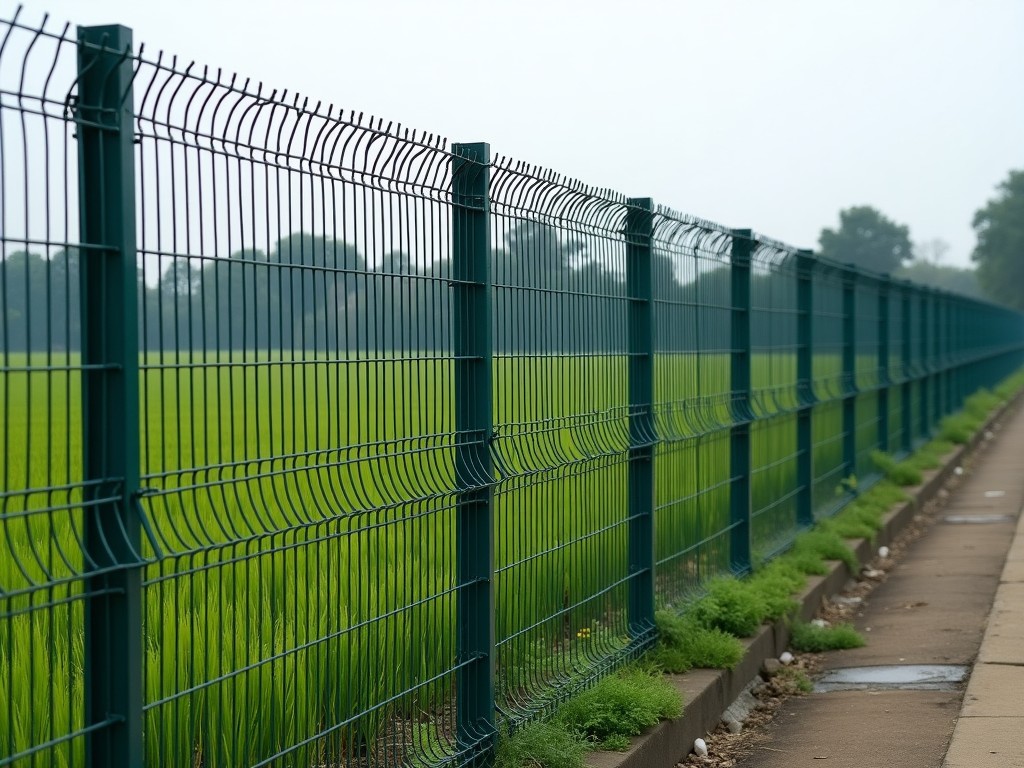
China Temporary Fencing with Stakes
Temporary fencing systems with ground stakes are engineered for rapid deployment and secure anchoring in non-permanent site applications. These systems combine modular panel construction with integrated or detachable steel stakes to provide lateral stability without requiring concrete foundations or permanent ground penetration. The design prioritizes reusability, transport efficiency, and adaptability to varying soil conditions while maintaining structural integrity under typical site loads such as wind, pedestrian pressure, and light equipment impact.
Structural Configuration and Material Selection
Panels are typically fabricated from galvanized steel tubing with outer diameters ranging from 32mm to 48mm and wall thicknesses between 1.2mm and 2.0mm, selected based on required load capacity and service life. Vertical members are spaced at 100mm to 150mm intervals to prevent climb-through while maintaining visibility. Horizontal rails use round or square tubing, welded or clamped at panel corners to form rigid rectangular frames. Ground stakes are manufactured from cold-drawn steel bar with diameters of 16mm to 20mm and lengths of 600mm to 900mm, featuring a pointed tip for soil penetration and a deformed or ribbed shaft to increase pull-out resistance. All steel components undergo hot-dip galvanization per ISO 1461 standards, providing a minimum zinc coating of 55μm to ensure corrosion resistance in outdoor environments for multiple reuse cycles.
Stake Integration and Ground Anchoring Mechanics
Stakes connect to the panel frame via two primary methods: welded lugs at the base of vertical members or removable U-bolt clamps that allow positional adjustment. Welded lugs offer faster installation and higher shear resistance but limit adaptability to uneven terrain. Removable clamps enable stake placement optimization based on soil density and panel alignment requirements, reducing the risk of bending or pull-out in soft ground. The stake-to-panel connection is designed to transfer lateral loads primarily through bending resistance in the stake rather than relying on soil passive pressure alone, with typical pull-out capacities ranging from 1.5kN to 3.0kN in compacted gravel and 0.8kN to 1.8kN in loose sand, depending on embedment depth and stake geometry.
Panel Dimensions and Modularity
Standard panel heights range from 1.0m to 2.4m to accommodate varying security and visibility needs, with 1.2m and 1.8m being most common for general site perimeter control. Widths are standardized at 2.0m, 2.5m, or 3.0m to optimize handling, transportation, and alignment on-site. Panels feature interlocking couplers at vertical edges — typically pin-and-loop or clamp-and-bolt systems — allowing rapid connection without tools while maintaining structural continuity. The modular nature enables straight runs, 90-degree corners, and curved configurations through variable coupling angles, accommodating irregular site boundaries without custom fabrication.
Surface Treatment and Environmental Durability
Hot-dip galvanization provides uniform zinc coverage on all surfaces, including internal tube sections and weld points, offering sacrificial protection that exceeds electrogalvanizing in longevity. The coating resists white rust formation during storage and red rust development in service, with typical service life exceeding 5 years under continuous outdoor exposure in temperate climates. In high-humidity or coastal environments, additional protection such as powder coating over galvanized substrate may be specified, though this increases cost and requires careful damage inspection during reuse cycles. All finished panels undergo visual inspection for coating continuity, with pinholes or thin spots exceeding ISO 1461 limits requiring repair or rejection.
Load Resistance and Stability Performance
Lateral stability is achieved through the combined action of ground embedment, panel flexural rigidity, and inter-panel coupling strength. A single panel with two stakes embedded 500mm into compacted soil can resist a 1.0kN lateral load at mid-height with less than 50mm deflection. System stiffness increases with panel count due to load distribution across multiple anchoring points. Wind load calculations follow ASCE 7-16 principles, treating the fence as a porous barrier with a drag coefficient of 1.2 to 1.5 depending on infill density. For sites requiring resistance to 110km/h wind gusts, panel spacing is reduced to 2.0m widths and stake embedment increased to 700mm in cohesive soils, with intermediate bracing recommended for runs exceeding 10 panels.
Applications in Temporary Site Management
These systems are selected when permanent fencing is impractical due to short project duration, leased land restrictions, or the need for frequent reconfiguration. In construction, they delineate work zones, prevent unauthorized access to hazardous areas, and manage pedestrian flow around active sites without requiring ground excavation. Event organizers use them for crowd control, VIP area separation, and backstage perimeter security, benefiting from quick setup and teardown cycles. Municipal projects deploy them during roadworks or utility repairs to protect workers and guide traffic, where their visibility and modularity allow rapid adaptation to changing lane configurations. Agricultural applications include livestock containment during seasonal grazing and protection of newly planted areas from wildlife, where the non-permanent nature avoids long-term soil disruption.
Customization Options for Project-Specific Requirements
Panel height, width, and infill pattern can be adjusted to meet site-specific security, visibility, or aesthetic needs. Mesh infill options include welded wire (50mmx50mm to 100mmx100mm), expanded metal, or perforated steel sheets, selected based on climb resistance, wind loading, or debris containment requirements. Stake length and diameter are customized according to soil bearing capacity reports, with longer stakes used in sandy or reclaimed lands and shorter, thicker variants for rocky substrates. Surface finishes can include powder coating in standard colors (white, blue, green, black) for visual identification or branding, though this requires damage assessment protocols during reuse. Packaging is optimized for containerized shipping, with panels stacked vertically and stakes bundled separately to minimize damage during transit.
Quality Control and Manufacturing Considerations
Manufacturing begins with tube cutting to precise lengths using cold saws to minimize burr formation. Vertical and horizontal members are assembled on jigs to ensure dimensional accuracy before welding or clamping. Welds are inspected visually and via dye penetrant testing for cracks or incomplete fusion, particularly at stake lug connections. Galvanizing bath temperature, immersion time, and withdrawal speed are monitored to achieve consistent coating thickness. Final inspection includes dimensional verification, coating adhesion testing (ISO 2409), and load simulation on sample units. Packaging uses corner protectors and stretch film to prevent abrasion, with each bundle labeled with batch number, specifications, and QC pass status for traceability.
| Parameter | Typical Range | Notes |
|---|---|---|
| Panel Height | 1.0m – 2.4m | Custom heights available |
| Panel Width | 2.0m – 3.0m | Standardized for handling |
| Tube Diameter | 32mm – 48mm | Vertical and horizontal members |
| Tube Wall Thickness | 1.2mm – 2.0mm | Based on load requirements |
| Stake Diameter | 16mm – 20mm | Cold-drawn steel bar |
| Stake Length | 600mm – 900mm | Embedment depth dependent |
| Zinc Coating | ≥55μm | Hot-dip galvanized per ISO 1461 |
| Pull-Out Capacity (Compacted Gravel) | 1.5kN – 3.0kN | At 500mm embedment |
| Wind Load Resistance | Up to 110km/h gusts | With reduced panel spacing |
Selecting the appropriate temporary fencing with stakes requires matching system characteristics to site-specific constraints including duration, soil conditions, load expectations, and reusability needs. Engineers should evaluate stake embedment depth based on geotechnical reports, verify coating longevity for the expected number of reuse cycles, and confirm coupling compatibility with existing inventory if expanding a system. Proper installation — ensuring vertical alignment, adequate stake depth, and secure panel coupling — directly impacts performance and safety. For projects requiring repeated deployment, maintaining detailed logs of panel condition, coating damage, and stake straightness after each use extends service life and reduces long-term costs.
Product Categories


Send Inquiry
If you are interested in our products, leave your information here and we will be in touch shortly.