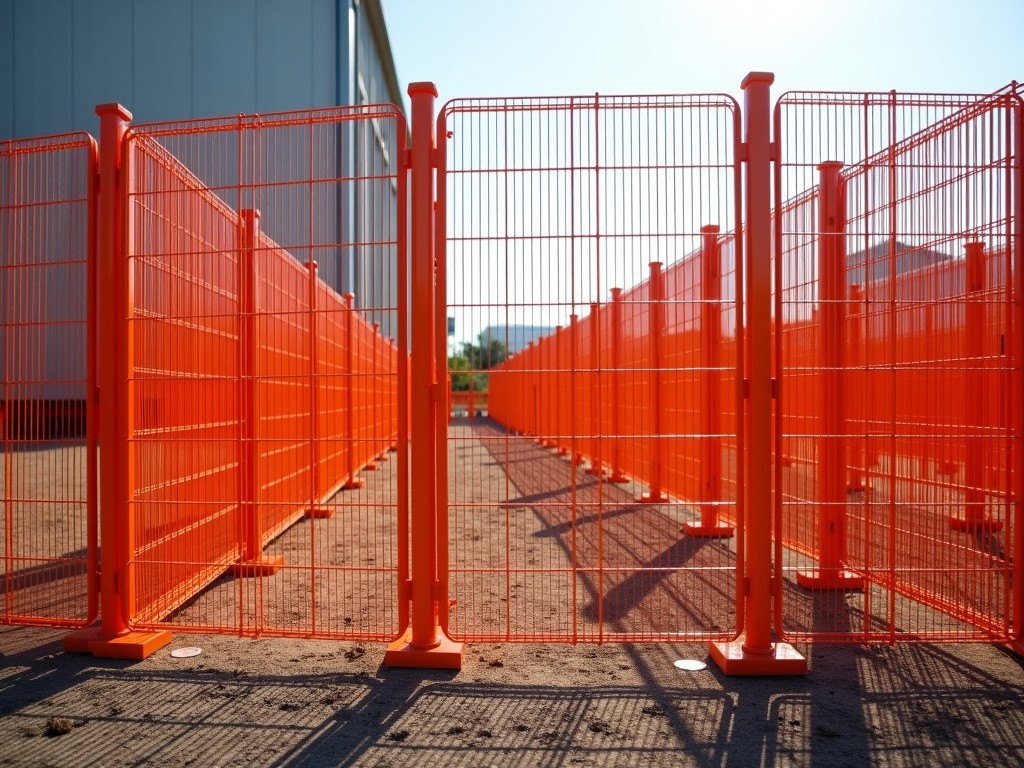
Orange Temporary Construction Fence
Temporary construction fencing serves as a critical safety and site control barrier on active worksites. The orange color provides high visibility under varying light conditions, meeting OSHA and
Orange Temporary Construction Fence
Temporary construction fencing serves as a critical safety and site control barrier on active worksites. The orange color provides high visibility under varying light conditions, meeting OSHA and local jurisdictional requirements for hazard delineation. This product is engineered for rapid deployment, repeated use, and reliable performance in demanding environments.
Material Composition and Structural Design
The fence panels are constructed from high-density polyethylene (HDPE) with a minimum density of 0.94 g/cm³, selected for its resistance to UV degradation, moisture absorption, and chemical exposure common on construction sites. The material maintains flexibility down to -20°C and retains impact resistance up to 60°C, ensuring functionality across seasonal temperature ranges. Each panel features a rectangular mesh pattern with 50 mm x 100 mm openings, providing visibility while preventing easy hand or foothold access.
Vertical ribs are integrated into the panel design at 150 mm intervals to increase bending stiffness without adding significant weight. The ribs run the full height of the panel and are molded as a single unit with the mesh, eliminating weak points at joints. Standard panel height is 1.2 meters, with a width of 2.4 meters per section, yielding a total area of 2.88 square meters per unit. The weight averages 8.5 kg per panel, allowing manual handling by two workers while resisting wind loads up to 110 km/h when properly secured.
Connection System and Installation Method
Panels connect via a dual-point interlocking system located at the top and bottom edges. Each connection uses a reinforced nylon pin with a 12 mm diameter, inserted through aligned holes in adjacent panels. The pin design includes a spring-loaded latch that prevents accidental disengagement under vibration or lateral load. Installation requires no tools; workers align panels and insert pins by hand, achieving a secure joint in under 15 seconds per connection.
For ground stabilization, the fence uses a proprietary base system consisting of recycled rubber weights measuring 400 mm x 300 mm x 50 mm, each weighing 12 kg. Two weights are placed per panel at the base, positioned to counteract overturning moments from wind or incidental impact. The base features a textured underside to increase friction against gravel, soil, or pavement, reducing slip risk. An optional ground spike adapter is available for soft soil applications, penetrating up to 300 mm for added anchorage.
Performance Characteristics
| Property | Value | Test Standard |
|---|---|---|
| Tensile Strength (MD) | 28 MPa | ASTM D638 |
| Flexural Modulus | 1.1 GPa | ASTM D790 |
| UV Resistance (1500 hrs) | <70% tensile retention | ASTM G154 |
| Impact Resistance (Notched Izod) | 450 J/m | ASTM D256 |
| Wind Load Capacity | 110 km/h (with base weights) | ASCE 7-16 |
The HDPE material demonstrates minimal creep under sustained load, with less than 2% elongation after 1,000 hours at 23°C and 0.5 MPa stress. Color stability is maintained through the addition of UV stabilizers and pigments dispersed during extrusion, ensuring the orange hue remains visible for up to 24 months of continuous outdoor exposure without significant fading. The fence meets ANSI/ASSE A10.18-2017 requirements for temporary barriers and is accepted by major municipal authorities for roadwork and public safety applications.
Applications in Construction and Infrastructure
This fencing system is primarily used to delineate work zones, prevent unauthorized access, and protect pedestrians and vehicles from construction hazards. Its high visibility color is especially effective in low-light conditions, such as dawn, dusk, or overcast weather, where contrast against backgrounds like soil, concrete, or vegetation is critical for hazard recognition. The open mesh design allows wind to pass through, reducing sail effect and minimizing the risk of panel displacement or total system failure during gusty conditions.
Common applications include highway resurfacing projects, utility trenching, building demolition sites, and municipal infrastructure upgrades. The modular nature allows contractors to quickly adapt the fence layout to changing site conditions — for example, creating detour routes around excavations or securing equipment storage areas. Unlike solid barriers, this system does not create microclimates or trap debris, making it suitable for use in environmentally sensitive areas where airflow and drainage must be preserved.
The fence is also frequently deployed in event management and public gathering scenarios where temporary crowd control is needed. Its lightweight design enables rapid setup and teardown, reducing labor costs compared to steel or wood alternatives. After use, panels can be stacked flat for storage, with 50 units fitting in a standard 1.2m x 1.0m x 2.0m pallet footprint, optimizing warehouse space and transit efficiency.
Customization and Optional Features
While the standard orange color (Pantone 1655C) is optimized for visibility, alternative colors such as yellow, white, or black are available upon request for specialized applications — for example, white fencing in snow-covered environments or black for low-glare zones near optical sensors. Custom panel heights ranging from 0.9m to 1.8m can be manufactured to meet specific site requirements, with corresponding adjustments to rib spacing and base weight configuration.
Reflective strips compliant with ASTM D4956 Type III can be added to the vertical edges of panels for enhanced nighttime visibility under vehicle headlights. These strips are laminated onto the HDPE surface using industrial-grade adhesive and maintain reflectivity for up to 36 months. For sites requiring branding or safety messaging, custom printing is available on the panel surface using UV-curable inks that resist abrasion and weathering.
The base system can be modified with alternative materials — such as steel-reinforced rubber or concrete-filled designs — for high-wind or high-impact zones. Ground anchors with helical or auger tips are available for permanent or semi-permanent installations where soil conditions allow penetration. All customization options are subject to minimum order quantities and lead times, which vary based on material availability and tooling requirements.
Quality Control and Manufacturing Considerations
Manufacturing begins with virgin HDPE resin pellets that undergo melt flow index testing to ensure consistency in viscosity and processability. The material is blended with UV stabilizers, antioxidants, and color masterbatch in a controlled ratio before extrusion. Each batch is sampled for density, melt index, and tensile properties before being approved for production. During extrusion, panel thickness and rib geometry are monitored using laser gauges to maintain tolerances within ±0.5 mm.
After molding, panels undergo a visual inspection for surface defects, flash, or incomplete filling. Connection holes are verified for alignment and diameter using go/no-go gauges. A sample from each production run is subjected to accelerated weathering testing (UV condensation cycle) to validate long-term performance. Finished panels are stacked with protective interleaving sheets to prevent surface abrasion during storage and transit.
The base weights are made from recycled tire rubber processed through ambient grinding and molding. Each weight is checked for dimensional accuracy, hardness (Shore A 65±5), and metal content to ensure safety and durability. Final assembly kits include panels, pins, and base weights, packaged in quantities that optimize handling and reduce waste. All products are labeled with batch numbers, material codes, and QR codes linking to technical data sheets and installation guides.
Environmental and Lifecycle Factors
HDPE is a recyclable thermoplastic, and end-of-life panels can be collected and reprocessed into new products such as pipe, lumber, or composite materials. The manufacturer supports take-back programs where logistics allow, reducing landfill burden and raw material consumption. The use of recycled rubber in base weights further improves the environmental profile by diverting waste tires from incineration or stockpiling.
Compared to single-use alternatives like wood slat fencing or plastic mesh rolls, this system offers significantly lower lifetime cost due to reusability. A typical panel set can endure 20+ deployment cycles with minimal degradation, assuming proper storage and handling. The modular design allows damaged units to be replaced individually rather than discarding entire sections, extending service life and reducing waste.
Transportation efficiency is enhanced by the flat-stackable design and low weight-to-strength ratio. A full truckload can carry approximately 1,200 panels, reducing fuel consumption per unit compared to bulkier alternatives. The absence of metal components eliminates corrosion risks and simplifies sorting at recycling facilities.
Product Categories


Send Inquiry
If you are interested in our products, leave your information here and we will be in touch shortly.