Pedestrian Gate For Temporary Fencing
Temporary fencing systems require controlled access points that maintain site security without compromising safety or installation speed. A pedestrian gate integrated into temporary fencing must
Pedestrian Gate for Temporary Fencing
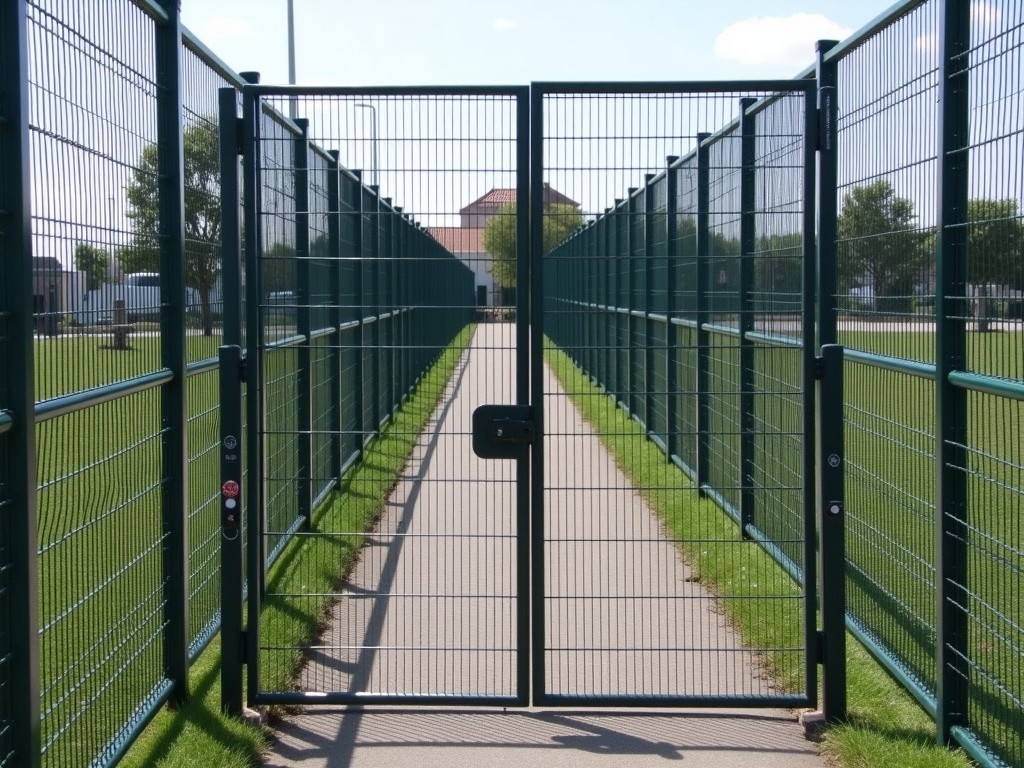
Temporary fencing systems require controlled access points that maintain site security without compromising safety or installation speed. A pedestrian gate integrated into temporary fencing must withstand repeated use, resist environmental exposure, and allow quick deployment and removal. This page outlines the technical considerations, material options, and configuration standards for pedestrian gates designed specifically for temporary fencing applications in construction, event management, and industrial site control.
Structural Design and Load Resistance
The gate frame must resist lateral forces from wind, accidental impact, and regular swinging motion without permanent deformation. Typical designs use square or rectangular steel tubing with a minimum wall thickness of 1.2 mm to balance rigidity and weight. Diagonal bracing or gusset plates at the hinge and latch corners prevent racking under cyclic loading. Hinge assemblies are engineered to support the gate’s self-weight plus dynamic loads, with bearing surfaces hardened or lubricated to reduce wear over 5,000+ cycles.
Material Selection and Corrosion Protection
Steel remains the primary material due to its strength-to-cost ratio and ease of fabrication. Hot-dip galvanization provides a zinc coating thickness of 55–85 µm, offering protection against rust in outdoor environments for 12–24 months depending on exposure. For longer-term reuse or coastal applications, powder-coated galvanized steel adds a polymer barrier that enhances UV resistance and scratch tolerance. Stainless steel (Grade 304) is available for high-moisture or chemical-exposure zones but increases weight and cost by approximately 40%.
Standard Dimensions and Clearance Requirements
Pedestrian gates for temporary fencing typically match the height of the adjacent fence panels, commonly 2.0 m or 2.4 m to deter climbing. Clear opening width ranges from 0.9 m to 1.2 m to accommodate single-person flow, equipment passage, or ADA-compliant access when required. The gate leaf overlaps the frame by 25–50 mm on the latch side to minimize gaps while allowing smooth operation. Hinge clearance is set to 3–5 mm to prevent binding during thermal expansion or ground settling.
Hardware and Access Control Integration
Hinges are typically heavy-duty butt or pivot types with grease fittings or sealed bearings to resist dirt ingress. Latching mechanisms include gravity drops, slide bolts, or padlock-compatible hasps designed for quick engagement and tamper resistance. Some models incorporate spring-assisted closing for self-latching behavior, reducing the risk of gates being left open. All hardware is selected for compatibility with standard padlock shackles (6–10 mm diameter) and can be retrofitted with electronic access controls if needed.
Installation and Removal Efficiency
Gates are designed to attach to temporary fencing bases using the same coupling system as the fence panels—commonly via pins, clamps, or welded lugs that align with the base’s hole pattern. This allows the gate to be installed or removed in under two minutes without tools. Weight is kept under 18 kg for manual handling by a single worker. When disassembled, the gate leaf and frame nest flat for stacking, minimizing storage footprint and transport volume.
Comparison of Gate Configurations
| Configuration | Typical Use Case | Weight (kg) | Setup Time | Reusability |
|---|---|---|---|---|
| Single Swing, Galvanized Steel | General construction sites | 14–16 | < 2 min | 12–24 months |
| Single Swing, Powder-Coated | Events, urban projects | 15–17 | < 2 min | 24–36 months |
| Double Swing, Galvanized | Wide access points | 22–26 | < 3 min | 12–24 months |
| Self-Closing, Spring-Assist | High-traffic zones | 16–18 | < 2 min | 12–24 months |
Quality Control and Testing Protocols
Each gate undergoes dimensional verification against CAD models to ensure alignment with fence panel interfaces. Weld integrity is checked via visual inspection and dye penetrant testing on critical joints. Coating thickness is measured using magnetic induction probes to confirm compliance with galvanization standards. Functional testing includes 500 open-close cycles under load to validate hinge durability and latch engagement. Final inspection confirms smooth operation, absence of sharp edges, and proper hardware torque before packaging.
Applications in Temporary Access Control
Pedestrian gates are essential in construction zones where controlled worker entry prevents unauthorized access while maintaining flow during shift changes. In event management, they enable ticketed entry and exit points that integrate with perimeter fencing without creating bottlenecks. For utility or municipal projects, gates provide secure access for inspection teams while keeping the site isolated from public areas. Their temporary nature allows relocation as project phases progress, reducing the need for permanent infrastructure.
Product Categories


Send Inquiry
If you are interested in our products, leave your information here and we will be in touch shortly.