Temporary Fencing For Construction Sites
Temporary fencing serves as a critical safety and security barrier on construction sites, defining work zones, preventing unauthorized access, and protecting both personnel and equipment. Unlike
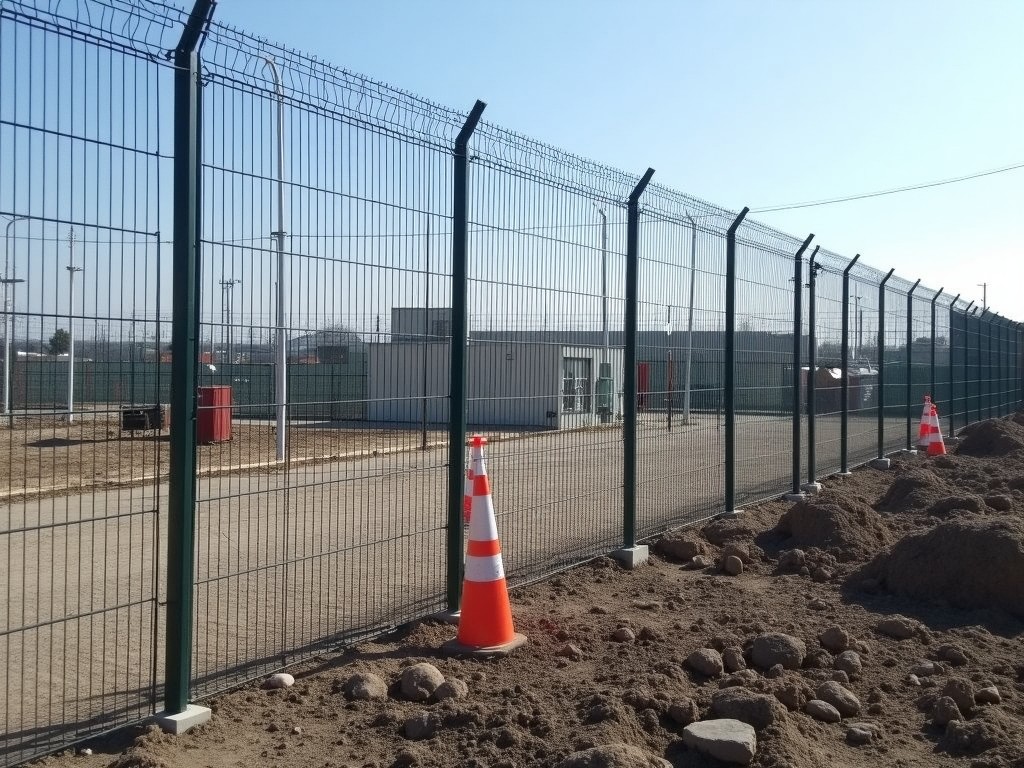
Temporary Fencing for Construction Sites
Temporary fencing serves as a critical safety and security barrier on construction sites, defining work zones, preventing unauthorized access, and protecting both personnel and equipment. Unlike permanent barriers, it must balance rapid deployment with sufficient structural integrity to withstand site-specific environmental loads such as wind, incidental impact, and ground settlement.
Selection of temporary fencing involves evaluating material composition, panel dimensions, connection mechanisms, anchoring methods, and compatibility with site logistics. Industrial buyers prioritize solutions that minimize installation time, reduce long-term handling costs, and comply with local safety regulations without requiring specialized labor or tools.
Material Composition and Structural Properties
Most temporary construction fencing utilizes galvanized steel tubing for vertical posts and horizontal rails, with welded or woven wire mesh infill. The steel typically conforms to ASTM A653 or equivalent standards, with a zinc coating weight of Z275 (275 g/m² total) to resist corrosion in outdoor conditions for 6–24 months depending on exposure.
Panel frames commonly use 32 mm diameter round tubing with a wall thickness of 1.2–1.5 mm, providing a balance between rigidity and manageable weight (approximately 8–12 kg per standard 2.4 m × 2.1 m panel). Mesh openings are usually 50 mm × 50 mm or 75 mm × 50 mm, sized to prevent climbing while maintaining visibility and wind permeability.
Alternative materials include HDPE plastic for low-impact zones or powder-coated steel for aesthetic requirements in urban environments, though these options generally sacrifice impact resistance or increase cost without proportional safety benefits in heavy-duty construction scenarios.
Panel Design and Connection Systems
Standard panels feature vertical posts spaced at 2.4 m intervals, connected via overlapping sleeves and secured with drop pins or butterfly clips. This modular design allows for straight runs, 90-degree corners, and variable-length configurations using adjustable coupler joints or swing gates.
Connection hardware is typically made from the same galvanized steel as the frame, ensuring galvanic compatibility. Drop pins are retained via spring latches or cotter keys to prevent accidental disengagement during wind loading or incidental contact. Some systems incorporate anti-lift brackets to deter panel removal from the base.
The height of temporary fencing is most commonly 2.1 m, meeting OSHA and local jurisdictional requirements for perimeter security. Taller variants (2.4 m) are available for high-risk zones but increase wind load significantly, requiring deeper anchoring or additional bracing.
Anchoring and Stability Considerations
Stability depends entirely on the anchoring method, as temporary fencing lacks foundation embedment. Common options include cast-in-place concrete blocks (20–25 kg each), driven steel spikes for soil penetration, or ballast frames designed to hold sandbags or gravel.
Concrete blocks are preferred on paved or compacted surfaces, providing consistent lateral resistance. Each panel typically requires two blocks—one at each post—positioned to resist overturning moments from wind or impact. Spike systems are faster to install in soft ground but offer less resistance to lateral loads and may damage underground utilities.
Wind load calculations are essential for exposed sites. A 2.1 m high panel with 50% solidity experiences approximately 180 N of force at 30 km/h wind speed. Proper anchoring must counteract both sliding and overturning failures, with safety factors of 1.5–2.0 applied based on site risk assessment.
Comparison of Common Temporary Fencing Systems
| Feature | Steel Panel System | Plastic Mesh System | Wire Rope Barrier |
|---|---|---|---|
| Material | Galvanized steel | HDPE | Steel cable + posts |
| Typical Weight (per 2.4 m) | 10–12 kg | 4–6 kg | 8–10 kg |
| Impact Resistance | High | Low | Medium |
| Wind Permeability | Medium (mesh) | High | High |
| Installation Speed | Moderate | Fast | Slow |
| Reusability | High (5+ cycles) | Medium (2–3 cycles) | Medium |
| Typical Use Case | General construction, urban sites | Landscaping, low-risk zones | Traffic control, temporary detours |
Customization and Site-Specific Adaptation
While standard panels suit most applications, site constraints often require modifications. Common customizations include adjustable-height posts for sloped terrain, integrated pedestrian gates with self-closing hinges, and privacy screens made from UV-stabilized fabric for dust control or visual screening.
For projects requiring frequent repositioning, quick-release couplers or wheeled panel systems reduce labor time during phase changes. In high-security zones, anti-climb features such as 35 mm mesh or angled top extensions can be specified, though these increase wind load and may necessitate reinforced anchoring.
Color options are limited to standard galvanized finish or powder-coated colors (e.g., white, orange, black) for visibility or aesthetic compliance. Custom branding via stenciled panels is available but adds cost and is generally reserved for long-term municipal projects.
Quality Control and Lifecycle Considerations
Manufacturing quality directly affects reusability and safety. Critical inspection points include weld integrity at frame joints, zinc coating thickness uniformity, and straightness of tubing after forming. Panels should exhibit no permanent deformation after 50 kg lateral load test at mid-span.
Reusable systems are designed for 5–10 deployment cycles before significant wear necessitates replacement. Wear points include pin holes, sleeve interiors, and base corners where blocks bear weight. Regular maintenance involves checking for rust at cut edges, replacing damaged pins, and verifying block integrity.
End-of-life recycling is straightforward for steel systems, with over 90% material recovery possible. Plastic systems present greater recycling challenges due to mixed polymer composites and contamination from site debris.
Product Categories


Send Inquiry
If you are interested in our products, leave your information here and we will be in touch shortly.