China 12 Gauge Vinyl Coated Welded Wire Fencing
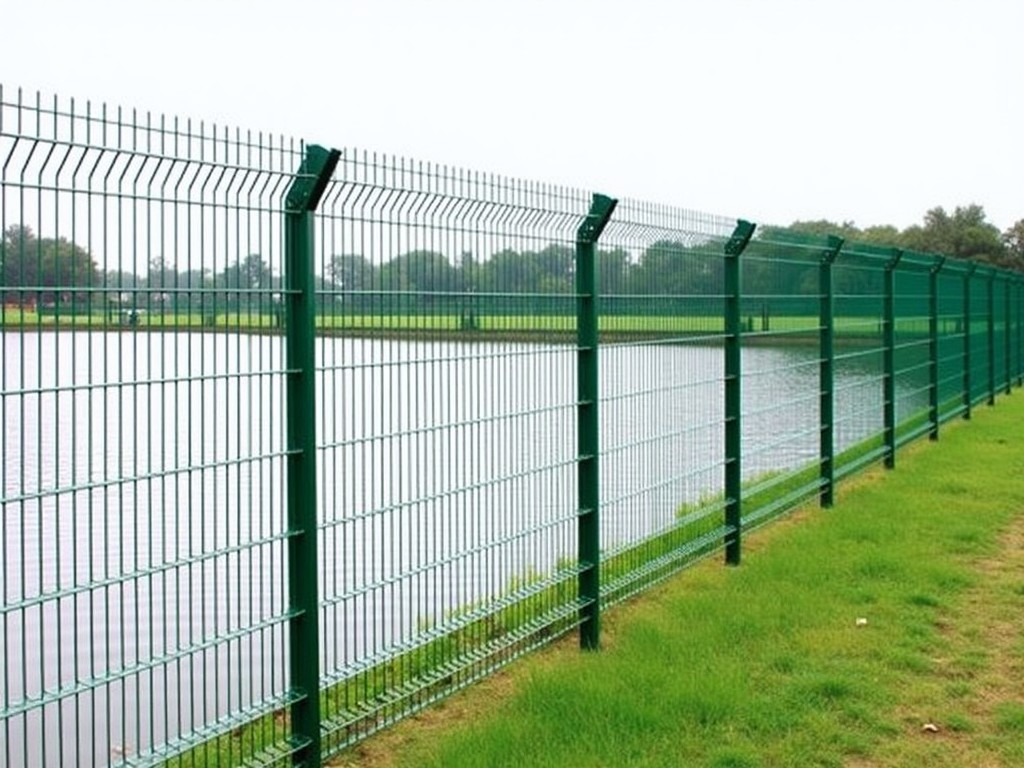
12 gauge vinyl coated welded wire fencing is a structural barrier system fabricated from low-carbon steel wire with a nominal diameter of 2.05 mm, formed into a grid pattern through resistance
China 12 Gauge Vinyl Coated Welded Wire Fencing
12 gauge vinyl coated welded wire fencing is a structural barrier system fabricated from low-carbon steel wire with a nominal diameter of 2.05 mm, formed into a grid pattern through resistance welding at every intersection, and subsequently encapsulated in a thermoplastic polyvinyl chloride (PVC) coating. This combination provides mechanical strength from the steel core and environmental resistance from the polymer layer, making it suitable for demanding industrial, agricultural, and infrastructure applications where long-term dimensional stability and corrosion resistance are required.
Material Composition and Manufacturing Process
The base wire is produced from ASTM A641 compliant low-carbon steel, cold-drawn to achieve a tensile strength between 450–550 MPa and a yield strength of approximately 350 MPa. After welding, the mesh undergoes a dual-layer vinyl coating process: first, a primer layer ensures adhesion to the steel surface; second, a topcoat of UV-stabilized PVC is applied via extrusion or dip-coating to achieve a total coating thickness of 0.25–0.35 mm. This coating thickness is critical—it provides sufficient barrier against moisture, chlorides, and UV degradation while maintaining flexibility to prevent cracking under impact or thermal cycling.
Welding is performed using automatic resistance welders calibrated to deliver precise heat input, ensuring each joint achieves a shear strength of at least 80% of the parent wire’s tensile capacity. Post-weld, the mesh is straightened under tension to eliminate distortion, then passed through a cooling chamber before coating. Quality control includes inline wire diameter monitoring, weld pull-test sampling (1 per 50 linear meters), and coating adhesion testing via ASTM D4541 (minimum 1.5 MPa).
Technical Specifications and Performance Characteristics
| Parameter | Typical Value | Test Standard / Notes |
|---|---|---|
| Wire Gauge | 12 AWG (2.05 mm nominal) | ASTM A641 |
| Mesh Opening | 50 mm x 50 mm (2" x 2") | Standard; customizable from 25 mm to 100 mm |
| Coating Type | UV-stabilized PVC | ASTM D4236 compliant |
| Coating Thickness | 0.25–0.35 mm (total) | Measured via micrometer on cross-section |
| Tensile Strength (Wire) | 450–550 MPa | ASTM A370 |
| Weld Shear Strength | ≥360 MPa (80% of wire) | ASTM A185 |
| Coating Adhesion | ≥1.5 MPa | ASTM D4541 |
| UV Resistance (Color Retention) | >80% after 1000 hrs | ASTM G154 (UV-A, 0.89 W/m²) |
| Operating Temperature Range | -30°C to +60°C | No cracking or delamination |
Application-Specific Advantages
In agricultural settings, the 50 mm x 50 mm opening prevents livestock from inserting heads or hooves while allowing adequate airflow and visibility. The vinyl coating eliminates sharp edges from exposed welds, reducing animal injury risk during contact. Unlike galvanized alternatives, the PVC layer does not produce zinc runoff, making it suitable for organic farming zones where soil contamination must be avoided.
For industrial perimeter security, the welded construction provides rigid panel integrity—unlike woven or knitted meshes that can deform under sustained load. The coating resists salt spray and chemical splashes common in coastal or chemical processing environments, maintaining structural appearance and function where bare steel would require frequent repainting or replacement. Posts and rails can be directly welded or bolted to the mesh without damaging the coating, preserving the barrier’s continuity.
In infrastructure projects such as highway medians or utility substations, the product’s dimensional stability under thermal cycling prevents gap formation that could compromise safety zones. The coating’s dielectric properties (volume resistivity >10¹² Ω·cm) allow safe proximity to low-voltage electrical conduits without risk of corrosion from stray currents—a critical consideration in electrified rail or substation fencing where galvanic corrosion must be mitigated.
Customization Options and Ordering Considerations
Mesh aperture can be adjusted between 25 mm and 100 mm square to match specific containment or filtration requirements—smaller openings for rodent control, larger for deer exclusion or windbreak applications. Roll widths are available from 0.9 m to 2.4 m in 0.3 m increments, with standard lengths of 15 m, 30 m, or 50 m per roll; custom lengths up to 100 m are feasible for large-scale projects to minimize field splicing.
Coating color options include forest green, black, white, and brown, formulated with pigments that resist fading under prolonged UV exposure. Custom colors are available upon request with minimum order quantities. Edge treatments vary: plain cut, knuckled (folded back to eliminate sharp points), or looped for easier attachment to posts. For high-impact zones, a reinforced border wire (10 gauge) can be welded along the perimeter to increase resistance to sagging or impact deformation.
Before quotation, buyers should provide: required roll dimensions, mesh size, coating color, edge treatment, and any project-specific standards (e.g., ASTM, ISO, or local municipal codes). Samples are available for evaluation—typically 300 mm x 300 mm sections with full coating and weld integrity—to verify adhesion, flexibility, and visual appearance under intended lighting conditions.
Quality Control and Packaging
Each production lot undergoes random sampling for wire diameter (±0.03 mm tolerance), weld strength (minimum 90% of lot average), and coating thickness uniformity. Rolls are wrapped in UV-stabilized polyethylene film to prevent coating abrasion during transit, then placed on sturdy wooden pallets with corner protectors. For export shipments, desiccant packs are included to control moisture within the packaging, and pallets are secured with poly straps rated for 500 kg holding strength.
Lead time for standard configurations is typically 10–15 working days after receipt of technical confirmation and deposit. Custom colors or non-standard apertures may extend lead time to 20–25 days. All shipments include a mill test report detailing wire chemistry, tensile test results, and coating adhesion data for the specific batch.
Product Categories


Send Inquiry
If you are interested in our products, leave your information here and we will be in touch shortly.