China Perforated Black Metal Sheet
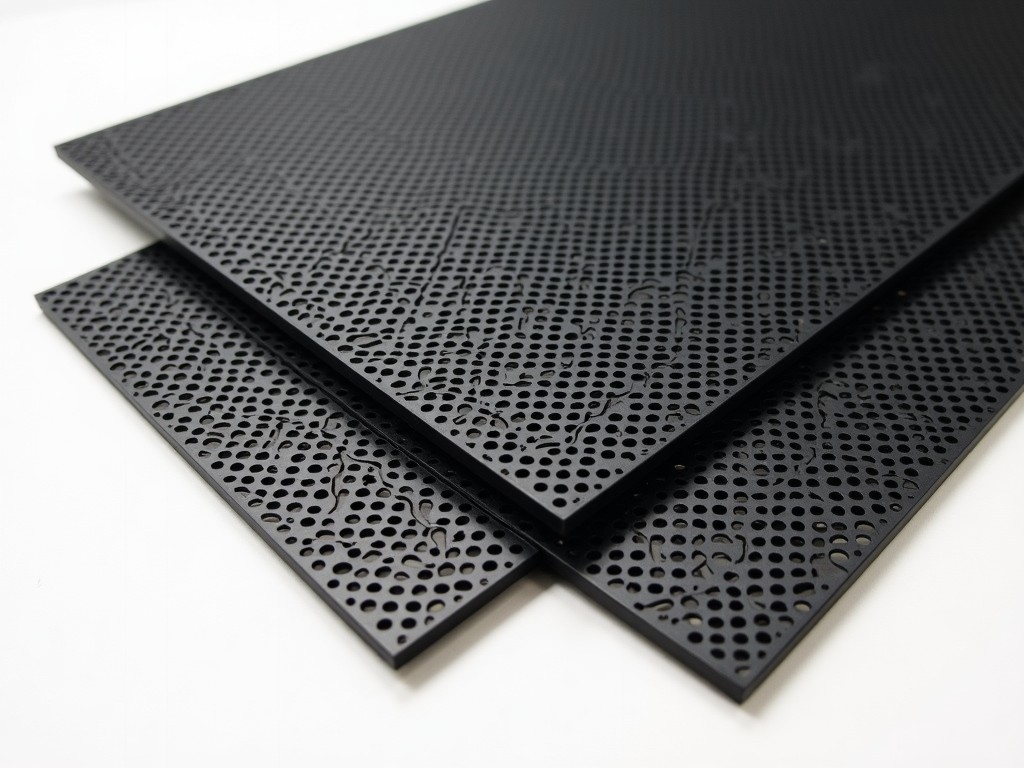
Perforated black metal sheets are engineered for industrial applications requiring controlled airflow, light diffusion or aesthetic screening while maintaining structural integrity. The term "black"
Perforated Black Metal Sheet
Perforated black metal sheets are engineered for industrial applications requiring controlled airflow, light diffusion or aesthetic screening while maintaining structural integrity. The term "black" refers to the base metal's untreated oxidized surface commonly found on cold-rolled steel or the application of a black oxide coating for corrosion resistance and non-reflective finish. Perforation patterns are precision-engineered to meet specific open area requirements hole geometry and spacing tolerances critical for filtration acoustic management or machine guarding.
Material selection begins with substrate evaluation—typically low-carbon steel grades like SPCC or Q195 for formability and cost efficiency or higher-strength options such as Q235B for load-bearing applications. Hole shapes include round square slotted or hexagonal arranged in staggered or straight rows with pitch measurements defined as center-to-center distance. Open area percentage—the ratio of hole surface to total sheet area—is calculated to determine airflow resistance pressure drop and visual transparency.
Manufacturing Process and Tolerances
Perforation is achieved via CNC turret punch presses or rotary die systems applying tonnage ranging from 5 to 50 tons depending on material thickness and hole size. Thickness capabilities span 0.5mm to 6.0mm with tolerances adhering to ISO 2768-m for hole position ±0.1mm and hole diameter ±0.08mm for sheets under 2mm. Thicker materials may require pilot drilling to prevent tool wear and burr formation which is minimized through optimized punch clearance typically set at 10-15% of material thickness.
Post-perforation treatments include deburring via vibratory tumbling or brushing to remove sharp edges critical for handler safety and downstream assembly. Black oxide conversion coating follows ASTM D769 standards producing a magnetite layer (Fe3O4) 1-2μm thick that enhances corrosion resistance without adding measurable thickness. Alternative finishes include phosphate priming for powder coating adhesion or light oil coating for temporary rust protection during transit.
Technical Specifications Table
| Parameter | Typical Range | Notes |
|---|---|---|
| Material Thickness | 0.5 – 6.0 mm | Custom thicknesses available upon request |
| Hole Diameter | 1.0 – 25.0 mm | Smaller holes require tighter punch clearance |
| Pitch (Center-to-Center) | 1.5 – 50.0 mm | Determines open area and structural strength |
| Open Area Percentage | 10% – 70% | Calculated from hole geometry and pitch |
| Sheet Width | Up to 1500 mm | Limited by press bed size; wider sheets require splicing |
| Sheet Length | Up to 3000 mm | Length constrained by handling and transportation logistics |
| Tolerance (Hole Position) | ±0.1 mm | Per ISO 2768-m for thicknesses <2mm |
| Surface Finish | Black oxide Phosphate Oil | Finish selected based on corrosion and painting needs |
Application-Driven Design Considerations
In HVAC systems perforated black metal sheets serve as diffuser faces where open area and hole distribution directly influence air throw velocity and noise reduction. A 40% open area with 3mm round holes on 6mm pitch delivers balanced airflow distribution in ceiling plenums while minimizing visible ductwork. The black finish reduces glare in occupied spaces and hides dust accumulation compared to reflective surfaces.
For industrial machine guarding the same material provides operator visibility while meeting ISO 13857 safety distances. Hole sizes under 4mm prevent finger penetration whereas 6mm holes allow tool access for maintenance. Structural rigidity is maintained through margin borders typically 10-20mm unperforated on all edges to prevent crack propagation under vibration loads.
Architectural applications leverage the material’s aesthetic properties—perforation patterns create controlled light filtering for façades or interior partitions. Designers specify variable open areas across a single sheet to create gradient transparency effects achievable through CNC programming of hole density. The black oxide finish provides a uniform matte appearance that complements glass wood and concrete in modern builds.
Customization and Ordering Parameters
Quotation requires specification of base material grade thickness hole shape size pitch pattern layout (staggered or straight) sheet dimensions and desired edge treatment (mill edge deburred or hemmed). Open area percentage is often the primary design input from which hole size and pitch are back-calculated to satisfy airflow or lighting criteria. Tolerance class—standard commercial or precision—affects tooling setup and inspection frequency.
Secondary operations include bending notching or laser cutting for complex profiles which must be considered during nesting to avoid perforation distortion near bend lines. Minimum order quantities typically start at one sheet for prototyping but scale to pallet loads (20-50 sheets) for production efficiency. Lead times range from 5-10 days for stock materials to 15-25 days for custom thicknesses or special alloys.
For technical consultation on hole geometry material selection or tolerance requirements for your specific application contact our engineering team.
Request Quote or Technical Data
More Products

Send Inquiry
If you are interested in our products, leave your information here and we will be in touch shortly.