Wholesale Perforated Mild Steel Plate
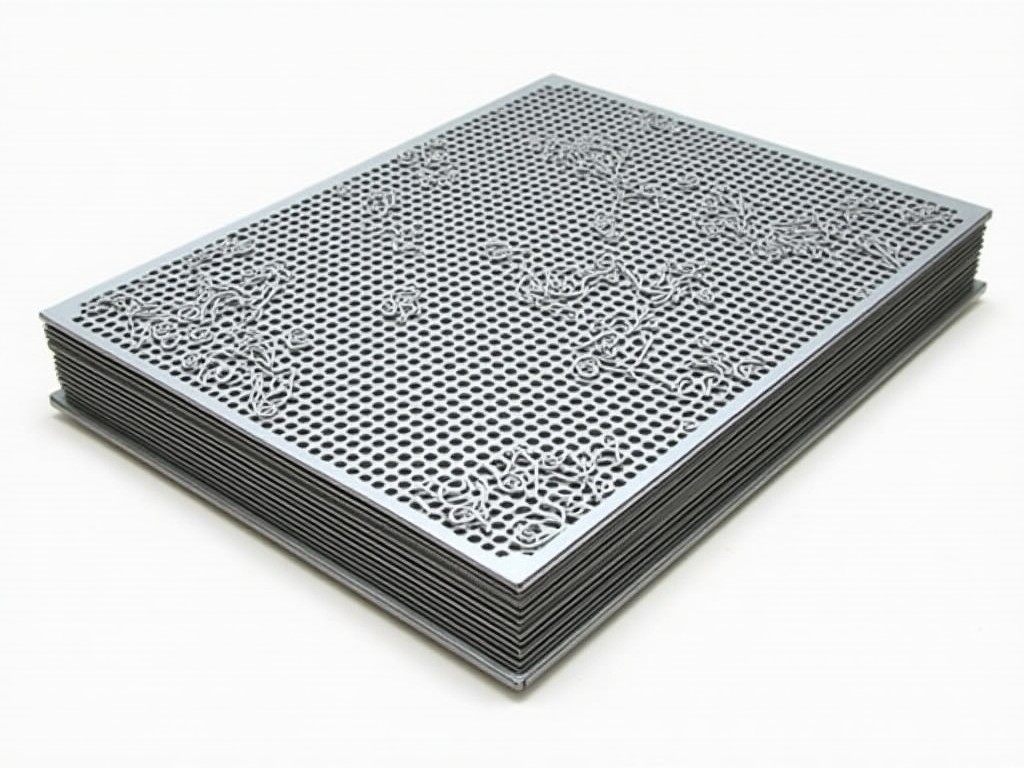
Perforated mild steel plate is a flat-rolled steel product featuring a regular pattern of holes punched or laser-cut through its surface. The base material is low-carbon steel (typically grades such
Wholesale Perforated Mild Steel Plate
Perforated mild steel plate is a flat-rolled steel product featuring a regular pattern of holes punched or laser-cut through its surface. The base material is low-carbon steel (typically grades such as Q235, S235JR, or ASTM A36), selected for its balance of formability, weldability, and cost-effectiveness. Hole patterns, sizes, and open area percentages are engineered to meet specific functional requirements across industrial applications.
The perforation process removes material strategically to achieve desired airflow, light transmission, sound attenuation, or filtration characteristics while retaining structural integrity. Unlike decorative perforations in architectural contexts, industrial-grade perforated mild steel plates prioritize mechanical performance, dimensional stability, and repeatability under load. The thickness of the base plate typically ranges from 0.8 mm to 6.0 mm, with hole diameters from 1.5 mm to 25 mm, depending on the application.
Open area — the percentage of the plate’s surface occupied by holes — is a critical design parameter. It directly influences pressure drop in ventilation systems, light transmission in lighting fixtures, and flow rate in filtration units. Common open area ranges from 15% to 60%, with standard patterns including round, square, slot, and hexagonal arrangements. The pattern’s orientation (straight or staggered) affects both aesthetics and mechanical anisotropy.
Material Specifications and Tolerances
The mild steel substrate conforms to international standards for hot-rolled or cold-rolled low-carbon steel. Typical chemical composition includes carbon content below 0.25%, manganese between 0.30% and 0.60%, and controlled levels of phosphorus and sulfur (<0.045% each). Mechanical properties generally yield a tensile strength of 370–500 MPa and elongation at break of 20–30%, ensuring adequate ductility for forming and perforating without cracking.
Dimensional tolerances follow industry norms: thickness tolerance is typically ±0.05 mm for cold-rolled and ±0.10 mm for hot-rolled base plates. Length and width tolerances are ±3 mm for sheets under 2000 mm and ±5 mm for longer dimensions. Hole position tolerance is maintained within ±0.2 mm for CNC-punched patterns and ±0.1 mm for laser-cut variants, ensuring consistency across large production runs.
Surface finish options include untreated (mill finish), oiled to prevent rust during storage, or pre-galvanized (Z120–Z275 coating) for enhanced corrosion resistance in humid environments. For applications requiring painting or powder coating, the surface is cleaned and phosphated to promote adhesion. These finishes are applied post-perforation to avoid damaging the coating during hole formation.
Perforation Patterns and Engineering Considerations
Round hole patterns are the most common due to ease of tooling and predictable flow characteristics. Staggered (60°) arrangements provide higher open area and better load distribution than straight rows for the same hole diameter and pitch. Square and slot holes offer directional flow control — useful in screens where particle shape or orientation matters. Hexagonal patterns maximize open area while maintaining ligament strength between holes.
Ligament strength — the material remaining between adjacent holes — determines the plate’s resistance to deformation under pressure or impact. A minimum ligament width of 1.0 mm is generally recommended to avoid tearing during handling or service. Engineers calculate effective strength using net section methods, accounting for stress concentration around hole edges. For high-vibration environments, hole edges may be deburred or radiused to reduce crack initiation sites.
Open area is calculated as: (Area of one hole × Number of holes) / Total plate area × 100%. For round holes in a staggered pattern, the formula incorporates pitch and hole diameter. Designers balance open area against structural needs — increasing hole size or density improves flow but reduces stiffness. Finite element analysis is often used to validate performance under expected loads, especially in safety-critical guards or pressure vessels.
Industrial Applications and Functional Benefits
In HVAC systems, perforated mild steel plates serve as diffuser faces and return air grilles. The open area allows controlled air dispersion while the steel structure resists deformation from duct pressure. Compared to aluminum or plastic alternatives, steel offers superior impact resistance and fire rating (non-combustible), making it suitable for industrial kitchens, factories, and mechanical rooms where durability is paramount.
As machine guards and safety barriers, these plates provide visibility and airflow without compromising protection. The hole pattern prevents entanglement hazards while allowing operators to monitor moving parts. Unlike solid barriers, perforated designs reduce heat buildup around motors and gearboxes. The mild steel substrate absorbs impact energy better than brittle materials, enhancing safety in high-torque environments.
In filtration and screening, perforated plates act as support screens for filter media or as primary separators for coarse particles. The hole size determines the minimum particle passage, while open area affects pressure drop and cleaning frequency. For liquid filtration, staggered round holes minimize clogging; for dry solids, square or slot patterns may improve discharge. The steel construction withstands backwashing and mechanical cleaning cycles better than synthetic meshes.
Acoustic applications utilize perforated plates as facings for sound-absorbing cores (e.g., mineral wool or foam). The holes allow sound waves to penetrate the absorbent material, while the plate’s mass reflects higher frequencies. Hole diameter and spacing are tuned to target specific noise bands — smaller holes attenuate high frequencies, larger open areas improve low-frequency absorption. This principle is applied in enclosures for generators, compressors, and industrial fans.
Customization Options and Ordering Guidelines
Wholesale supply accommodates custom specifications for hole diameter, pitch, pattern type, open area, sheet size, and thickness. Customers provide detailed drawings or parameters including: base material grade (e.g., Q235, DD11), desired finish (bare, oiled, galvanized, painted), hole shape and arrangement, margin widths (unperforated borders for framing), and edge treatment (sheared, deburred, or rolled). Tolerances for critical dimensions can be tightened upon request.
Minimum order quantities vary based on tooling requirements. Standard round hole patterns using existing punches may accept orders as low as 50 kg. Custom patterns requiring new tooling typically start at 200–500 kg to amortize setup costs. Lead times range from 7–14 days for stock patterns to 3–6 weeks for new tooling, depending on material availability and production schedule. Sample plates (100×100 mm) are available for approval before full production.
Packaging is designed to prevent deformation and corrosion during transit. Sheets are stacked flat with interleaving paper or plastic film between layers, then wrapped in waterproof shrink film and secured on wooden pallets. Corner protectors and edge guards prevent damage from forklift handling. For export, moisture-desiccant packs and vapor corrosion inhibitors (VCI) are included inside the wrapping. All packages are labeled with material grade, dimensions, hole pattern, and heat number for traceability.
| Parameter | Typical Range | Notes |
|---|---|---|
| Base Material Thickness | 0.8 mm – 6.0 mm | Cold-rolled preferred <3 mm; hot-rolled ≥3 mm |
| Hole Diameter | 1.5 mm – 25 mm | Smaller holes require higher tonnage tooling |
| Pitch (Center-to-Center) | 2.0 mm – 50 mm | Determines open area and ligament strength |
| Open Area | 15% – 60% | Application-dependent; affects flow and strength |
| Sheet Width | Up to 1500 mm | Limited by press bed size; wider via welding |
| Sheet Length | Up to 3000 mm | Longer lengths available in coils for roll forming |
Quality control begins with material verification — mill certificates are checked for chemical composition and mechanical properties. During production, hole dimensions and positional accuracy are monitored using gauges and vision systems. First-piece inspection validates pattern alignment, open area, and dimensional accuracy before full production runs. Final inspection includes visual checks for burrs, coating uniformity, and flatness (typically <3 mm/m deviation).
To request a quotation or technical consultation, provide your application requirements, desired specifications, and estimated annual volume. Our engineering team will review hole pattern feasibility, material suitability, and finishing options to deliver a optimized solution. Contact us to discuss how perforated mild steel plate can meet your functional needs with predictable performance and long-term durability.
More Products

Send Inquiry
If you are interested in our products, leave your information here and we will be in touch shortly.