Stainless Steel Ribbon Wire
Stainless steel ribbon wire is a flat-rolled wire product with a rectangular cross-section, manufactured from corrosion-resistant alloys through precision cold rolling and annealing processes. Unlike
Stainless Steel Ribbon Wire
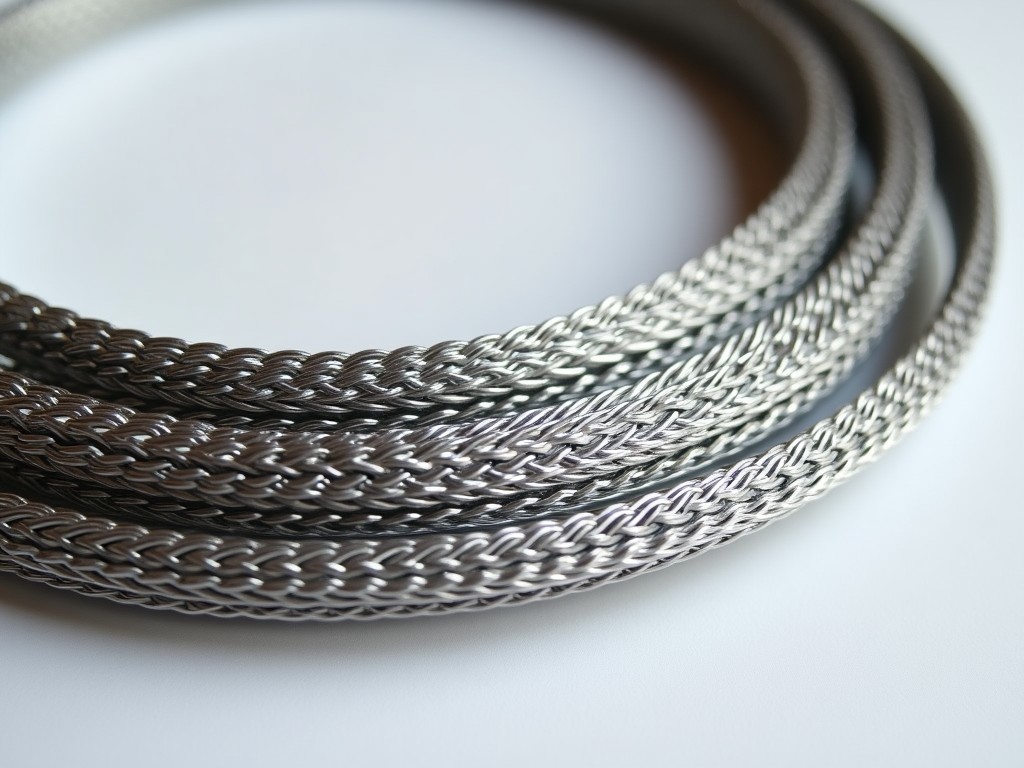
Stainless steel ribbon wire is a flat-rolled wire product with a rectangular cross-section, manufactured from corrosion-resistant alloys through precision cold rolling and annealing processes. Unlike round wire, its flat geometry provides a higher surface area-to-volume ratio, which influences heat dissipation, electrical contact performance, and mechanical bonding in industrial applications. This product is typically supplied in coil form, enabling continuous processing in automated manufacturing lines.
Material Composition and Properties
The most commonly used grades for ribbon wire are AISI 304 and 316 stainless steel, selected based on environmental exposure and mechanical demands. Grade 304 contains approximately 18% chromium and 8% nickel, offering good resistance to oxidation and mild chemical environments up to 870°C intermittent service. Grade 316 includes 2-3% molybdenum, significantly enhancing resistance to chlorides and acidic solutions, making it suitable for marine, chemical processing, and food-grade applications where pitting corrosion is a concern.
Mechanical properties are tailored through controlled cold work and annealing. Typical tensile strength ranges from 500 MPa for annealed condition to over 1400 MPa for full-hard temper, depending on reduction ratio and alloy composition. Elongation at break varies inversely with hardness, from 40% in soft temper to less than 5% in spring-temper condition. These parameters allow engineers to select tempers that balance formability for coiling or winding with stiffness for structural or conductive roles.
Dimensional Tolerances and Manufacturing Process
Ribbon wire dimensions are defined by width, thickness, and edge condition. Standard widths range from 0.5 mm to 50 mm, with thicknesses from 0.01 mm to 3.0 mm, though extreme dimensions require specialized rolling mills. Tolerances are typically ±0.02 mm for thickness and ±0.1 mm for width under standard conditions, achievable through inline laser gauging and feedback-controlled rolling mills. Tighter tolerances (±0.005 mm thickness) are available for precision applications such as thermal sensors or micro-actuators.
The manufacturing process begins with casting stainless steel into slabs, followed by hot rolling to approximate thickness, then multiple passes through cold rolling mills to achieve final dimensions and desired temper. Intermediate annealing may be performed to relieve internal stresses and restore ductility for further reduction. Edge conditioning—such as slitting, deburring, or rounding—is applied post-rolling to meet safety, handling, or performance requirements, particularly in medical or electronic applications where sharp edges pose risks.
Surface Finish and Edge Conditions
Surface finish is specified according to industrial needs, ranging from matte (No. 1 finish) to bright annealed (BA) or mirror-like (No. 8 finish). A matte finish results from hot rolling and annealing without polishing, suitable for applications where coating adhesion or weldability is prioritized. Bright annealed finish is achieved through annealing in a controlled hydrogen atmosphere, yielding a smooth, reflective surface with low roughness (Ra < 0.2 µm), beneficial for fluid flow or optical reflectivity.
Edge conditions significantly affect performance and safety. Square edges are standard after slitting but may require deburring to prevent injury or wire breakage during handling. Rounded edges reduce stress concentration and are preferred in dynamic applications like springs or belts. Knurled or patterned edges can be introduced via rolling to improve grip in composite winding or prevent slippage in tensioned systems. Edge quality is inspected visually and via profilometry to ensure consistency across coils.
Typical Industrial Applications
In heating elements, stainless steel ribbon wire is used in industrial furnaces and appliance heating coils where its flat profile increases radiant surface area compared to round wire of equivalent cross-section, improving thermal efficiency. The uniform width ensures consistent resistance per unit length, critical for precise temperature control in semiconductor manufacturing or food processing equipment.
For electromagnetic shielding and grounding straps, the high surface area enables effective EMI attenuation at high frequencies when bonded to enclosures or cables. Its flexibility allows conformal wrapping around irregular shapes, while corrosion resistance ensures long-term conductivity in humid or chemically active environments. Unlike braided shields, ribbon wire provides lower DC resistance and easier termination via welding or crimping.
In filtration and belt applications, ribbon wire is woven into meshes or linked into conveyor belts where its flat profile minimizes flow resistance and maximizes open area. Stainless steel construction withstands repeated cleaning cycles, high temperatures, and exposure to sanitizers in pharmaceutical or food processing lines. The absence of protrusions reduces particle entrapment, supporting compliance with hygienic design standards such as 3-A SSI or EHEDG.
Comparison: Ribbon Wire vs. Round Wire
| Property | Ribbon Wire | Round Wire (Equivalent Area) |
|---|---|---|
| Surface Area (per unit length) | Higher (2×(width+thickness)) | Lower (π×diameter) |
| Heat Dissipation | Improved due to greater exposure | Standard |
| Electrical Contact Resistance | Lower and more uniform | Variable depending on contact point |
| Flexibility in Plane | High (bends easily across thickness) | Uniform in all directions |
| Coiling Stability | Prone to edge deformation if not supported | Naturally resists deformation |
| Typical Use Case | Heating, shielding, flat belts | Springs, fasteners, general conduction |
Customization Options
Width and thickness can be customized within the capabilities of available rolling mills, with minimums constrained by material strength and equipment limits. Widths below 0.5 mm require precision slitting of ultra-thin strip, while thicknesses over 3 mm may necessitate hot rolling followed by limited cold reduction. Intermediate dimensions are typically achievable without tooling changes, supporting rapid prototyping.
Temper selection is based on end-use requirements: soft (annealed) for deep drawing or coiling, quarter-hard for moderate forming, half-hard for spring applications requiring elastic recovery, and full-hard for maximum strength where minimal deformation is acceptable. Yield strength and elongation values are provided per lot upon request, enabling precise spring constant or bend radius calculations.
Additional customizations include slit-to-width tolerances, edge rounding radii (typically 0.1–0.5 mm), surface cleaning (ultrasonic or acid pickling), and special packaging such as oxidized-paper interleaving or vacuum-sealed coils with desiccant for moisture-sensitive alloys like 316L. Length per coil is adjustable based on handling equipment, with standard weights ranging from 5 kg to 50 kg to accommodate manual or automated feeding systems.
Quality Control and Testing
Dimensional verification occurs at multiple stages using laser micrometers and optical comparators, with data logged per coil for traceability. Mechanical properties are validated via tensile testing on specimens taken from both head and tail of each coil to ensure consistency. Surface roughness is measured using contact profilometers, with Ra values reported for critical finishes.
Chemical composition is confirmed through spectrometer analysis of each melt, with mill test reports available upon request. For applications requiring corrosion resistance validation, salt spray testing (ASTM B117) or intergranular corrosion testing (ASTM A262 Practice E) can be performed. Visual inspection under 10x magnification ensures absence of scratches, pits, or rolling defects that could impair performance in dynamic or electrical applications.
Packaging and Handling
Ribbon wire is wound onto corrosion-resistant cores—typically plastic or coated steel—to prevent surface damage and ensure smooth unwinding. Coils are secured with biodegradable ties or steel straps and wrapped in polyethylene film to protect against moisture and particulates. For export or long-term storage, vapor-corrosion inhibitor (VCI) paper is interleaved between layers, particularly for grades susceptible to pitting in humid climates.
Labeling includes grade, dimensions, temper, weight, coil number, and heat lot for full traceability. Handling instructions recommend horizontal storage to prevent sagging and avoidance of sharp bends during unpacking. For automated feeding systems, coil orientation and tension control parameters are provided to minimize stretching or camber development during pay-off.
To request a quotation or technical consultation, please provide your required dimensions, grade, temper, surface finish, edge condition, and estimated annual volume. Our engineering team will review your application and respond with feasible options, lead times, and packaging recommendations within two business days.


More Products

Send Inquiry
If you are interested in our products, leave your information here and we will be in touch shortly.