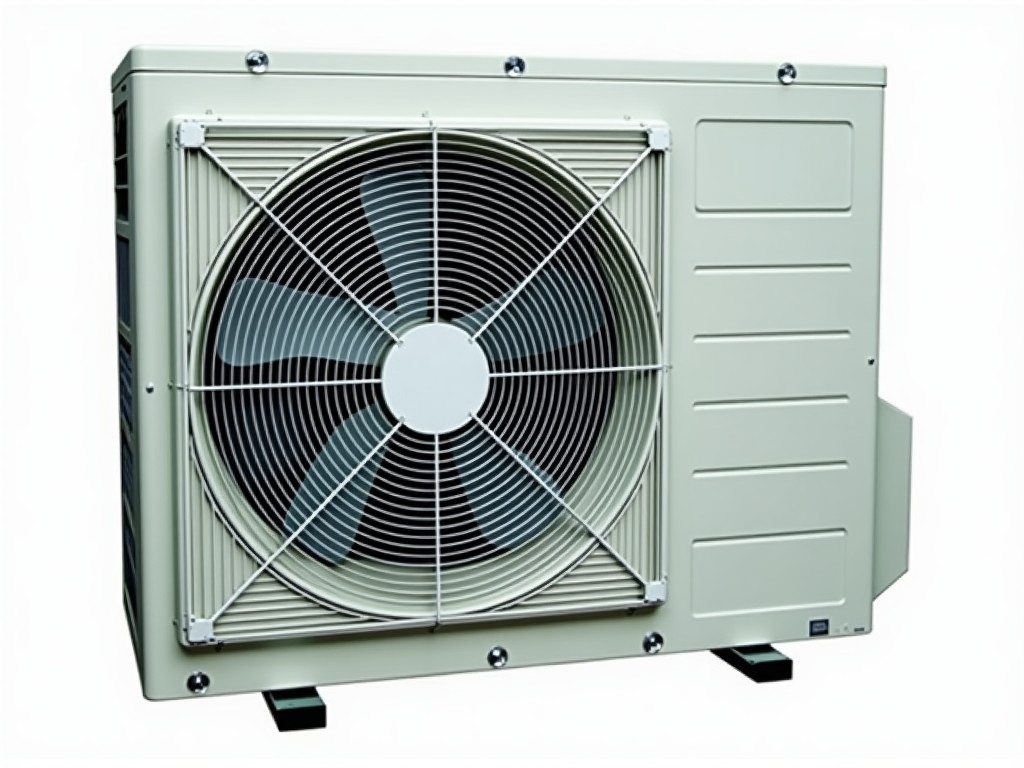
Air Conditioner Condenser Outdoor Fan Guard Grill
The outdoor fan guard grill for air conditioner condensers serves as a critical protective barrier between the rotating fan assembly and external environmental hazards. Positioned directly over the
Air Conditioner Condenser Outdoor Fan Guard Grill
The outdoor fan guard grill for air conditioner condensers serves as a critical protective barrier between the rotating fan assembly and external environmental hazards. Positioned directly over the fan blade sweep area, it prevents intrusion of debris, tools, wildlife, and accidental contact while maintaining sufficient airflow for heat exchange efficiency. Industrial and commercial HVAC systems require grills engineered to withstand prolonged UV exposure, thermal cycling, and mechanical stress without deforming or corroding, ensuring both safety compliance and sustained thermal performance over the equipment lifecycle.
Engineering Design and Airflow Optimization
Fan guard grill design balances two competing requirements: maximum physical protection and minimal restriction to airflow. The open area ratio—typically between 60% and 75% for standard coil configurations—is calculated based on fan blade tip speed, static pressure drop across the coil, and required CFM (cubic feet per minute) at design conditions. Wire diameter, opening geometry (square, hexagonal, or circular), and pitch are optimized using computational fluid dynamics (CFD) to ensure pressure loss remains below 0.05 in. w.g. at nominal fan speed, preventing motor overwork and efficiency loss. Structural ribs or flanges are integrated where necessary to resist buckling under impact loads without increasing solidity excessively.
Material Selection for Environmental Resistance
Material choice depends on installation environment, expected lifespan, and maintenance accessibility. Galvanized steel (G90 coating) is common for standard outdoor units, offering corrosion resistance up to 20 years in moderate climates with periodic inspection. In coastal or industrial zones with high chloride or sulfur exposure, 304 stainless steel is preferred due to its resistance to pitting and crevice corrosion, though it carries a 40–60% cost premium. Powder-coated aluminum provides lightweight alternatives where weight savings on rooftop mounts are critical, though its lower tensile strength requires thicker cross-sections to match steel impact resistance. All materials undergo salt spray (ASTM B117) and UV exposure (ASTM G154) testing to validate performance claims.
Mounting Configurations and Retention Systems
Secure attachment is essential to prevent vibration-induced loosening or displacement during operation. Common mounting methods include direct screw fastening to the condenser flange, spring-clip retention for tool-free access during maintenance, and bolt-through brackets with lock washers for high-vibration applications. Flange designs often incorporate rolled edges or hemmed perimeters to eliminate sharp edges and increase rigidity. Clearance between the grill and fan tip is maintained at 1/4" to 3/8" to accommodate blade flex and thermal expansion while minimizing recirculation zones. Some designs feature asymmetric profiles to align with skewed fan mounts or restricted installation envelopes.
Impact Resistance and Safety Compliance
Outdoor fan guards must resist deformation from impacts such as hail, falling debris, or maintenance tools without creating gaps that expose moving parts. Design validation includes drop-ball testing (per UL 1995) where a 500g steel ball impacts the grill at specified energies; permanent deformation must not exceed 2mm, and no opening shall allow passage of a 12mm diameter probe. Compliance with IEC 60335-2-40 and ANSI/UL 60335-2-40 is verified through third-party testing. In public-access installations, additional requirements may apply to prevent finger entrapment, governed by ISO 13857 thresholds for lower limb protection.
Customization for OEM and Retrofit Applications
OEMs often require grills tailored to specific condenser geometries, including non-rectangular footprints, curved top panels, or integrated discharge baffles. Retrofit scenarios demand precise replication of legacy mounting hole patterns and airflow characteristics to avoid recalibrating system controls. Customization options include material grade, wire diameter (typically 2.0mm to 4.5mm), opening size (10mm to 25mm), flange depth, and surface finish. Engineers provide CAD models (STEP or IGES) for validation against enclosure constraints and fan tip clearance rules. Prototypes are available for fit-check testing prior to production tooling.
| Parameter | Typical Range / Options | Notes |
|---|---|---|
| Wire Diameter | 2.0 – 4.5 mm | Selected based on impact load and span |
| Opening Size | 10 – 25 mm | Balances protection vs. airflow |
| Open Area Ratio | 60% – 75% | CFD-validated for pressure drop |
| Material | G90 Galvanized, 304 SS, Powder-Coated Al | Chosen per environmental exposure |
| Fan Tip Clearance | 6 – 10 mm | Prevents blade contact during flex |
| Mounting Method | Screw, Spring-Clip, Bolt Bracket | Selected for access and vibration |
Quality Control and Traceability
Manufacturing consistency is critical for safety-critical components. Each production lot undergoes dimensional inspection of opening squareness, wire diameter uniformity, and flange flatness using calibrated gauges and vision systems. Material test reports (MTRs) are maintained for coil stock, and weld integrity (where applicable) is verified via dye penetrant or ultrasonic inspection. Finished parts are labeled with lot numbers, material codes, and date stamps to enable traceability. Packaging includes corrosion-inhibiting separators and stack limits to prevent deformation during transit. Final audit includes airflow resistance sampling using calibrated manometers to confirm batch consistency with design targets.
More Products

Send Inquiry
If you are interested in our products, leave your information here and we will be in touch shortly.