Airfryer Stainless Steel Wire Mesh Basket
This component serves as the primary food-contact surface in countertop air fryers, designed to hold ingredients while enabling rapid hot-air circulation. Its open mesh structure directly influences
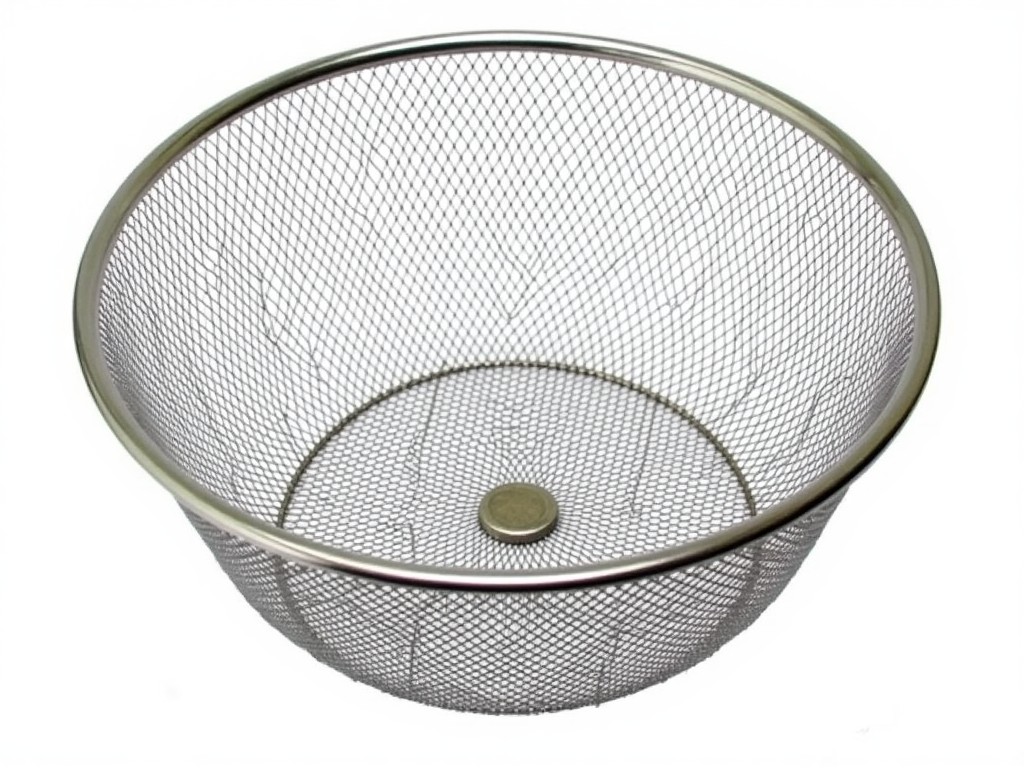
Air Fryer Stainless Steel Wire Mesh Basket
This component serves as the primary food-contact surface in countertop air fryers, designed to hold ingredients while enabling rapid hot-air circulation. Its open mesh structure directly influences cooking efficiency, food release characteristics, and long-term durability under repeated thermal cycling.
Unlike solid trays, the wire mesh configuration minimizes aerodynamic resistance, allowing heated air to penetrate food uniformly from all sides. This reduces cooking times by approximately 15–25% compared to perforated solid baskets, depending on food density and arrangement.
Material selection focuses on food-grade austenitic stainless steel, typically AISI 304 or 316L, chosen for its resistance to oxidation at temperatures up to 260°C and immunity to corrosion from acidic food residues, oils, and cleaning agents.
Engineering Characteristics
Wire diameter typically ranges from 0.8 mm to 1.2 mm, balancing structural rigidity with open area percentage. Thicker wires increase basket weight and reduce airflow but improve resistance to deformation under load; thinner wires enhance air passage but may sag over time with heavy or dense food loads.
Mesh opening size is generally 2 mm × 2 mm to 4 mm × 4 mm, optimized to prevent small food items (e.g., peas, diced vegetables) from falling through while maintaining sufficient airflow. Opening geometry—square or hexagonal—affects flow dynamics; hexagonal patterns offer ~8% lower pressure drop than square at equivalent open area.
Open area percentage typically falls between 60% and 75%, calculated as the ratio of void space to total projected area. This metric correlates directly with convective heat transfer coefficient; values below 55% significantly impede airflow, while values above 80% compromise mechanical integrity and food support.
Manufacturing Process
The basket is formed from drawn stainless steel wire, welded at intersections using resistance welding to create a uniform grid. Post-welding, the assembly undergoes stress-relief annealing at 400–450°C for 1–2 hours to reduce residual stresses from welding and drawing, minimizing the risk of warping during thermal cycling.
Edges are typically folded over or fitted with a stainless steel rim wire (same grade) to eliminate sharp projections and enhance rigidity. This rim also serves as a seating surface for the basket within the fryer cavity, ensuring proper alignment and preventing lateral movement during operation.
Surface finish is generally passivated or electropolished to remove free iron and improve corrosion resistance. Electropolishing reduces surface roughness to Ra < 0.4 μm, minimizing food adhesion and simplifying cleaning—critical for compliance with food safety standards such as FDA 21 CFR §177.1520.
Performance Under Operating Conditions
Thermal expansion coefficient of AISI 304 is approximately 17.3 µm/m·K. Over a 200°C temperature swing (room temp to max cooking temp), dimensional change in a 200 mm basket diameter is ~0.69 mm—accounted for in clearance design to prevent binding or rattling.
Fatigue resistance is evaluated through cyclic thermal testing; baskets typically endure 5,000+ cycles (heating to 200°C and cooling to 25°C) without visible cracking or permanent deformation. Failure modes, if any, originate at weld points or sharp bends, underscoring the importance of proper post-weld treatment.
Food release performance depends on surface energy and roughness. Electropolished surfaces reduce adhesion forces by ~30–40% compared to as-welded finishes, decreasing the need for oil spray and improving cleanup efficiency. This is particularly relevant for starch-rich or protein-rich foods prone to sticking.
Customization Options
Basket diameter is commonly customized to match specific air fryer models, ranging from 180 mm to 280 mm to accommodate 2–5 liter capacities. Depth varies from 40 mm to 80 mm, influencing maximum food load height and airflow path length.
Wire material can be upgraded to AISI 316L for enhanced chloride resistance, beneficial in environments with frequent exposure to salt-based marinades or industrial cleaning agents. Alternative grades like 430 (ferritic) are occasionally used for cost-sensitive applications but offer lower corrosion and thermal fatigue resistance.
Surface treatments include optional PTFE-coated variants (non-stick) for specialized applications, though these are limited to continuous use below 260°C and require careful handling to avoid coating damage. Uncoated stainless steel remains the standard for high-cycle, high-temperature industrial and commercial use.
Quality Control and Testing
Dimensional inspection verifies wire diameter, pitch, and overall dimensions using calibrated gauges and optical comparators. Tolerances are typically ±0.1 mm for wire diameter and ±0.5 mm for basket diameter and depth.
Weld integrity is assessed via visual inspection and tensile testing of sample welds, ensuring minimum shear strength of 80% of the parent wire’s tensile strength. Open area percentage is validated through image analysis or airflow resistance testing.
Food contact compliance is confirmed through migration testing per FDA or EU 10/2011 standards, particularly for chromium, nickel, and iron leaching under simulated use conditions (e.g., 2% acetic acid at 70°C for 2 hours). Results must show migration levels below specified limits.
Applications in Air Fryer Systems
The basket enables effective separation of food from drippings, allowing fat and moisture to fall through the mesh into the drip tray below. This prevents steaming or sogginess, promoting crispiness—especially important for breaded items, chicken wings, or frozen fries where surface moisture inhibits Maillard reaction.
In commercial settings such as quick-service restaurants or food processing lines, baskets are designed for high-frequency use, often featuring reinforced rims and thicker wires to withstand repeated loading, unloading, and agitation during automated or manual cycling.
For OEMs, basket geometry is integrated into the overall airflow design of the fryer, influencing fan selection, heater placement, and temperature uniformity. Computational fluid dynamics (CFD) simulations frequently use basket open area and wire geometry as key inputs to optimize heating efficiency and minimize hot spots.
Comparison with Alternative Materials
| Property | Stainless Steel Wire Mesh (AISI 304) | Perforated Aluminum | Carbon Steel with Chrome Plating |
|---|---|---|---|
| Max Operating Temp | 260°C | 250°C (risk of warping above 200°C) | 260°C (plating degrades >250°C) |
| Corrosion Resistance | Excellent (passive Cr₂O₃ layer) | Poor (oxidizes, pits with salts/acids) | Fair (plating porous, prone to rust) |
| Fatigue Life (Thermal Cycles) | >5,000 cycles | ~1,000–2,000 cycles (creep risk) | ~2,000–3,000 cycles (plating cracks) |
| Food Release (Uncoated) | Moderate (improves with electropolish) | Poor (high adhesion, especially starch) | Poor to Fair (plating wears unevenly) |
| Weight (Equivalent Size) | Medium | Low | High |
*Typical values; actual performance depends on design, finish, and operating conditions.
Engineers and procurement teams seeking detailed specifications, material certifications, or custom design support for air fryer stainless steel wire mesh baskets are invited to submit technical inquiries. Please include target dimensions, operating temperature range, food type exposure, and expected cycle life for accurate quotation and feasibility assessment.
Request Technical Specification Sheet
More Products

Send Inquiry
If you are interested in our products, leave your information here and we will be in touch shortly.