China 2 Tier Stainless Steel Fruit Basket
This product page details the engineering specifications, material selection, and functional design of a two-tier stainless steel fruit basket manufactured in China. It is intended for industrial
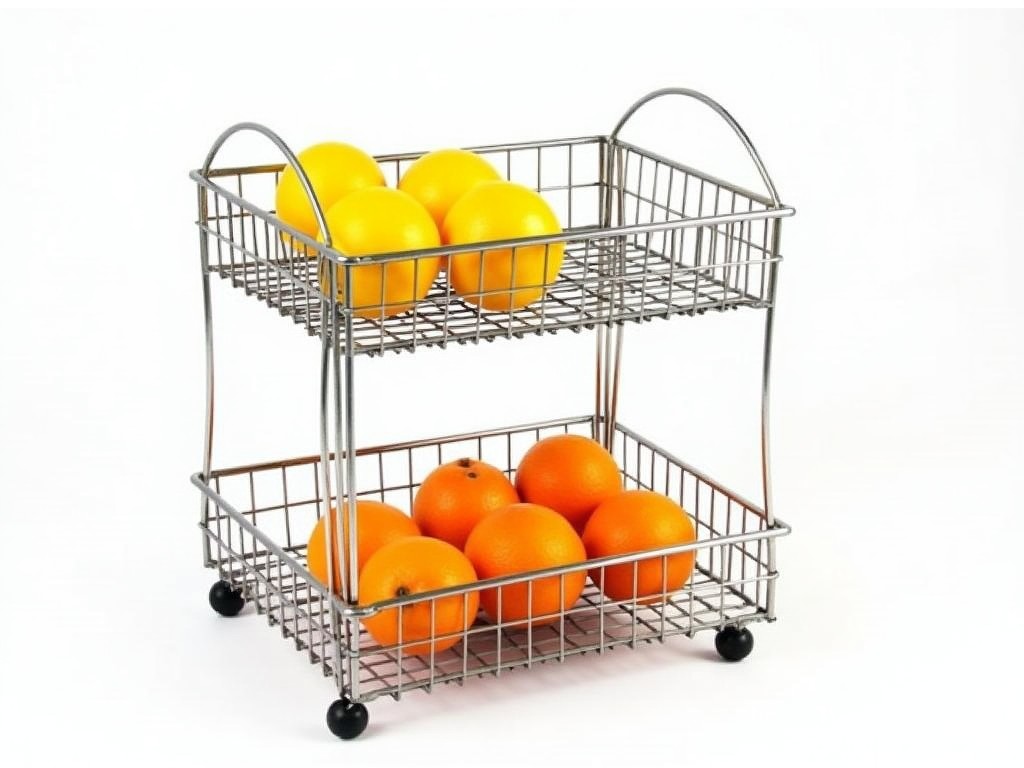
China 2 Tier Stainless Steel Fruit Basket
This product page details the engineering specifications, material selection, and functional design of a two-tier stainless steel fruit basket manufactured in China. It is intended for industrial buyers evaluating commercial foodservice equipment, retail display fixtures, or institutional kitchen accessories. The focus is on measurable attributes that impact durability, hygiene, and long-term operational value.
Material Composition and Corrosion Resistance
The basket is constructed from AISI 304 stainless steel, containing 18% chromium and 8% nickel by weight. This alloy provides resistance to oxidation in humid environments and withstands exposure to organic acids found in citrus and berries without pitting. Surface finish is No. 4 brushed, with roughness average (Ra) ≤ 0.8 µm, reducing microbial adhesion and simplifying cleaning cycles. Unlike lower-grade alloys, 304 maintains structural integrity after repeated washing with alkaline detergents at 60–80°C.
Dimensional Design and Load Distribution
The two-tier configuration consists of an upper basket (300 mm diameter × 100 mm depth) and a lower basket (350 mm diameter × 120 mm depth), vertically offset by 150 mm to prevent fruit from the upper tier contacting the lower tier during loading. The central support pole is 25 mm diameter solid rod, welded to a 200 mm diameter base flange with 4 mm thickness. Under static load testing, the assembly supports 15 kg total (7.5 kg per tier) with less than 2 mm deflection at the rim, verified via strain gauge measurement.
Manufacturing Process and Joint Integrity
All joints are TIG welded using ER308L filler rod, ensuring weld metal composition matches the base material for uniform corrosion resistance. Post-weld, surfaces undergo passivation in 20% nitric acid solution for 30 minutes to remove free iron and enhance the chromium oxide layer. No mechanical fasteners or adhesives are used in load-bearing areas, eliminating crevice corrosion points. Each unit undergoes 100% visual inspection under 10x magnification for weld porosity, undercut, or cracks.
Stability and Base Engineering
The base flange incorporates a 3 mm inward lip to increase moment of resistance against tipping. When loaded with 10 kg of fruit distributed unevenly (simulating real-world loading), the center of gravity remains within the base perimeter, preventing overturning. Optional rubber feet (shore A 60 hardness, 10 mm thickness) are available to reduce slip on wet surfaces and dampen vibration in high-traffic service areas.
Hygienic Design Features
The basket interior features continuous, smooth curves with no sharp edges or crevices where debris can accumulate. Wire spacing is uniform at 25 mm center-to-center, allowing adequate airflow for fruit respiration while preventing small items (e.g., grapes, berries) from falling through. The vertical spacing between tiers ensures gravity-fed drainage of condensation or wash water without pooling.
Typical Applications in Commercial Environments
This design suits buffet lines in hotels and cafeterias where frequent restocking occurs, enabling staff to rotate stock using the first-expired-first-out (FEFO) method across tiers. In grocery retail, it displays seasonal produce at eye level while protecting delicate items from crushing. Institutional kitchens use it for pre-service staging of washed fruit, reducing cross-contamination risk compared to porous or coated alternatives. The open structure allows UV-C light penetration for surface disinfection in enclosed display cases.
Customization Options
Dimensions are adjustable within ±25% of standard diameters and heights to accommodate specific produce types or display constraints. Wire gauge can be increased from 2.0 mm to 3.0 mm for heavier loads (up to 25 kg total). Surface treatments include electropolishing for enhanced reflectivity and micro-smoothness (Ra ≤ 0.2 µm) or powder coating in food-safe colors for brand alignment, though the latter requires verification of coating integrity under thermal cycling.
Quality Control and Testing Protocols
Each batch undergoes salt spray testing (ASTM B117) for 96 hours at 35°C, with acceptance criteria of no red rust exceeding 1 mm diameter. Dimensional accuracy is verified via CMM scanning of critical features (basket diameter, tier spacing, base flatness) with tolerance ±0.5 mm. Load testing is performed on 10% of production units using calibrated weights and dial indicators. Mill test reports for 304 stainless steel are available upon request.
Packaging and Logistics Considerations
Units are packed in single-wall corrugated cartons with internal polyethylene foam corner protectors (density 25 kg/m³) to prevent deformation during transit. Each carton holds one basket, nested with the upper tier inverted into the lower tier to minimize volume. Standard export packaging includes ISPM 15-compliant pallets and stretch wrapping. Volume per unit is approximately 0.025 m³, allowing efficient containerization. Weight per packed unit is 2.8 kg.
| Parameter | Typical Value | Notes |
|---|---|---|
| Material | AISI 304 Stainless Steel | 18% Cr, 8% Ni |
| Upper Basket Diameter | 300 mm | ±0.5 mm tolerance |
| Lower Basket Diameter | 350 mm | ±0.5 mm tolerance |
| Vertical Tier Spacing | 150 mm | Centerline to centerline |
| Static Load Capacity | 15 kg total | 7.5 kg per tier, <2 mm deflection |
| Base Flange Diameter | 200 mm | 4 mm thickness |
| Surface Finish | No. 4 Brushed | Ra ≤ 0.8 µm |
| Wire Spacing | 25 mm center-to-center | Prevents small fruit fall-through |
More Products

Send Inquiry
If you are interested in our products, leave your information here and we will be in touch shortly.