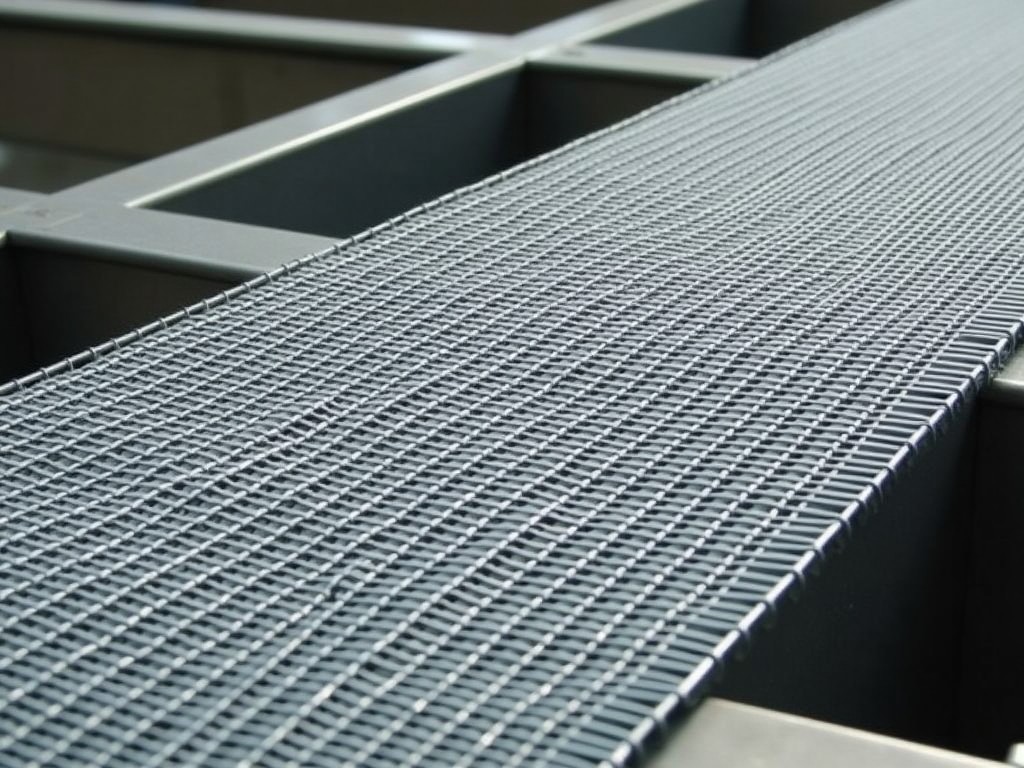
China Flat Flex Wire Mesh Conveyor Belt
Flat flex wire mesh conveyor belts are engineered for applications requiring high open area, precise product handling, and resistance to extreme temperatures or cleaning processes. Constructed from
China Flat Flex Wire Mesh Conveyor Belt
Flat flex wire mesh conveyor belts are engineered for applications requiring high open area, precise product handling, and resistance to extreme temperatures or cleaning processes. Constructed from interlinked flat wire strands woven in a balanced weave pattern, these belts provide consistent airflow, drainage, and sanitation while maintaining dimensional stability under load. Unlike modular plastic or solid surface belts, flat flex designs minimize product contact points, reducing marks and contamination risks in sensitive industries.
Material Composition and Wire Specifications
The performance of a flat flex wire mesh belt depends directly on the base material, wire diameter, and tensile strength. Stainless steel grades 304 and 316L are most common due to their corrosion resistance in wet, acidic, or high-hygiene environments. Wire diameters typically range from 0.8 mm to 2.0 mm, with tensile strength between 800–1200 N/mm² depending on grade and cold-work level. For high-temperature applications exceeding 400°C, alloys such as Inconel 600 or heat-treated 310S stainless steel are available, maintaining structural integrity up to 1000°C in continuous operation.
Surface finish options include passivated, electropolished, or coated variants (e.g., PTFE or silicone) to reduce product adhesion or enhance chemical resistance. Electropolishing improves surface smoothness to Ra < 0.4 μm, critical in pharmaceutical or food processing where biofilm formation must be minimized. Wire edges are rounded or deburred during manufacturing to prevent product damage and ensure safe handling during maintenance.
Mesh Geometry and Open Area Characteristics
The defining feature of flat flex belts is their balanced weave geometry, where warp and weft wires interlace at 90-degree angles with uniform spacing. Standard pitch (distance between wire centers) ranges from 6.35 mm to 25.4 mm, directly influencing open area percentage. A 12.7 mm pitch with 1.2 mm wire typically yields ~65% open area, while finer pitches (e.g., 6.35 mm) with thinner wire can exceed 80%. This high porosity enables efficient heat transfer, steam penetration, and liquid drainage—essential in baking, freezing, washing, and coating lines.
Flat wire profiles (typically 0.5–1.5 mm thick × 2–6 mm wide) increase lateral stability compared to round wire, reducing belt tracking issues under lateral load. The flat profile also increases contact area with support rails, distributing load more evenly and reducing point pressure on conveyor frames. Pitch tolerance is held to ±0.1 mm during manufacturing to ensure consistent sprocket engagement and prevent tooth jumping or belt creep.
Edge Design and Sprocket Interaction
Belt edges are finished to match sprocket tooth geometry, preventing lateral drift and ensuring reliable power transmission. Common edge types include welded loops, flared ends, or integrated drive lugs molded into the wire weave. Welded loops provide a smooth, low-friction interface with sprockets, reducing wear on both belt and teeth. For high-torque applications, drive lugs are formed by thickening specific wire intersections during weaving, creating positive engagement without separate attachments.
Sprocket pitch diameter is calculated based on belt pitch and desired speed ratio. Standard sprocket materials match belt composition (e.g., 304 stainless) to prevent galvanic corrosion. Tooth profiles are either involute or square-cut, with square-cut preferred in high-abrasion environments for easier replacement. Proper sprocket alignment—within ±0.5 mm axial and ±1.0 mm radial tolerance—is critical to avoid edge wear and premature fatigue.
Typical Industrial Applications
Flat flex wire mesh belts are selected when process requirements demand both permeability and mechanical reliability. In food baking lines, the high open area allows uniform hot air circulation, ensuring even browning and moisture removal from products like bread, crackers, or pet food. The belt’s ability to withstand repeated thermal cycling (e.g., –40°C freezer to +200°C oven) without elongation or embrittlement makes it suitable for spiral freezing systems where product must traverse rapid temperature zones.
In pharmaceutical drying or coating lines, the belt’s cleanability and resistance to hydrogen peroxide or alcohol-based sanitizers prevent cross-contamination. Electropolished 316L variants are often specified to meet FDA 21 CFR §177.2600 and EU 1935/2004 food contact regulations. For chemical processing, such as catalyst drying or polymer film quenching, belts made from Hastelloy or titanium alloys resist degradation in chlorinated or oxidizing atmospheres where standard stainless steel would pit or crack.
Automotive parts manufacturers use flat flex belts in paint curing and adhesive drying lines, where consistent airflow prevents solvent pooling and ensures uniform film thickness. The belt’s non-marking surface preserves finish quality on painted or coated components. In electronics manufacturing, belts with low outgassing and anti-static properties (achieved via conductive coatings or grounding strips) transport PCBs through reflow ovens without damaging sensitive components.
Customization Options and Engineering Support
Flat flex belts are routinely customized to match specific conveyor geometry, load conditions, and environmental exposures. Widths can be fabricated from 50 mm to 2000 mm, with seamless construction available up to 1500 mm via spiral weaving techniques. Beyond this width, segmented belts with overlapping joints or laced connections are used, designed to maintain flatness and minimize product disruption at seams. Length is determined by conveyor center distance and take-up allowance, typically supplied in continuous loops or open ends for on-site welding.
Additional features include side guards (formed by upsetting wire edges vertically), cleats or flights (attached via welding or clamping) for incline conveyance, and perforated inserts for specialized product support. Belt pretension is set during manufacturing based on expected load and elongation characteristics—typically 0.2–0.5% initial tension—to prevent slippage without overloading bearings or frames. Engineering support includes finite element analysis of belt sag under load, thermal expansion modeling, and fatigue life estimation based on flex cycles per minute.
Quality Control and Testing Protocols
Each belt undergoes dimensional verification, tensile testing, and surface inspection before shipment. Width and pitch are measured at multiple points using calibrated laser gauges to ensure conformance to ±0.5% tolerance. Tensile strength is validated via pull-to-failure testing on wire samples, with results compared to batch-specific mill certificates. Surface defects such as burrs, weld spatter, or coating pinholes are inspected under 10x magnification; any edge irregularity exceeding 0.1 mm depth is cause for rejection.
For hygienic applications, belts may undergo electropolishing validation using spectrophotometric roughness measurement or ferroxyl testing to confirm passive layer integrity. In high-temperature cases, samples are subjected to thermal cycling tests (e.g., 20 cycles between 25°C and 900°C) to detect microcracking or embrittlement. All test records are retained and traceable to lot number, supporting audit requirements for ISO 9001, ISO 13485, or BRCGS certification.
| Parameter | Typical Range | Notes |
|---|---|---|
| Wire Diameter | 0.8 mm – 2.0 mm | Dependent on load and open area requirements |
| Pitch | 6.35 mm – 25.4 mm | Smaller pitch = higher open area |
| Open Area | 50% – 85% | Calculated from wire diameter and pitch |
| Operating Temperature | –200°C to +1000°C | Material-dependent; e.g., 316L: 800°C max continuous |
| Tensile Strength | 800 – 1200 N/mm² | Based on stainless steel grade and temper |
Ordering Information and Technical Inquiry
To request a quotation or technical review, provide the following details: conveyor center distance, belt width, load per unit area (kg/m²), operating temperature range, exposure to chemicals or cleaning agents, and required certifications (e.g., FDA, 3A, ISO). Include a sketch or layout showing drive and idler sprocket positions, take-up mechanism, and any side guides or cleats. Our engineering team will validate belt geometry, calculate expected elongation, and recommend appropriate edge design and sprocket specifications.
Samples are available upon request for validation in actual process conditions. Lead times typically range from 3 to 6 weeks for standard configurations, with expedited options available for critical projects. All belts are packaged in moisture-resistant crates with internal bracing to prevent deformation during transit. For export shipments, VCI vapor inhibitors and desiccant packs are included to protect against corrosion during sea freight.
More Products

Send Inquiry
If you are interested in our products, leave your information here and we will be in touch shortly.