Factory Direct Perforated Sheet Metal 4 X8
Perforated sheet metal in 4 x 8 foot dimensions is a standard format used across industrial applications requiring controlled airflow, light diffusion, sound attenuation, or particle separation.
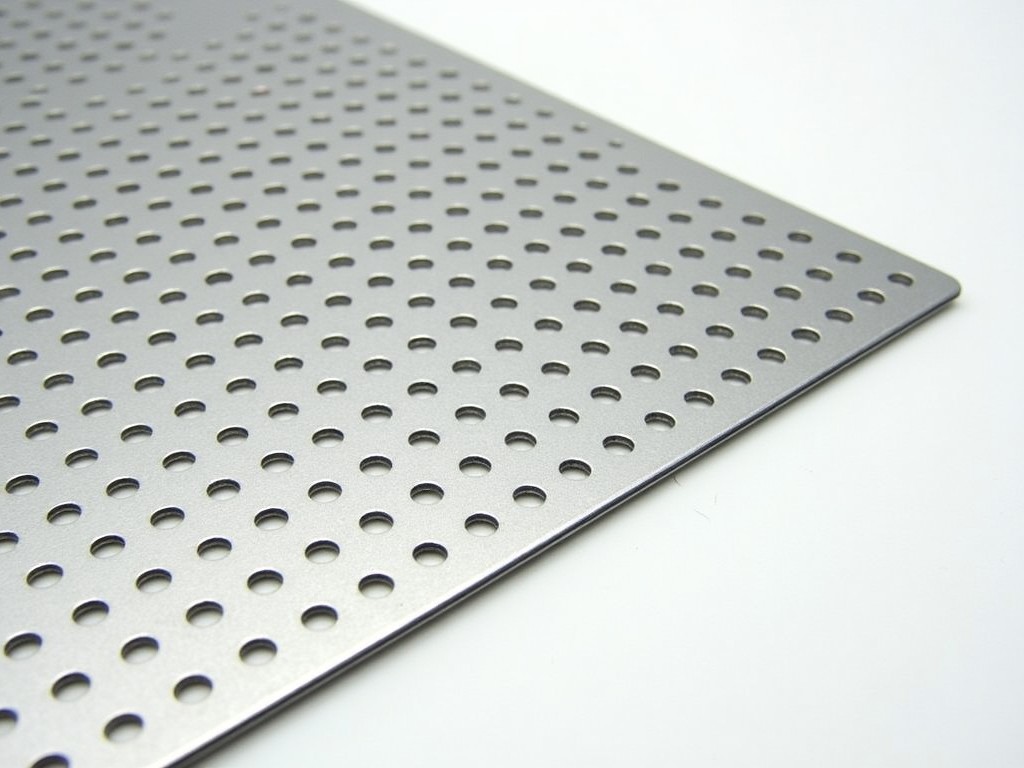
Factory Direct Perforated Sheet Metal 4 x 8
Perforated sheet metal in 4 x 8 foot dimensions is a standard format used across industrial applications requiring controlled airflow, light diffusion, sound attenuation, or particle separation. Purchasing directly from the manufacturer eliminates distributor markups and allows for precise specification alignment with project requirements. This page details the technical characteristics, material options, perforation patterns, and procurement considerations for 4 x 8 perforated sheet metal supplied factory direct.
Standard Dimensions and Tolerances
The 4 x 8 foot (1219 x 2438 mm) sheet size refers to the overall outer dimensions of the flat sheet before any forming or edge treatment. Manufacturing tolerances for length and width typically comply with ASTM A1008/A1008M for cold-rolled steel or equivalent standards for other materials, with common variations of ±1/8 inch (3.2 mm) unless tighter tolerances are specified. Squareness is maintained within 1/16 inch per foot to ensure compatibility with framing and fastening systems. Edge conditions—such as mill edge, slit edge, or deburred edge—are defined per order and affect handling and installation.
Material Options and Mechanical Properties
Material selection influences corrosion resistance, strength, weight, and formability. Commonly available substrates for 4 x 8 perforated sheet include:
- Cold-rolled steel (ASTM A1008), suitable for painted or powder-coated finishes
- Hot-rolled pickled and oiled (HRPO), offering cost-effective base for further processing
- Galvanized steel (ASTM A653), with G60 or G90 zinc coating for outdoor exposureStainless steel (304 or 316 grade), for corrosive environments or sanitary requirements
- Aluminum alloys (3003-H14 or 5052-H32), providing lightweight construction with natural corrosion resistance
Thickness options typically range from 0.020 inch (0.5 mm) to 0.125 inch (3.2 mm), depending on material and perforation density. Thinner gauges are common in architectural screens; thicker gauges are used in machine guards or industrial filtration. Mechanical properties such as tensile strength and yield point follow the base material specifications and are reduced proportionally by the open area percentage.
Perforation Patterns and Open Area Calculations
The perforation pattern defines functionality. Standard patterns include round, square, slot, and hexagonal holes, each arranged in staggered or straight rows. Hole size, pitch (center-to-center distance), and layout determine the open area percentage—a critical parameter for airflow, filtration efficiency, or acoustic performance. For example:
| Hole Type | Hole Size | Pitch | Typical Open Area |
|---|---|---|---|
| Round | 1/8" | 3/16" staggered | 23% |
| Round | 1/4" | 3/8" staggered | 28% |
| Slot | 1/8" x 3/4" | 1/2" staggered | 38% |
| Square | 1/4" | 3/8" straight | 25% |
Open area is calculated as (hole area / total area) × 100. Custom patterns are available to meet specific flow coefficients, sound absorption coefficients, or particle retention ratings. Edge margins—typically 1/2 inch to 1 inch—are maintained to preserve structural integrity and facilitate handling.
Applications Requiring 4 x 8 Format
The 4 x 8 foot size aligns with standard building modules, equipment enclosures, and conveyor systems, reducing the need for field cutting or splicing. Common applications include:
- HVAC diffuser panels and return air grilles where uniform airflow distribution is required
- Machine guarding for CNC routers, presses, and conveyors, balancing visibility with operator protection
- Acoustic ceiling tiles and wall panels in manufacturing facilities to reduce reverberation noise
- Industrial screens for sorting, dewatering, or classifying bulk materials in mining and aggregate processing
- Architectural facades and sunshades where perforation density controls solar gain and visual transparency
- Speaker grilles and microphone arrays in public address systems requiring sound transparency
In each case, the 4 x 8 dimension allows for efficient nesting during material layout, minimizing scrap. For OEMs integrating perforated panels into larger assemblies, factory-direct sourcing ensures dimensional consistency across batches.
Factory Direct Procurement Advantages
Purchasing perforated sheet metal factory direct provides control over material traceability, perforation accuracy, and delivery scheduling. Unlike distributor stock, which may involve secondary handling or inconsistent edge quality, factory-direct sheets are produced to order from master coils, ensuring uniform perforation registration and minimal lateral distortion. Lead times typically range from 2 to 4 weeks depending on material availability and pattern complexity, with expedited options available for critical projects.
Quotations require specification of: material type and grade, thickness, perforation pattern (hole size, pitch, layout), open area target, edge condition, quantity, and any required secondary operations such as deburring, leveling, or surface finishing. Providing a drawing or DXF file reduces interpretation errors. Minimum order quantities vary by material and pattern but often start at one sheet for standard configurations.
Quality Control and Inspection
Quality assurance begins with coil certification and continues through perforation accuracy, flatness, and edge condition. Critical inspection points include:
- Hole diameter and positional tolerance (typically ±0.003 inch for precision applications)
- Open area variation across the sheet (should not exceed ±5% of nominal)
- Flatness deviation (measured as I-units or peak-to-valley height over 24-inch span)
- Edge burr height (kept below 0.005 inch for handling safety)
- Surface finish consistency (especially for pre-painted or anodized materials)
Statistical process control (SPC) monitors punch press wear and alignment. Final inspection includes visual defect checks and dimensional sampling per ANSI/ASQ Z1.4. Test reports or certificates of conformance are available upon request. Packaging uses corrugated separators and stretch wrapping to prevent scratching and corrosion during transit.
Customization and Secondary Processing
While the 4 x 8 sheet is a standard blank, secondary operations enhance functionality for specific installations. Available customizations include:
- Shearing to custom widths or lengths for non-standard framing
- Notching, slotting, or tabbing for interlocking assemblies
- Bending or forming into channels, boxes, or conical shapes
- Painting, powder coating, or anodizing for corrosion protection or color coding
- Applying PSA-backed foam or rubber gaskets for sealing or vibration damping
- Adding stiffening ribs or perforated reinforcements for high-load areas
These operations are performed in-house or through qualified partners to maintain dimensional integrity. Combining perforation with forming requires careful consideration of material elongation and hole distortion near bend radii—engineering review is recommended for complex shapes.
Request a Factory Direct Quote for 4 x 8 Perforated Sheet Metal
More Products

Send Inquiry
If you are interested in our products, leave your information here and we will be in touch shortly.