Factory Direct Perforated Slotted Metal Sheet
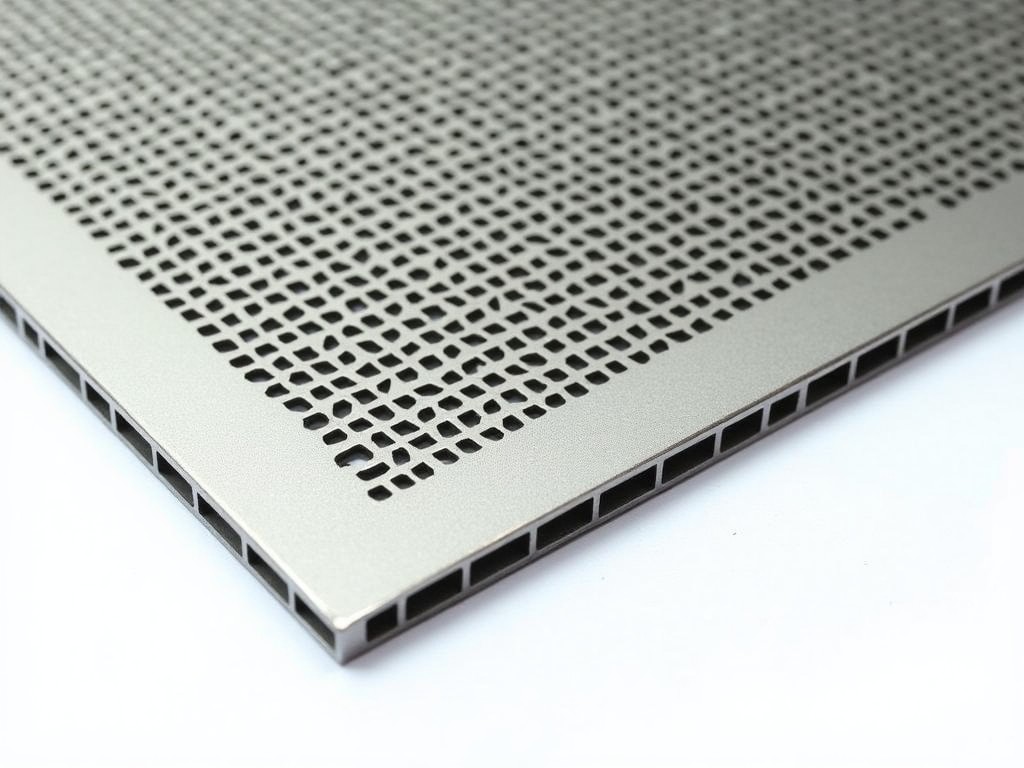
Perforated slotted metal sheets combine precise hole patterns with elongated slots to achieve specific airflow, filtration, shielding, or drainage characteristics unattainable with standard
Factory Direct Perforated Slotted Metal Sheet
Perforated slotted metal sheets combine precise hole patterns with elongated slots to achieve specific airflow, filtration, shielding, or drainage characteristics unattainable with standard perforations alone. This hybrid design allows engineers to tune open area, directional flow resistance, and structural integrity for demanding industrial environments where conventional perforated or expanded metal falls short.
Material Selection and Mechanical Properties
Base material choice directly influences corrosion resistance, strength-to-weight ratio, formability, and service temperature limits. Common substrates include cold-rolled steel (SPCC/SPHC) for cost-sensitive structural applications, galvanized steel (Z120/Z275) for outdoor exposure requiring sacrificial protection, stainless steel grades 304 and 316 for chemical or moisture-rich environments, and aluminum alloys (3003-H14, 5052-H32) where weight reduction and natural oxide layer protection are priorities. Each material exhibits distinct yield tensile values: cold-rolled steel typically 250–350 MPa, galvanized steel similar to base steel with zinc coating adding abrasion resistance, 304 stainless steel 215–505 MPa depending on temper, 316 stainless offering enhanced pitting resistance with comparable strength, and aluminum alloys ranging from 110–275 MPa yield strength with elongation between 10–20% for formability during slotting.
Slot geometry introduces directional anisotropy; load-bearing capacity varies significantly depending on whether force is applied parallel or perpendicular to the slot axis. Finite analysis shows that slots aligned with primary stress directions reduce effective cross-section less than transverse orientations, allowing designers to orient patterns to maximize stiffness where needed while maintaining open area for fluid or particulate passage. Edge condition after slotting—whether deburred, rounded, or left sharp—also impacts safety handling and fluid dynamics, particularly in high-velocity air or liquid systems where turbulence initiation affects pressure drop and noise generation.
Perforation and Slot Design Parameters
Pattern definition requires three interdependent variables: hole diameter, slot length and width, and pitch (center-to-center spacing). Standard round hole diameters range from 1.0 mm to 12.0 mm, while slots typically feature lengths between 5.0 mm and 50.0 mm with widths from 1.5 mm to 6.0 mm, though custom geometries—including elongated ovals, rectangles, or complex combinations—are feasible within material thickness constraints. Pitch must exceed the sum of feature size and minimum web thickness to prevent tear-out during punching; for 1.5 mm thick stainless steel, minimum pitch is often 2.5 mm for 1.0 mm holes and 4.0 mm for 3.0 mm slots, scaling linearly with thickness and material tensile strength.
Open area percentage—critical for airflow, light transmission, or fluid flow calculations—is calculated by subtracting the total area occupied by holes and slots from the gross sheet area, then dividing by the gross area. A sheet with 3.0 mm diameter holes on 6.0 mm pitch and 10.0 mm × 2.0 mm slots on 15.0 mm pitch achieves approximately 28% open area from holes and 18% from slots, totaling 46% before adjusting for edge margins or staggered arrangements. Staggered (triangular) pitch increases achievable open area by up to 15% compared to square pitch for the same feature size due to tighter packing efficiency, though it complicates tooling and may increase production cost for low-volume orders.
Manufacturing Considerations and Tolerances
High-speed CNC turret punches or dedicated punch presses execute the combined perforation and slotting sequence, where tool wear, material springback, and burr formation necessitate real-time monitoring. Punches and dies are typically made from carbide or high-speed steel (HSS) with coatings like TiN or TiAlN to extend life when processing abrasive materials such as galvanized or stainless steel. Positional accuracy for feature placement is generally maintained within ±0.15 mm over 300 mm length under controlled conditions, while hole diameter tolerance averages ±0.10 mm and slot width/length within ±0.20 mm, influenced by material thickness, punch sharpness, and lubrication effectiveness.
Secondary operations such as deburring, edge trimming, or surface finishing may be required depending on downstream use. Vibratory deburring removes sharp edges without altering dimensional tolerances, while chemical passivation for stainless steel enhances corrosion resistance post-processing. For applications requiring tight flatness—such as sealing gaskets or precision diffuser plates—stress-relief annealing after punching or leveling rolls may be employed to counteract residual stresses introduced during high-force punching, which can cause bowing or twisting exceeding 0.5 mm/m in untreated sheets.
Typical Industrial Applications
In HVAC systems, perforated slotted sheets serve as acoustic liners in ductwork where the combination of small holes for mid-frequency absorption and slots for low-frequency dissipation broadens the effective noise reduction coefficient (NRC) beyond what uniform perforation achieves. The directional nature of slots allows engineers to align them with airflow to minimize turbulence-induced pressure drop while maximizing sound absorption surface area, a critical balance in variable air volume (VAV) boxes and air handling units where energy efficiency and occupant comfort are concurrently optimized.
Food processing equipment utilizes these sheets in washing, sorting, and drying conveyors where slots prevent small product loss while allowing efficient water drainage and air circulation. Stainless steel 316L constructions with electropolished finish resist chloride-induced pitting from salt-based cleaning agents, and slot orientations are often aligned perpendicular to conveyor direction to capture particulates without creating snag points that could damage delicate items like berries or pastry dough. Open area typically ranges from 35–50% to balance product support with drainage rate, validated through spray testing under simulated production conditions.
Industrial machinery guards and ventilation panels benefit from the hybrid pattern’s ability to maintain structural rigidity while providing targeted cooling. Slots oriented radially from a heat source enhance convective flow through buoyancy-driven airflow, whereas peripheral holes distribute intake evenly to prevent localized vacuum formation. Finite element analysis shows that a 2.0 mm thick steel sheet with 25% open area via combined perforation and slotting retains 85% of the bending stiffness of a solid plate while achieving equivalent airflow to a 40% perforated alternative, allowing lighter guarding solutions without compromising impact resistance against flying debris.
Quality Assurance and Inspection Protocol
Dimensional verification begins with optical comparators or vision systems checking hole diameter, slot dimensions, and positional accuracy against CAD tolerances, sampling every 20th sheet in production lots or 100% for aerospace-grade orders. Surface integrity is assessed via tactile finger testing and 10x magnification to detect burrs exceeding 0.05 mm height, which could compromise seals or cause injury during handling. Material thickness is validated using micrometers at five points per sheet, with acceptance criteria typically ±0.08 mm for cold-rolled steel and ±0.10 mm for coated or stainless variants due to coating thickness variability.
Open area validation employs either gravimetric methods—weighing the sheet before and after chemical removal of material—or digital image analysis using calibrated photography and software to calculate void percentage, cross-referenced against theoretical values based on punch tooling. For corrosion-resistant grades, salt spray testing (ASTM B117) may be conducted on sample coupons to verify coating adhesion or passive layer integrity, with 316 stainless steel commonly exceeding 1000 hours without red rust under standard test conditions. All inspection records are retained for traceability, linking raw material certificates, tooling logs, and final acceptance data to each batch.
Customization and Ordering Information
Engineers initiate customization by providing substrate material, thickness, overall dimensions, hole diameter, slot length and width, pitch arrangement (square or staggered), and required open area percentage. Additional specifications may include edge condition (mill edge, deburred, rounded), surface finish (mill, brushed, electropolished, painted), flatness tolerance, and any secondary operations such as bending, notching, or rivet hole preparation. For repeat orders, maintaining a master tooling drawing ensures pattern consistency across batches, minimizing requalification efforts in regulated industries.
Minimum order quantities vary by material and complexity; standard gauges in cold-rolled or galvanized steel often accept orders from one sheet for prototyping, while stainless steel or aluminum runs may require 5–10 sheets to justify setup time. Lead times typically range from 5–10 business days for stock materials with standard tooling, extending to 15–20 days for exotic alloys or intricate patterns requiring special punch fabrication. Shipping is conducted via flat pallets with corner protectors and moisture-resistant wrapping to prevent deformation or corrosion during transit, with export shipments incorporating desiccant packs and ISPM-15 compliant wood packaging.
Request a Technical Quote
To receive a detailed quotation with material certifications, lead time confirmation, and tooling drawings, submit your specifications including material grade, thickness, sheet size, hole and slot dimensions, pitch, and required quantity. Our engineering team will review for manufacturability and return a formal response within one business day.
Submit Specification for Quote
More Products

Send Inquiry
If you are interested in our products, leave your information here and we will be in touch shortly.