Factory Supply Stainless Steel Wire Conveyor Belt
Wire conveyor belts constructed from stainless steel are engineered for continuous material handling in environments where corrosion resistance, thermal stability, and sanitation are critical. Unlike
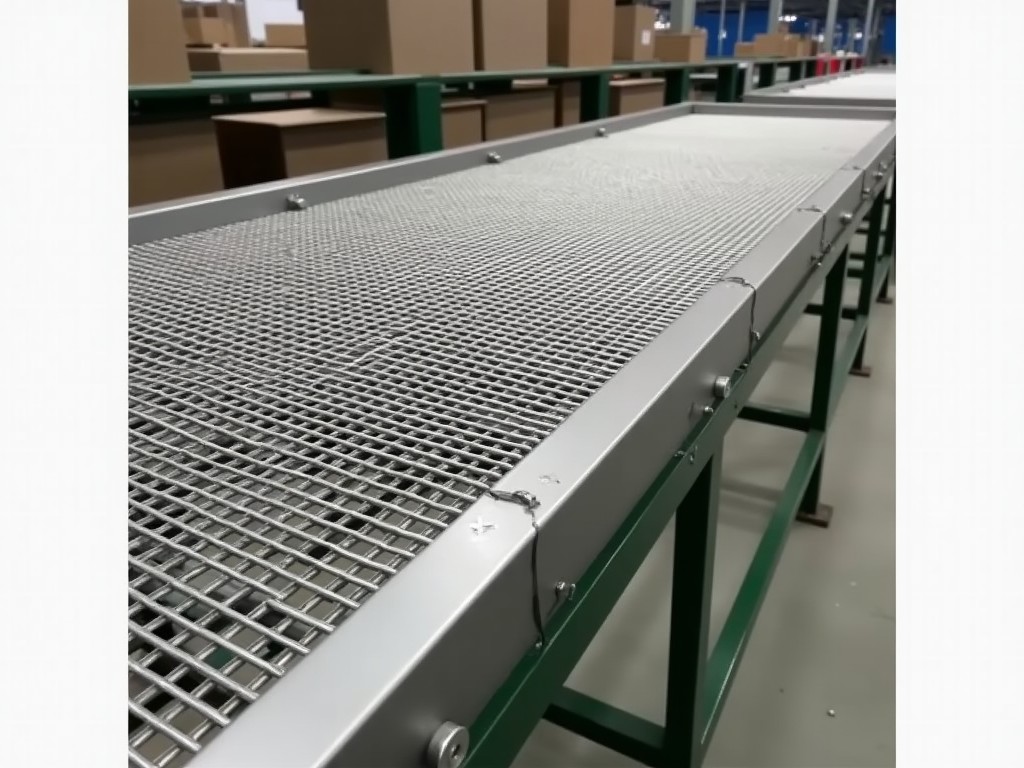
Stainless Steel Wire Conveyor Belt for Factory Supply Applications
Wire conveyor belts constructed from stainless steel are engineered for continuous material handling in environments where corrosion resistance, thermal stability, and sanitation are critical. Unlike solid-surface belts, their open mesh design allows airflow, liquid drainage, and particulate release, making them suitable for processes involving washing, cooling, drying, or high-temperature exposure. These belts transmit drive force through interlinked spirals or balanced weaves, maintaining consistent product positioning under load. Selection depends on wire diameter, mesh pitch, edge configuration, and alloy grade—each influencing belt strength, open area, and service life in specific industrial conditions.
Material Composition and Corrosion Resistance
The base material for these belts is typically austenitic stainless steel, selected for its chromium-nickel microstructure that forms a passive oxide layer resistant to oxidation and chemical attack. Grade 304 (18% Cr, 8% Ni) offers adequate resistance to moisture, mild acids, and alkaline cleaners in food processing or packaging lines. For environments with chlorides, sulfides, or elevated temperatures—such as seafood processing, chemical washing, or heat treatment furnaces—Grade 316 (with 2–3% molybdenum) provides enhanced pitting and crevice corrosion resistance. Wire tensile strength ranges from 800 to 1000 MPa depending on cold work during drawing, directly affecting belt load capacity and fatigue life under cyclic tension.
Belt Construction Types and Open Area Characteristics
Two primary weave patterns dominate industrial wire belts: balanced weave and spiral (or coiled) weave. Balanced weave belts use alternating left- and right-hand spirals connected by crimped cross rods, producing a flat, stable surface with consistent open area—typically 40–60% depending on wire diameter and spiral pitch. This design minimizes belt tracking issues and is preferred for precise product positioning in drying ovens or coating lines. Spiral weave belts feature continuous helically wound wires joined by cross connectors, offering higher flexibility and greater open area (up to 70%), advantageous for intensive washing or rapid cooling where maximum fluid penetration is required. Edge finishes—such as welded, looped, or sealed edges—are selected based on belt width, tension, and risk of fraying or product snagging.
Thermal Performance and Temperature Limits
Stainless steel wire belts maintain structural integrity across broad temperature ranges, making them suitable for both cryogenic and high-heat processes. In continuous operation, Grade 304 belts are generally limited to 870°F (465°C) to prevent sensitization and loss of corrosion resistance; Grade 316 extends this to approximately 1000°F (540°C) before significant microstructural degradation occurs. For intermittent exposure—such as furnace entry/exit zones—short-term tolerance may reach 1200°F (650°C) with reduced service life. Thermal expansion coefficient (~9.6 µin/in·°F for 304) must be accounted for in conveyor length calculations to avoid buckling or excessive tension at elevated temperatures. Open mesh design minimizes radiant heat trapping, promoting uniform product heating or cooling.
Load Capacity, Tension, and Drive Considerations
Belt tensile strength is determined by wire cross-sectional area, alloy grade, and weave density. A typical 304 stainless steel wire belt with 0.080" diameter wire and 1" spiral pitch may achieve a maximum allowable tension of 150–250 lb/ft of belt width, depending on splice type and support spacing. Exceeding this limit risks permanent elongation, wire fatigue, or splice failure. Proper tensioning—usually 1–2% elongation at take-up—ensures adequate friction with drive sprockets or friction rollers while minimizing wear. Drive mechanisms must accommodate belt stiffness; positive drive via sprockets engaging edge loops or notches is preferred over friction drive for widths over 24" or in wet/slippery conditions to prevent slippage and tracking drift.
Sanitation, Cleanability, and Hygienic Design
In food, pharmaceutical, or chemical processing, belt cleanability directly impacts product safety and regulatory compliance. The open geometry of wire belts eliminates crevices where contaminants can accumulate, allowing effective cleaning via spray-in-place (SIP), foam, or immersion methods. Stainless steel surfaces resist biofilm formation and withstand aggressive sanitizers, including hydrogen peroxide, peracetic acid, and hot caustic solutions. Unlike modular plastic belts, wire belts have no hinges, pins, or pockets that trap particulates. Their smooth, continuously welded or mechanically interlocked edges reduce bacterial harborage points, supporting compliance with FDA, USDA, and 3-A Sanitary Standards when designed and installed correctly.
Customization Options for Industrial Integration
Wire conveyor belts are manufactured to precise dimensional and functional specifications based on process requirements. Key customizable parameters include belt width (typically 6" to 80"+), length (endless or spliced), wire diameter (0.020" to 0.125"), spiral pitch (0.25" to 2.0"), edge treatment, and connector type (cross rods, rivets, or welds). Additional features such as side guards, cleats, or baffles can be integrated to prevent product lateral movement or facilitate incline/decline conveying. Belt ends may be finished with endless welds, mechanical fasteners, or clipper splices depending on accessibility for maintenance and required tensile strength. All specifications are defined per project to ensure compatibility with existing conveyor frames, drive shafts, and tensioning systems.
Quality Control and Manufacturing Consistency
Reliability in continuous operation depends on consistent wire quality, precise weaving tolerances, and verified edge integrity. Manufacturing begins with certified stainless steel wire, tested for diameter tolerance (±0.001"), tensile strength, and elongation. During weaving, spiral pitch and cross-rod alignment are monitored to maintain uniform open area and belt flatness. Edges are inspected for uniformity—looped edges must maintain consistent radius to prevent stress concentration; welded edges undergo penetrant testing to detect cracks. Final inspection includes width measurement, length verification, and tensile sampling. Belts are typically supplied with a mill test report (MTR) for material grade and a certificate of conformity for dimensional compliance.
Typical Applications Across Process Industries
These belts are selected where process demands exceed the capabilities of solid or modular alternatives. In food processing, they convey baked goods through ovens, fruits and vegetables through blanching or cooling tunnels, and meat products through washing or glazing lines—benefiting from drainage and airflow. In automotive manufacturing, they transport components through paint drying ovens or zinc phosphate coating tanks, where chemical resistance and thermal stability are essential. In electronics, they support printed circuit board (PCB) washing and drying, allowing rinse solutions to penetrate component gaps. In chemical processing, they handle catalysts or granules through calciners or dryers, resisting abrasion and corrosive off-gases. Each application leverages the belt’s open area, material inertness, and thermal endurance to solve specific conveying challenges.
Installation, Maintenance, and Lifecycle Factors
Proper installation begins with verifying shaft parallelism and levelness to prevent belt drift. Tension should be applied gradually using take-up screws or counterweights, aiming for uniform elongation across the width. Tracking adjustment is performed via snub rollers or asymmetric crowns on drive pulleys, not by skewing rollers—which can induce edge wear. Maintenance involves periodic inspection for broken wires, rod displacement, or edge wear; lubrication is generally unnecessary and may attract contaminants. Cleaning routines should avoid high-pressure impingement on splices or edges. Under normal operating conditions, a well-maintained 304 or 316 wire belt in a food processing line may operate 2–5 years before replacement; in less abrasive, dry environments, service life can exceed 10 years. Replacement belts are fabricated to match original specifications, ensuring drop-in compatibility.
Comparison with Alternative Belt Types
Compared to solid plastic or rubber belts, wire stainless steel belts offer superior temperature tolerance, chemical resistance, and cleanability—but lower impact strength and higher initial cost. Modular plastic belts provide easier repair and lower noise but cannot match stainless steel’s thermal range or resistance to harsh chemicals. Flat wire belts (made from stamped sheet) offer a smoother surface than round-wire designs but have reduced flexibility and open area. For applications requiring both drainage and product support—such as drying coated parts or cooling fried foods—the open mesh of round-wire belts often provides the optimal balance of airflow, strength, and sanitation. The choice ultimately depends on whether process demands prioritize thermal endurance, hygiene, or mechanical resilience over factors like noise reduction or impact absorption.
| Parameter | Typical Range / Option |
|---|---|
| Stainless Steel Grade | 304, 316, 316L (custom grades available) |
| Wire Diameter | 0.020" – 0.125" (0.5 – 3.2 mm) |
| Spiral Pitch | 0.25" – 2.0" (6 – 50 mm) |
| Belt Width | 6" – 80"+ (150 mm – 2000+ mm) |
| Open Area | 40% – 70% (dependent on weave and pitch) |
| Max Continuous Temp (304) | 870°F (465°C) |
| Max Continuous Temp (316) | 1000°F (540°C) |
| Tensile Strength (Wire) | 800 – 1000 MPa |
| Edge Types | Looped, Welded, Sealed, Clipper |
| Splice Options | Endless Weld, Mechanical Fastener, Clipper |
For technical evaluation or quotation, provide conveyor dimensions (width, length, center-to-center drive spacing), operating conditions (temperature, humidity, chemical exposure), product characteristics (weight, size, fragility), and belt speed. Details on drive mechanism (sprocket, friction roller, motor power) and tensioning system allow accurate specification of wire diameter, weave density, and edge configuration. Samples or material test reports can be arranged upon request to validate suitability for your specific process environment.

More Products
Send Inquiry
If you are interested in our products, leave your information here and we will be in touch shortly.