Metal Security Mesh For Windows
Security mesh for windows is manufactured from cold-rolled steel wire with a tensile strength ranging from 450 to 650 MPa, depending on wire diameter and tempering process. The base material
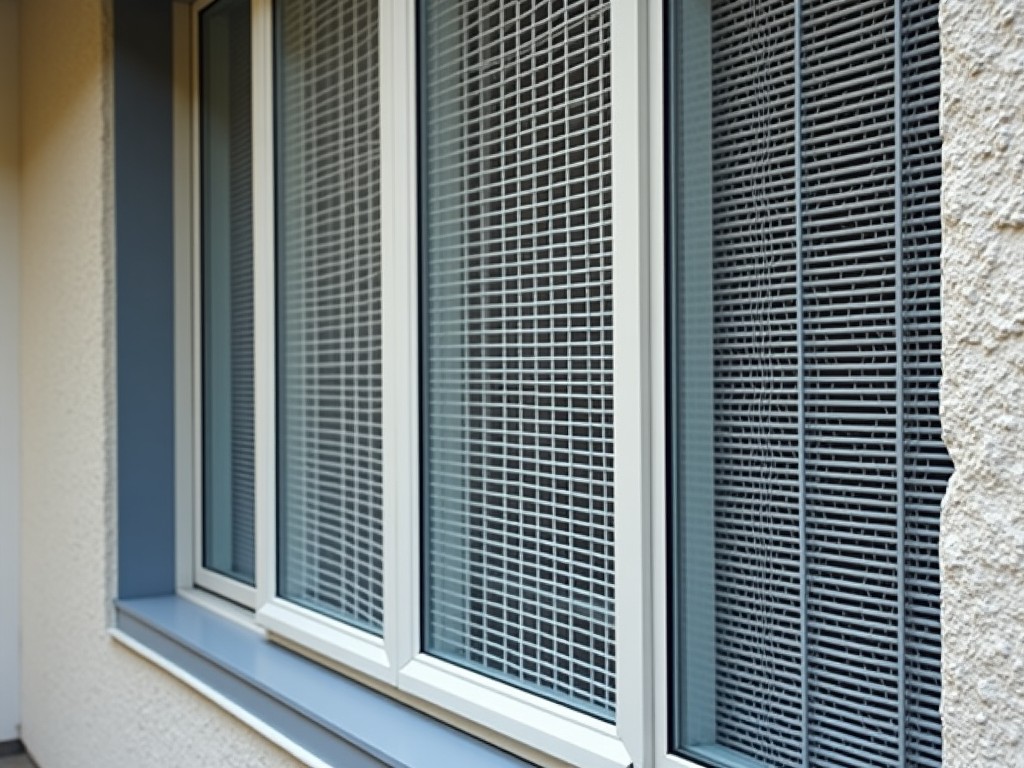
Metal Security Mesh for Windows
Material Composition and Structural Properties
Security mesh for windows is manufactured from cold-rolled steel wire with a tensile strength ranging from 450 to 650 MPa, depending on wire diameter and tempering process. The base material undergoes electrolytic zinc coating to achieve a minimum coating weight of 120 g/m² per side, providing corrosion resistance suitable for exterior exposure in C3 atmospheric environments as defined by ISO 12944-2. Wire diameters typically range from 0.8 mm to 2.0 mm, with aperture sizes between 6 mm x 6 mm and 25 mm x 25 mm, forming a welded or woven grid that resists deformation under impact loads up to 150 J without permanent elongation exceeding 2% of original dimensions.
The mesh geometry is engineered to balance visibility, airflow, and intrusion resistance. Smaller apertures (6–12 mm) achieve over 85% open area while rejecting spherical probes larger than 10 mm in diameter, meeting the physical barrier requirements of LPS 1175 Issue 8 for SR1 rated applications. Larger apertures (18–25 mm) maintain structural integrity under uniform pressure loads of 1.5 kPa while allowing approximately 90% light transmission and unimpeded HVAC airflow. All standard configurations undergo stress-relief annealing post-welding to minimize residual stresses that could lead to stress corrosion cracking in humid or chloride-exposed environments.
Corrosion Protection Systems and Lifecycle Performance
Beyond base zinc coating, security mesh can be supplied with additional protective layers tailored to environmental exposure levels. For marine or industrial zones (C4–C5 per ISO 12944-2), a duplex system applies a 60 µm epoxy primer over the zinc layer, followed by a 40 µm UV-stable polyester topcoat, achieving a total dry film thickness of 100 µm. This system demonstrates less than 5% red rust after 1,000 hours of neutral salt spray testing (ASTM B117) and maintains coating adhesion above 4 MPa (cross-hatch test, ASTM D3359). In non-exposed interior applications, a clear chromate conversion coating may be specified to preserve weldability while delaying white rust formation during storage and transit.
Lifecycle cost analysis indicates that properly coated security mesh reduces long-term maintenance expenses by 40–60% compared to uncoated or painted alternatives over a 15-year service period. Field observations in urban environments show that zinc-coated mesh retains structural integrity beyond 20 years when installed with proper drainage and without direct contact with dissimilar metals that could initiate galvanic corrosion. Accelerated weathering tests (QUV-A, 8 hrs UV/4 hrs condensation @ 50°C) confirm that polyester topcoats retain over 80% gloss and color stability (ΔE < 5) after 2,000 hours of exposure, critical for aesthetic consistency in architectural applications.
Installation Compatibility and Mechanical Integration
Security mesh is designed for integration into standard window framing systems without requiring custom adapters. The mesh edges are typically finished with a folded hem (10–15 mm return) or fitted into a U-channel extrusion made from the same base material, allowing direct fastening to aluminum, steel, or timber frames using corrosion-resistant fasteners. For aluminum frames, 4.8 mm diameter stainless steel (A2-70) self-tapping screws with EPDM washers are recommended to prevent galvanic coupling, installed at 150 mm intervals along the perimeter. In steel frames, zinc-coated self-drilling screws (ISO 1479:2004) with sealing washers provide equivalent pull-out resistance exceeding 1.2 kN per fastener.
Retrofitting into existing openings requires measurement of the daylight opening (DLO) with tolerance allowances for expansion and contraction. The mesh panel should be fabricated 5–10 mm smaller than the DLO in both height and width to accommodate thermal movement (±1.5 mm/m/°C for steel) and installation clearances. When mounted within a secondary frame or grille system, the mesh is secured via snap-in clips or wedge gaskets made from UV-stabilized EPDM, maintaining tension without point loading that could cause wire fatigue. All mounting methods preserve the mesh’s ability to distribute impact loads across its full area, preventing localized tearing.
Customization Options and Fabrication Tolerances
Standard manufacturing capabilities support wire diameters from 0.8 mm to 2.0 mm in 0.1 mm increments, with aperture sizes adjustable in 1 mm steps within the 6–25 mm range. Panel dimensions are customizable up to 2,400 mm in height and 1,200 mm in width as a single piece; larger assemblies are fabricated using overlapping sections with intermediate support bars to maintain structural continuity. Tolerances adhere to ISO 9044:2021 for welded wire mesh, with dimensional accuracy of ±2 mm for overall dimensions and ±0.5 mm for aperture uniformity across any 300 mm test length.
Surface finishes are available in RAL-certified powder coatings (60–80 µm thickness) for color matching to architectural specifications, with salt spray resistance exceeding 500 hours for standard colors and 1,000 hours for marine-grade formulations. Optional treatments include anti-glare micro-etched finishes (reducing reflectivity to <15%) or antimicrobial silver-ion coatings (effective against 99.9% of E. coli and S. aureus per ISO 22196) for healthcare or food processing environments. All customizations are subject to minimum order quantities and require validation of mechanical properties post-treatment to ensure no degradation in tensile strength or elongation at break.
Quality Assurance and Testing Protocols
Each production lot undergoes incoming wire certification verifying tensile strength, elongation, and coating weight per EN 10244-2. In-process monitoring includes inline vision systems that scan 100% of weld points for consistency, rejecting any mesh with missing welds, wire misalignment exceeding 0.3 mm, or aperture variation beyond ±10% of nominal size. Final inspection employs statistical sampling (ISO 2859-1, AQL 0.65 for critical defects) to assess coating uniformity, edge integrity, and flatness, with rejection criteria including any coating holidays detected via 67.5 V pulsed holiday detection or permanent deformation exceeding 3% under a 50 N point load applied at the center of a 100 mm square.
Performance validation includes burst pressure testing per ASTM F1306, where panels are subjected to increasing uniform pressure until failure, with minimum acceptable values of 2.5 kPa for 0.8 mm wire and 6.0 kPa for 2.0 mm wire at 12.5 mm apertures. Corrosion resistance is verified through cyclic salt fog testing (ASTM G85, Annex A3) for coated variants, requiring less than 1% red rust after 1,000 cycles. All test reports are retained for traceability and provided upon request, supporting compliance with project-specific specifications such as those required for government infrastructure, educational facilities, or high-security commercial installations.
Applications in Commercial and Institutional Buildings
In educational facilities, security mesh is installed on ground-floor windows to deter forced entry while maintaining compliance with egress requirements. The open area preserves natural daylighting and allows for emergency ventilation or firefighter access, addressing a key limitation of solid bars or grilles. For example, in K–12 campuses, mesh with 12 mm apertures and 1.2 mm wire provides sufficient resistance to common hand tools (e.g., screwdrivers, small pry bars) while allowing unimpeded passage of a 570 mm diameter sphere—meeting the minimum opening size required by NFPA 101 for secondary egress in classrooms.
Healthcare installations utilize antimicrobial-coated mesh in psychiatric units or emergency departments where ligature resistance and infection control are both critical. The smooth, non-porous surface prevents fluid retention and facilitates cleaning with hospital-grade disinfectants without degrading the coating. In data centers, mesh with 6 mm apertures restricts unauthorized physical access to server room windows while permitting adequate airflow for passive cooling systems, reducing reliance on mechanical ventilation and associated energy costs. Transportation hubs such as train stations and airports deploy mesh in terminal concourses to protect against vandalism and projectile threats without obstructing sightlines for security personnel or compromising architectural aesthetics.
Comparison of Mesh Configurations by Performance Criteria
| Aperture Size | Wire Diameter | Open Area (%) | Impact Resistance (J) | Typical Use Case |
|---|---|---|---|---|
| 6 mm | 0.8 mm | 78 | 80 | High-security glazing, pharmacy windows |
| 12 mm | 1.2 mm | 86 | 120 | Schools, clinics, retail frontages |
| 18 mm | 1.6 mm | 89 | 180 | Office buildings, data centers |
| 25 mm | 2.0 mm | 91 | 250 | Industrial warehouses, transport hubs |
Values represent typical performance for zinc-coated steel mesh under standard test conditions. Actual values may vary based on material temper, coating type, and panel dimensions. Custom configurations available upon request.
Ordering Information and Technical Support
To initiate a quotation, provide the following details: required panel dimensions (height × width), preferred wire diameter and aperture size, environmental exposure level (e.g., interior, urban, marine), desired finish (galvanized only, painted, powder coated, or antimicrobial), and any applicable project specifications or standards (e.g., LPS 1175, NFPA, local building codes). For retrofit projects, include measurements of the existing frame recess or daylight opening, along with photos of the installation condition if available. Lead times typically range from 3–5 weeks for standard galvanized mesh and 5–8 weeks for custom-coated or non-standard sizes, subject to material availability and production scheduling.
Technical support includes assistance with load calculations, corrosion compatibility assessments, and installation detailing. Samples of standard configurations (300 mm × 300 mm) are available upon request, with freight charges collect or prepaid based on destination. All products are packaged in water-resistant kraft paper with edge protectors and secured on pallets for LTL or FTL shipment. Export shipments include fumigated pallets and moisture-barrier wrapping as required for ISPM 15 compliance. For specification inquiries or to request a formal quotation, contact our technical sales team.
Request Quotation or Technical Data
More Products

Send Inquiry
If you are interested in our products, leave your information here and we will be in touch shortly.