Metric Perforated Sheet Metal
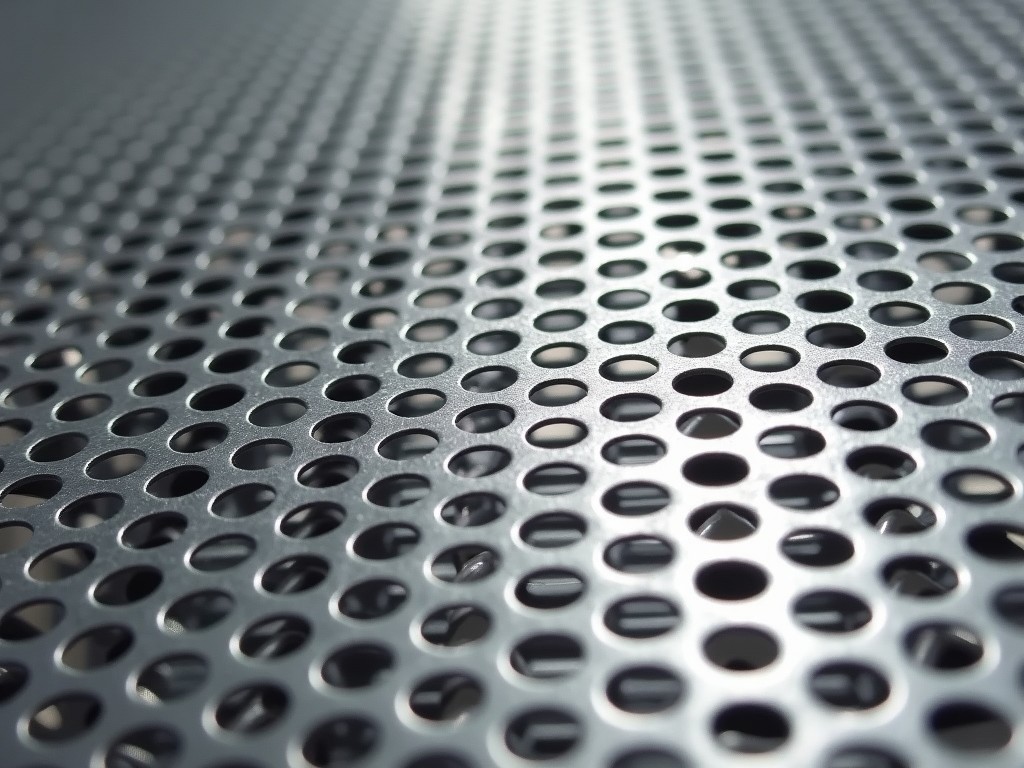
Metric perforated sheet metal refers to flat metal sheets processed with a regular pattern of holes using precision punching or laser techniques, manufactured to metric dimensional standards. These
Metric Perforated Sheet Metal
Metric perforated sheet metal refers to flat metal sheets processed with a regular pattern of holes using precision punching or laser techniques, manufactured to metric dimensional standards. These sheets serve functional roles in filtration, ventilation, shielding, and architectural applications where hole size, spacing, open area, and material thickness must conform to engineering specifications. Unlike non-perforated sheet, the perforation pattern directly influences airflow, light transmission, sound attenuation, and structural integrity, making technical accuracy essential for performance-critical uses.
Material Selection and Mechanical Properties
Common base materials include cold-rolled steel (SPCC), hot-rolled steel (SS400), stainless steel (grades 304, 316L), aluminum (5052-H32, 6061-T6), and galvanized steel (SGCC). Each material offers distinct corrosion resistance, tensile strength, and formability. For example, 304 stainless steel provides excellent oxidation resistance in humid environments with a typical tensile strength of 520 MPa, while 5052-H32 aluminum delivers good formability and marine-grade corrosion resistance at approximately 220 MPa tensile strength. Material thickness typically ranges from 0.5 mm to 6.0 mm, selected based on load requirements and hole size to prevent deformation during punching.
Perforation Patterns and Open Area Calculation
Standard perforation patterns include round, square, slot, hexagonal, and decorative shapes, arranged in staggered (60°) or straight (0°) alignments. Open area—the percentage of open space relative to total sheet area—is a key performance metric calculated as: (hole area × number of holes) / total sheet area × 100. For instance, a 3 mm diameter round hole on a 6 mm staggered pitch yields approximately 23% open area, while a 5 mm square hole on a 10 mm straight pitch results in 25% open area. Designers select patterns based on required flow rates, acoustic damping, or visual transparency, with tolerances typically held to ±0.1 mm for hole diameter and ±0.2 mm for pitch in precision applications.
Typical Industrial Applications
In HVAC systems, perforated sheets function as diffuser faces where hole size and open area regulate air velocity and noise reduction—critical for meeting NC (Noise Criteria) levels in occupied spaces. In industrial filtration, they serve as protective screens for filter media, where hole size prevents media migration while maintaining sufficient flow area; for example, 1.5 mm holes in stainless steel are common in liquid filtration to block particulates >2 mm. Architectural applications use perforated panels for solar shading, where a 40% open area with 4 mm holes on 6 mm pitch balances daylight penetration with glare reduction. Acoustic enclosures leverage micro-perforations (0.5–1.0 mm holes) backed by absorbent material to achieve targeted sound absorption coefficients across mid-frequency ranges.
Manufacturing Considerations and Tolerances
Punching force depends on material shear strength, hole perimeter, and thickness—high-strength materials or thick gauges require higher tonnage presses to avoid burr formation or tool wear. Laser perforation offers advantages for thin materials (<1.5 mm) or complex patterns, eliminating mechanical stress but increasing energy consumption. Edge distortion, known as "roll-over" or "breakover," typically occurs on the exit side of the punch and may require secondary deburring if smooth surfaces are needed for sealing or food-contact applications. Minimum hole diameter is generally constrained to material thickness (e.g., a 1 mm hole in 2 mm steel risks tool breakage), though laser methods can achieve smaller ratios. Sheet flatness after perforation is influenced by punch distribution—symmetrical patterns minimize warping, while asymmetric layouts may require leveling.
Quality Control and Inspection
Dimensional verification includes hole diameter, pitch, and open area using calibrated gauges or vision systems, with sampling per ISO 2859-1 standards. Visual inspection checks for burrs, misalignment, or incomplete punches, particularly important in decorative or hygienic applications. Material thickness is validated via micrometry at multiple points to ensure uniformity. For stainless steel or aluminum, surface finish (e.g., 2B, #4 brush) is preserved unless specified otherwise, and any contamination from lubricants is removed via alkaline cleaning. Certifications such as mill test reports (MTRs) are available upon request to confirm alloy composition and mechanical properties.
Customization Options
Customers can specify hole shape, size, pitch, open area percentage, sheet dimensions (width × length), material grade, thickness, and edge treatment (mill edge, deburred, or hemmed). Secondary processes include bending, rolling, welding, or powder coating for corrosion protection or aesthetic finish. For example, a customer might request 1.2 mm diameter holes on a 3 mm staggered pitch in 1.5 mm 304 stainless steel, cut to 1000 mm × 2000 mm, with all four edges deburred and a #4 brushed finish for architectural cladding. Custom patterns such as logos, gradients, or variable density zones are feasible via CNC punching or laser, though they may affect structural uniformity and require engineering review.
Packaging and Handling
Sheets are typically stacked on pallets with interleaving paper or plastic film to prevent surface scratching, especially for prefinished aluminum or stainless steel. Corner protectors and stretch wrapping secure the load during transit. For thicknesses under 1.0 mm, additional rigid backing or crating may be recommended to avoid flexing-induced deformation. Export shipments include fumigated pallets and moisture-barrier wrapping for long-haul transport. Standard pack weights are kept below 1.5 tons per pallet to facilitate forklift handling, with dimensions optimized for container loading (e.g., 1200 mm × 1000 mm footprint).
Comparison: Round vs. Slot Perforation for Airflow Applications
When designing for airflow, round and slot perforations offer different performance trade-offs. Round holes provide uniform flow distribution and lower pressure drop at equivalent open area due to their aerodynamic shape, making them ideal for balanced ventilation in ceiling diffusers. Slot perforations, particularly when aligned with flow direction, can achieve higher flow capacity per unit width and are often used in linear grilles or duct silencers where space is constrained. However, slots may generate vortices at high Reynolds numbers, increasing noise if not properly designed. For a given open area of 20%, a 3 mm round hole on 6 mm pitch produces approximately 15% lower pressure drop than a 3 mm × 12 mm slot on the same pitch in turbulent flow conditions, based on standard duct testing protocols.
| Parameter | Round Perforation (3 mm Ø, 6 mm pitch) | Slot Perforation (3 mm × 12 mm, 6 mm pitch) |
|---|---|---|
| Open Area | 19.6% | 33.3% |
| Pressure Drop (at 5 m/s) | 12 Pa | 22 Pa |
| Flow Uniformity | High | Moderate (direction-dependent) |
| Typical Use Case | Ceiling diffusers, equipment guards | Linear grilles, silencers, architectural screens |
Note: Pressure drop values are representative of turbulent flow in rectangular ducts with 50% free area velocity; actual performance depends on installation conditions, upstream/downstream geometry, and flow profile. Custom configurations can be evaluated using computational fluid dynamics (CFD) or physical testing upon request.
Request a Quote or Technical Consultation
To receive a formal quotation or discuss application-specific requirements, provide details including material type, thickness, hole shape and size, pitch or open area target, sheet dimensions, quantity, and any required finishes or certifications. Our engineering team will review feasibility, suggest optimizations for manufacturability and cost, and provide lead times based on current capacity and material availability. Contact us to initiate a technical review—no obligation.
More Products

Send Inquiry
If you are interested in our products, leave your information here and we will be in touch shortly.